There’s a reason handprint crafts never go out of style. They’re personal in a way that no other kids’ craft is—that specific tiny hand at that specific age, preserved in paint on paper. Parents keep them for decades. Kids feel proud of them immediately. And unlike a lot of crafts that look great in theory and mediocre in execution, handprint flowers consistently produce results that genuinely look beautiful.
The trick is knowing which flower works best for which hand size, which paint techniques give the cleanest prints, and how to add the details that take a basic handprint from “cute” to “actually framing this.” Here are seven different handprint flower ideas with full instructions for each, plus everything you need to know to get clean, vivid prints every time.
Before You Start: How to Get a Perfect Handprint Every Time
The difference between a smudged, blurry print and a crisp, defined one almost always comes down to technique rather than age or ability. A few things that make a real difference before you even open the paint.
Use the right paint. Tempera paint is the best choice for handprint crafts—it’s water-based, washes off skin easily, and gives opaque, vivid color. Acrylic works on canvas and fabric but dries fast and can be harder to wash off small hands. Finger paint is fine but often too thin for a sharp print.
Apply paint to the hand, not the paper. Use a foam brush or sponge to apply paint evenly to the palm and fingers rather than pressing a hand into a paint tray. This gives more control over coverage and prevents the overloaded, blobby prints that happen when too much paint pools in one spot.
Press firmly and evenly, then lift straight up. The most common mistake is rocking the hand side to side while pressing or dragging it while lifting. Press the whole hand down at once with even pressure, hold for two seconds, then lift straight up without sliding.
Work on a hard, flat surface. Paper on a soft surface like a tablecloth gives blurry prints because the paper gives slightly under pressure. A hard table or a cutting board underneath the paper makes a real difference.
For babies and very young toddlers, have a second adult help—one to hold the child and one to guide the hand. Keep a wet cloth within reach for immediate cleanup.
What You’ll Need Across All Projects
Most of these crafts share a core supply list:
- Tempera paint in multiple colors
- Foam brushes or sponges for applying paint to hands
- Cardstock or heavy paper – regular printer paper works for practice but cardstock gives a cleaner print and a more finished result
- Paintbrushes in various sizes for adding details after the handprint dries
- Black marker or paint pen for outlines and fine details
- Googly eyes for any creature-style flowers
- Green paint or green cardstock for stems and leaves
- A bowl of warm water and paper towels for hand cleanup between colors
Idea 1: Handprint Sunflower
The sunflower is the most classic handprint flower and works for every age from baby to school-age. The wide spread fingers make perfect petals and the round center is easy to add afterward.
Step 1: Paint the entire palm and all five fingers in bright yellow or golden yellow using a foam brush. Make sure the paint reaches all the way to the fingertips and covers the full width of each finger.
Step 2: Press the hand firmly onto cardstock with fingers spread as wide as possible. Lift straight up and let the print dry completely before touching it—at least 10 minutes.
Step 3: Make a second handprint directly next to the first, overlapping slightly at the base of the palm so the two prints together form a full circle of petals. If the hands are small, a third print may be needed to complete the circle.
Step 4: Once fully dry, paint a large brown or dark orange circle in the center where all the palm bases meet. This covers the overlap point and becomes the seed center of the sunflower.
Step 5: Add texture to the center using a fingertip dipped in black or dark brown paint—small dots pressed across the surface mimic the seed pattern of a real sunflower.
Step 6: Paint a thick green stem downward from the base of the flower using a paintbrush, and add one or two oval green leaves branching off the stem.
Step 7: Once everything is dry, use a black marker to add a thin outline around the petals and center if you want a more graphic, bold look—this step is optional but significantly sharpens the finished result.
Idea 2: Handprint Tulip
The tulip uses a fist print rather than an open hand—the knuckle side of a closed fist makes a beautifully shaped tulip head with almost no additional work required.
Step 1: Paint the knuckle side of a closed fist in red, pink, purple, or orange—any classic tulip color. Cover the full width of the knuckles and the side of the hand.
Step 2: Press the fist firmly onto paper with the knuckles facing down. The four knuckles create a natural scalloped top edge that looks exactly like the petal line of a tulip. Lift straight up.
Step 3: While the print dries, cut two long, pointed leaf shapes from green cardstock or paint them with a brush—tulip leaves are long, narrow, and slightly curved.
Step 4: Glue or paint the leaves flanking the base of the tulip head, angling them slightly outward.
Step 5: Paint a thick green stem connecting the flower head to the leaves.
Step 6: Add detail lines on the tulip head with a slightly darker shade of the same color—two or three curved lines running from base to tip suggest the natural veining on tulip petals.
Step 7: For a garden scene, make a row of tulips in alternating colors across a long piece of paper. This is a brilliant group project for a classroom or a gift from a sibling group.
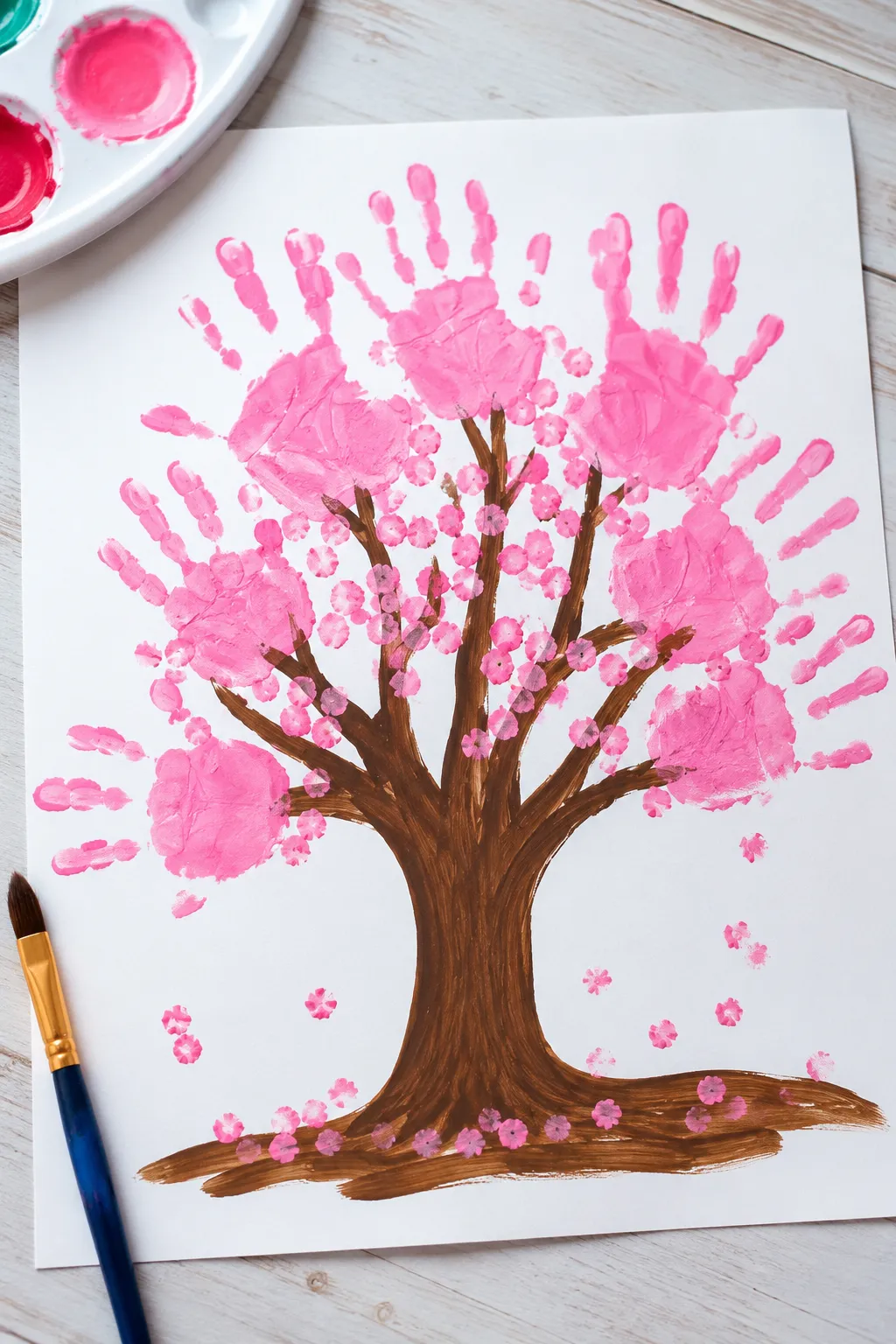
Idea 3: Handprint Cherry Blossom Tree
This one is more of a scene than a single flower and produces the most impressive finished result of all seven ideas—beautiful enough to frame and give as a gift.
Step 1: Paint a brown forearm and hand print for the tree trunk and branches. Press the forearm from elbow to wrist onto the paper, then splay the fingers wide to create the branches. This takes confidence—do a practice run on scrap paper first.
Step 2: Add additional branch lines with a brown paintbrush extending from the finger-branch tips to make the tree feel fuller and more dimensional.
Step 3: Let the tree dry completely. This step cannot be rushed—adding blossom prints to a wet tree smears everything.
Step 4: Dip a fingertip into soft pink paint and press small clusters of dots along all the branches. Each cluster of 4–5 finger dots becomes one blossom. Work along every branch until the tree looks full.
Step 5: Add a second layer of slightly darker pink dots on top of some clusters while the first layer is still slightly wet for depth and dimension.
Step 6: Dip a fine paintbrush into white paint and add tiny highlight dots to the center of each blossom cluster.
Step 7: Add small falling petals below the tree using single pink finger dots scattered across the lower half of the paper—this detail makes the whole piece look like a moment in time and is always the most commented-on element.
Idea 4: Handprint Daisy
The daisy works differently from the sunflower—instead of using the whole hand at once, individual fingers are used as separate petals to create a more delicate, realistic flower shape.
Step 1: Paint just the index finger in white and press it onto the paper at roughly the 12 o’clock position of where the flower center will be. This is the first petal.
Step 2: Continue pressing individual finger prints in a circle around the center point, rotating the paper slightly between each print so the petals radiate outward evenly. Use 8–10 finger prints total for a full daisy.
Step 3: Let the petals dry completely before adding the center so the colors don’t bleed into each other.
Step 4: Paint a large yellow circle in the center of the petal ring using a round brush or a fingertip. Add small brown or orange dots across the yellow center for texture.
Step 5: Paint a green stem and two small oval leaves below the flower.
Step 6: Use a fine black marker to add a thin vein line down the center of each white petal—this small detail makes the daisy look much more realistic and polished.
Step 7: For a meadow effect, make multiple daisies of different sizes across a blue-sky background. Mix in a few handprint butterflies between the flowers for an extra flourish.
Idea 5: Handprint Lavender
Lavender is the most unexpected flower on this list and produces the most sophisticated-looking result—it genuinely looks like botanical artwork when done well.
Step 1: Paint a full handprint in purple with fingers held close together rather than spread wide. The tight fingers create the narrow, elongated shape of a lavender sprig.
Step 2: Make 3–5 handprints in a loose cluster, slightly overlapping at the base and fanning outward at the tops—this grouping mimics the way lavender grows in a bunch.
Step 3: Once dry, paint long, thin green stems extending downward from the base of each handprint, converging to a single point at the bottom.
Step 4: Add small leaf details along the stems using a fine brush—lavender leaves are small, narrow, and grow in pairs opposite each other on the stem.
Step 5: Use a fine brush dipped in dark purple to add small vertical marks across the handprint to suggest individual florets on the lavender spike.
Step 6: Add a light purple or white highlight along one edge of each handprint spike to give dimension and suggest light hitting the flowers.
Step 7: This one works beautifully on a dark background—deep navy or black paper makes the purple and green pop dramatically and gives the finished piece a striking, grown-up quality that looks stunning framed.
Idea 6: Handprint Rose
The rose is the most complex of the seven but produces the most wow-worthy result. It uses a different technique—a fist print with a twist—to create the layered petal effect roses are known for.
Step 1: Paint the pinky-finger side of a closed fist in deep red or pink—this is the outer edge of the fist from wrist to pinky tip.
Step 2: Press and slightly drag the painted edge across the paper in a loose spiral motion—start with a small oval in the center and gradually work outward in increasingly larger arcs. The slightly dragged motion creates the overlapping petal effect. This takes practice; do two or three test prints before committing to the final paper.
Step 3: Build the spiral outward until the rose is the size you want, then lift. The result should look like a loosely layered rose viewed from above.
Step 4: Add shading while the paint is still slightly wet by pressing a fingertip dipped in darker red into the center and inner petal edges.
Step 5: Once dry, use a fine brush dipped in a lighter pink or white to add highlight strokes along the outer edges of each petal layer.
Step 6: Add green sepals at the base of the rose—small pointed green triangles that sit between the flower and the stem.
Step 7: Paint a curved stem with thorns and two or three deeply lobed rose leaves. A black fine-liner used to outline the entire flower once dry gives it a graphic, intentional quality that makes it look like an illustration.
Idea 7: Baby Footprint Flowers
This one uses footprints rather than handprints and is specifically designed for babies and young toddlers whose hands are too small and too grabby for clean prints. A baby footprint makes a perfect flower because the heel becomes the center and the toes become the petals.
Step 1: Paint the sole of a baby’s foot in any flower color—the full sole from heel to toe tips.
Step 2: Press the foot firmly onto paper with an adult supporting the leg to prevent kicking. Lift straight up. The heel creates a round center and the five toe prints radiate outward as petals.
Step 3: Let it dry fully, then add a contrasting color circle over the heel print to define the flower center. Add small dot details to the center in a darker shade.
Step 4: Paint a green stem extending downward from below the heel and add two leaf shapes.
Step 5: Write the baby’s name and age in small neat letters beside the flower—this transforms it from a cute craft into a keepsake. Add the date in small text somewhere on the paper.
Step 6: For a grandparent gift, make a bouquet of three footprint flowers in different colors on one piece of cardstock, frame it, and you have a gift that will genuinely be kept forever.
Step 7: Repeat annually on the same date each year and display them together—watching the footprint size grow from year to year is one of those things that hits differently once the kids are older.
Quick Fixes for Common Problems
| Problem | Most Likely Fix | Alternative Approach |
|---|---|---|
| Print is blurry or smudged | Apply paint with a foam brush rather than pressing into a tray | Press on a hard flat surface rather than a soft tablecloth |
| Fingers print separately instead of as a solid shape | Apply slightly more paint and press more firmly and evenly | Practice on scrap paper first to find the right pressure |
| Paint dries before details can be added | Work in small sections and add details to each before moving on | Use a slower-drying paint or mist the print lightly before detailing |
| Colors bleed into each other | Let each color dry fully before adding the next | Use thicker paint with less water mixed in |
| Baby or toddler won’t keep hand still | Have a second adult help hold the hand | Pre-cut hand shapes from cardstock and let kids decorate those instead |
| Print looks flat and uninteresting | Add shading with a slightly darker tone of the same color while still wet | Use a fine black marker to outline once dry for a graphic bold look |
How to Turn These Into Keepsake Gifts
A handprint flower craft becomes a genuinely treasured gift with a few small additions that cost almost nothing.
Write the child’s name, age, and date somewhere on the artwork in neat small letters. This information feels unnecessary right now and becomes priceless in ten years.
Frame it properly rather than just sticking it to the fridge. A simple white frame from a dollar store elevates even the most basic handprint print into something that looks intentional and beautiful on a wall.
For grandparent gifts, include a short note in the child’s own words about why they picked that flower or what color they chose. The combination of the handprint and the child’s voice in writing is the kind of thing grandparents genuinely treasure.
Make a series of the same flower in the same style across multiple years and display them together as a growing collection. The size change alone makes people emotional in the best possible way.
FAQ
What type of paint is safest for babies and toddlers? Non-toxic washable tempera paint is the safest and most practical choice. Always check the label for non-toxic certification. Avoid acrylic paint for babies—it dries faster than you can wash it off and can be harder to remove from skin and clothes.
How do I get the paint off quickly after printing? Have a bowl of warm water and a soft cloth ready before you start. Wipe hands immediately after printing while the paint is still wet. For babies, a wet wipe works well for a quick first pass before washing properly. Paint that dries on skin takes more effort—a little baby oil helps lift it.
Can I do these crafts on canvas instead of paper? Yes—canvas gives a premium result that looks especially good framed. Use acrylic paint rather than tempera for canvas since it adheres better to the texture. The tradeoff is that cleanup is harder with acrylic so have wipes immediately ready.
What if my child refuses to put their hand in paint? It happens. Don’t force it—a stressed print is always worse than a relaxed one. Try letting them watch you paint your own hand first, or offer a brush to paint their own hand themselves before pressing. Some kids need a few exposures before they’re comfortable with the sensation.
How do I preserve the finished artwork long-term? Once fully dry, apply a thin coat of Mod Podge over the entire surface with a foam brush. This seals the paint, prevents fading, and gives the artwork a slight sheen that makes colors pop. Let it cure for 24 hours before framing.
Conclusion
Handprint flower crafts earn their permanent place in the kids’ craft repertoire because they produce something genuinely meaningful—a record of a specific hand at a specific size at a specific moment in time. Choose the sunflower or daisy for the easiest entry point, the cherry blossom tree for the most impressive result, or the baby footprint bouquet for the most treasured keepsake. Get the paint technique right before you start, work on cardstock rather than regular paper, and add the name and date to every single one. You’ll be glad you did in about ten years.
Enjoyed this project? Get even more DIY ideas that save (and make) you money.
Join our free newsletter for profitable DIY projects, clever cleaning hacks, home ideas, and creative crafts delivered straight to your inbox.
✓ Free forever • No spam • Unsubscribe anytime