Overwatering is the most common way people kill houseplants, and the cruelest part is that it usually comes from a good place. More water feels like more care. The plant looks droopy so you water it again. The soil looks dry on top so you add more. Meanwhile the roots are sitting in saturated soil, slowly suffocating and rotting in conditions they were never designed to handle.
The frustrating part is that an overwatered plant often looks identical to an underwatered one—drooping leaves, wilting stems, yellowing foliage. That similarity is what tricks people into watering more when the plant actually needs the opposite. By the time the signs become obvious, root rot may already be underway. But here’s the thing most plant owners don’t realize: even a plant with significant root rot can often be saved if you act quickly and correctly.
This guide covers how to diagnose overwatering accurately, how to assess how bad the damage actually is, and exactly what to do at each stage of severity to give your plant the best possible chance of recovery.
Understanding Why Overwatering Is So Damaging
Before jumping into fixes, it helps to understand what’s actually happening when a plant is overwatered—because once you understand it, the recovery steps make intuitive sense rather than feeling like arbitrary instructions.
Plant roots need two things simultaneously: moisture and oxygen. Healthy soil provides both—water films coat the soil particles and fill small pores while larger air pockets between soil aggregates provide oxygen to the roots. When soil becomes saturated and stays that way, those air pockets fill with water and stay filled. Roots deprived of oxygen begin to die within 24 hours in severe cases.
Dead roots can’t take up water even when water is available, which is why an overwatered plant wilts—the plant is effectively dying of thirst even though it’s sitting in water. Dead roots also become colonized by anaerobic bacteria and water mold (most commonly Phytophthora and Pythium species), which then spread to healthy roots and accelerate the damage. This process is root rot, and it progresses faster in warm conditions.
The other thing worth understanding is that overwatering damage is cumulative. A single over-generous watering rarely kills a healthy plant. It’s the pattern of repeatedly watering before the soil has dried adequately that creates the conditions for root rot to develop.
How to Tell If Your Plant Is Actually Overwatered
Because overwatering and underwatering produce such similar symptoms, getting the diagnosis right before doing anything is the most important step. Treating an underwatered plant as though it’s overwatered—or vice versa—makes the situation significantly worse.
Check the soil before anything else. Push your finger two inches into the soil near the base of the plant. If the soil feels wet or damp at that depth, overwatering is the likely culprit. If it feels bone dry two inches down, underwatering is more likely despite any visible wilting.
Lift the pot. A well-watered pot feels noticeably heavier than a dry one. If the pot feels heavy despite the plant looking stressed, the soil is holding more water than it should.
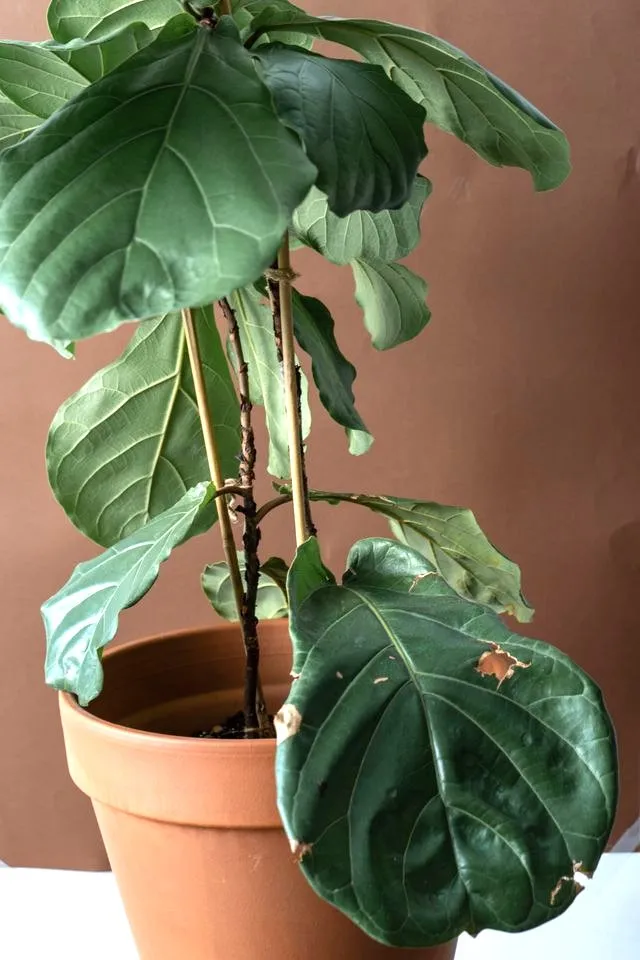
Look at the leaves carefully. Overwatered leaves tend to feel soft and slightly mushy when gently squeezed. Underwatered leaves feel limp but papery or thin. Yellowing that starts with the lower leaves and progresses upward is a classic overwatering pattern. Brown leaf tips with yellow halos around them also suggest overwatering rather than underwatering.
Check the base of the stem. At soil level, an overwatered plant may show soft, dark, or mushy stem tissue—this is rot beginning to move upward from the roots. This is a serious sign that needs immediate action.
Smell the soil. Healthy soil smells earthy and neutral. Waterlogged soil developing anaerobic bacterial activity smells sour, swampy, or rotten. If your soil smells off, root rot is likely already present.
Check the drainage holes. Blocked drainage holes trap water that should drain away. If water doesn’t flow freely from the bottom of the pot when you water, that’s a contributing factor worth addressing regardless of what else you do.
Assessing the Severity: Three Stages of Overwatering Damage
Not all overwatered plants need the same intervention. The right response depends on how far the damage has progressed.
Stage 1 – Early overwatering: The soil is consistently wet but roots are still white or pale tan, firm, and intact. The plant shows mild stress—slight wilting, a few yellowing leaves—but no mushy stems or foul smell. Recovery at this stage is highly likely with relatively simple intervention.
Stage 2 – Moderate damage with early root rot: Some roots are dark, soft, or mushy but healthy roots remain. The plant shows more pronounced wilting, more yellowing, possibly some leaf drop. Stem at the soil line may be slightly soft. Recovery is still very possible but requires more active intervention including root inspection and pruning.
Stage 3 – Severe root rot: Most or all roots are dark, mushy, and foul-smelling. Little healthy root tissue remains. The stem may be soft and discolored at the base. Leaf loss is significant. Recovery at this stage is uncertain but still worth attempting—some plants can regenerate from very little healthy tissue if conditions are corrected quickly.
Step 1: Stop Watering Immediately
This sounds obvious but is genuinely the first and most important step. Stop watering entirely until you’ve assessed the damage and the soil has had a chance to begin drying out. Every additional drop of water at this stage makes the situation worse.
Move the plant out of any decorative pot or cache pot it’s sitting in so you can see the nursery pot and drainage holes clearly. Check that the drainage holes are open and unblocked—a single layer of gravel or mesh over the holes can sometimes trap fine roots and slow drainage significantly.
Step 2: Improve Drainage and Airflow Immediately
While you’re assessing the situation, help the soil begin drying out faster.
Move the plant to a brighter, warmer spot with good air circulation if it’s been sitting in a low-light or cool corner. More light and warmth accelerates evaporation from the soil without stressing the plant the way direct harsh sun would. Avoid direct midday sun for already-stressed plants.
Remove any saucers or trays sitting under the pot that are holding water against the drainage holes. A pot sitting in standing water cannot drain regardless of how many holes it has.
Tilt the pot slightly to encourage water to drain toward the holes. Propping one side up on a small block for a few hours is surprisingly effective at encouraging stubborn waterlogged soil to release.
Create air channels by inserting a chopstick, pencil, or skewer into the soil in several places around the pot, pushing down to the root zone. This opens passages for air to reach the roots and for water vapor to escape. Be gentle to avoid damaging roots unnecessarily.
Remove dead leaves that have already yellowed or dropped—they’re not contributing to recovery and removing them reduces the plant’s overall water demand while it’s stressed.
Step 3: Assess the Roots
This is the step that makes most people nervous but is the most important diagnostic and treatment action for anything beyond early-stage overwatering.
Gently remove the plant from its pot by tipping it sideways and supporting the base of the plant while the root ball slides out. For large plants, lay the pot on its side. Don’t yank the plant out by the stem.
Examine the roots carefully. Healthy roots are white, cream, or pale tan and feel firm when you touch them. Rotted roots are brown or black, feel soft or mushy, may fall apart when touched, and often have a foul smell. Note how much of the root system is healthy versus damaged.
If all roots look healthy (Stage 1), the plant just needs improved drainage conditions and reduced watering frequency going forward. Repot into fresh, well-draining soil or simply allow to dry out before returning to normal care.
If some roots are damaged (Stage 2 and 3), move to the root pruning and repotting steps below.
Step 4: Prune Damaged Roots
Root pruning sounds drastic but is one of the most effective interventions for a plant with root rot. Removing dead and rotting roots stops the rot from spreading to healthy tissue and gives the plant a fighting chance to regenerate.
Prepare your tools before you start. Sterilize scissors or pruning shears with rubbing alcohol or a diluted bleach solution—using unsterilized tools to cut rotted roots can spread the fungal pathogens to healthy tissue and make the situation worse.
Remove all roots that are dark, soft, or mushy by cutting them back cleanly to where the tissue is firm and healthy in color. If a root is partially dark but firm, cut past the dark section to firm tissue and leave the remainder. If a root crumbles when you touch it, remove it entirely.
Rinse the remaining healthy roots gently under lukewarm running water to remove soil and any loose rotted material.
Apply a fungicide or cinnamon to the cut surfaces and remaining root system. Cinnamon has natural antifungal properties and is a widely used home treatment—dust it generously over the roots. Commercial fungicide drenches designed for root rot are more potent and worth using for severe cases.
Assess what remains. If 50% or more of the root system is healthy, recovery prospects are good. If less than 25% of the root system remains healthy, the plant is in critical condition—recovery is uncertain but still possible. If virtually no healthy roots remain, propagation from any remaining healthy stem or leaf tissue is the best remaining option.
Step 5: Treat the Remaining Roots and Pot
Before repotting, address any fungal contamination that might be present in the pot itself.
Wash the pot thoroughly with hot water and dish soap. If root rot was significant, sterilize the pot with a diluted bleach solution (1 part bleach to 9 parts water) and rinse thoroughly before reuse.
Alternatively, use a fresh pot if you have one available. For plants that have experienced significant root rot, starting in a completely fresh container eliminates any residual fungal spores from the old pot.
Choose the right pot size. One of the most common mistakes in repotting is moving a plant to a significantly larger pot. More soil holds more water, and a plant with reduced root capacity after pruning needs less soil volume, not more. Choose a pot only slightly larger than the remaining root ball—or even smaller if significant root mass was removed.
Ensure excellent drainage. The pot must have drainage holes. If the pot you love doesn’t have them, plant into a nursery pot with holes that fits inside the decorative one, and always check the cache pot for standing water after watering.
Step 6: Repot Into Fresh, Well-Draining Soil
The waterlogged soil the plant was sitting in should not be reused—it may harbor fungal spores and has already demonstrated it doesn’t drain well enough for this plant.
Choose the right soil mix for your plant type. Most common houseplants do well in a standard potting mix combined with perlite in a roughly 70/30 ratio—the perlite dramatically improves drainage and aeration. Succulents and cacti need an even more porous mix. Orchids need bark-based media that allows their roots to dry almost completely between waterings. Tropical aroids like monsteras and pothos appreciate a chunky mix with orchid bark and perlite added.
Fill the base of the fresh pot with a layer of new soil mix. Place the plant in the center and fill in around the roots with more fresh soil, pressing gently to eliminate large air pockets without compacting the soil.
Don’t add fertilizer at repotting time. A stressed plant with damaged roots cannot uptake nutrients effectively and fertilizing at this stage causes fertilizer burn on vulnerable root tissue. Wait until you see clear signs of new growth before feeding again.
Water very lightly after repotting—just enough to settle the soil around the roots. Then resist the urge to water again until the top two to three inches of soil are dry.
Step 7: Support the Plant Through Recovery
Repotting is not the end of the process—it’s the beginning of a recovery period that requires adjusted care for several weeks.
Reduce light intensity temporarily. A plant recovering from root damage is less able to move water from roots to leaves, which means full sun can cause leaf scorch even in a plant that normally thrives in bright light. Move to bright indirect light for 2–4 weeks while roots regenerate.
Hold off on watering until the soil is clearly dry at depth. Use the finger test every few days—two inches into the soil should feel dry before you water again. When you do water, water thoroughly until it drains from the bottom, then wait again. The cycle of thorough watering followed by appropriate drying is the correct rhythm for almost all houseplants.
Expect some leaf loss during recovery. The plant may drop more leaves over the first two weeks even with perfect care—this is a normal stress response and doesn’t mean the intervention has failed. New growth emerging from the stem or soil line is the sign that recovery is genuinely underway.
Increase humidity if possible. Many houseplants benefit from higher humidity during recovery since their damaged root systems are less efficient at supplying moisture to the leaves. A pebble tray with water beneath the pot (not touching the drainage holes), grouping plants together, or a small humidifier nearby all help.
Watch for new growth. New leaves or shoots emerging after 2–4 weeks indicate the root system has stabilized and is functioning again. This is the signal to resume normal care, including gradually increasing light back to normal levels and eventually resuming light fertilizing.
Propagating as a Backup Plan
If root rot is too severe to save the plant through root treatment, propagation from healthy above-ground tissue is worth attempting as a parallel
Claude’s response was interrupted.Try again
You said: do this one next: how to save an overwatered plant
do this one next: how to save an overwatered plant Give different solutions and write number in title
7:47 AM
Claude responded: Meta Description:
Meta Description:
Overwatering kills more houseplants than anything else—but most can be saved if you act fast and use the right method. Here are 7 ways to rescue an overwatered plant depending on how bad the damage is.
7 Ways to Save an Overwatered Plant (Even If the Roots Are Already Rotting)
Overwatering is the number one way people kill houseplants, and the worst part is that it almost always comes from a good place. The plant looks sad, so you water it. The soil looks dry on top, so you add more. The leaves are drooping, so surely it needs a drink. Meanwhile the roots are sitting in saturated, oxygen-depleted soil, slowly rotting in conditions they were never built to survive.
What makes it genuinely tricky is that an overwatered plant often looks exactly like an underwatered one—drooping leaves, yellowing foliage, wilting stems. That similarity is what causes people to keep watering when the plant needs the complete opposite. By the time the signs are obvious, root rot may already be well underway.
But here’s what most people don’t know: even a plant with significant root rot can be saved. The window is real, it closes as the damage progresses, but most plants are more resilient than they look. Here are seven methods that work, when to use each one, and exactly how to execute them.
Why Overwatering Does What It Does
Understanding the actual mechanism helps everything else make sense. Plant roots need two things at the same time: moisture and oxygen. Healthy soil provides both—water coats the soil particles while air pockets between them supply oxygen to the roots. When soil becomes saturated and stays that way, those air pockets fill with water. Roots deprived of oxygen begin dying within 24 to 48 hours.
Dead roots can’t take up water even when it’s sitting right there, which is why an overwatered plant wilts—it’s effectively dying of thirst while surrounded by water. Dead root tissue also becomes colonized by anaerobic bacteria and water molds that spread to healthy roots and accelerate the damage. This is root rot, and it moves faster in warm conditions.
The other critical thing to understand is that overwatering damage is almost always cumulative. One generous watering rarely kills a healthy plant. It’s the repeated pattern of watering before the previous water has been used that creates the conditions for rot to develop and spread.
How to Confirm It’s Actually Overwatering
Because overwatering and underwatering look so similar above the soil, confirming the diagnosis before doing anything is the most important step. Treating an underwatered plant as though it’s overwatered—stopping all water, digging up roots—makes things significantly worse.
Check the soil at depth, not just the surface. Push your finger two full inches into the soil near the base of the plant. Wet or damp soil at that depth points to overwatering. Bone dry soil at that depth, despite visible wilting, points to underwatering.
Lift the pot. A waterlogged pot feels noticeably heavier than a dry one. If the pot feels surprisingly heavy for its size while the plant looks stressed, excess water is almost certainly the problem.
Examine the leaves. Overwatered leaves feel soft and slightly mushy when gently squeezed. Underwatered leaves feel limp but papery or thin. Yellowing that starts with the lower, older leaves and moves upward is a classic overwatering pattern. Brown edges with yellow halos also suggest overwatering rather than drought stress.
Check the stem at soil level. Soft, dark, or discolored stem tissue at the soil line means rot is already moving upward from the roots—this is an urgent sign that needs immediate action.
Smell the soil. Healthy soil smells earthy and neutral. Waterlogged soil with active anaerobic bacterial breakdown smells sour, swampy, or distinctly rotten. If your soil smells off, root rot is already present.
How Bad Is It? Staging the Damage
The right method depends on how far the damage has progressed. Before choosing an approach, assess which stage applies.
Stage 1 – Early overwatering: Soil is consistently wet but roots are still firm, white, or pale tan. The plant shows mild stress—slight wilting, a few yellowing leaves—but no mushy stems or bad smell. Recovery is highly likely with simple intervention.
Stage 2 – Moderate damage: Some roots are dark or soft but significant healthy root mass remains. More pronounced wilting, more yellowing, possibly some leaf drop. The stem may be slightly soft at the base. Recovery is still very achievable but requires hands-on intervention.
Stage 3 – Severe root rot: Most roots are dark, mushy, and foul-smelling. Very little healthy root tissue remains. Significant leaf drop, stem may be collapsing at the base. Recovery is uncertain but worth attempting—some plants can regenerate from remarkably little healthy tissue.
Method 1: Stop Watering and Improve Drainage Immediately
This is the first response for Stage 1 overwatering and the essential first step before anything else regardless of severity. It sounds almost too simple but is genuinely the most impactful single action you can take.
Step 1: Stop watering completely and don’t water again until you’ve assessed the situation and the soil has had a real chance to dry out. Every additional drop at this stage makes the problem worse.
Step 2: Remove the plant from any decorative cache pot or saucer it’s sitting in. A plant sitting in a decorative pot with no drainage, or in a saucer full of standing water, cannot drain regardless of how many holes the nursery pot has.
Step 3: Move the plant to a brighter, warmer location with good air circulation. More light and gentle warmth accelerates evaporation from the soil without stressing the plant the way direct harsh sun would. Avoid intense direct sunlight for already-stressed plants—bright indirect light is the sweet spot.
Step 4: Tilt the pot to one side to encourage water to drain toward the holes. Propping one side up on a book or block for a few hours is surprisingly effective at encouraging stubborn waterlogged soil to release trapped water.
Step 5: Create air channels in the soil using a chopstick, pencil, or wooden skewer. Push it gently into the soil in several places around the pot, reaching down toward the root zone. These channels allow air to reach the suffocating roots and give water vapor a path to escape.
Step 6: Remove any yellowed or dead leaves that have already succumbed—they’re not contributing to recovery and removing them reduces the overall water demand on the stressed root system.
Step 7: Wait and monitor. For Stage 1 overwatering without root rot, this method alone—combined with allowing the soil to dry properly before the next watering—is often enough. Check soil moisture every few days and only water when the top two to three inches are clearly dry.
Method 2: The Dry Soil Swap (No-Root-Inspection Version)
This method is ideal for Stage 1 to early Stage 2 overwatering when you want to speed up drying significantly without the stress of full unpotting and root inspection. It works by surrounding the wet root ball with dry, absorbent material that pulls excess moisture out passively.
Step 1: Gently remove the plant from its pot by tipping it sideways while supporting the base of the plant. The root ball should slide out relatively intact.
Step 2: Set the root ball on a thick layer of dry newspaper or paper towels spread on a table or the floor. The dry paper begins drawing moisture out of the soil immediately through capillary action.
Step 3: Wrap more dry newspaper or paper towels loosely around the sides of the root ball without disturbing the roots. You’re creating a moisture-absorbing jacket around the wet soil.
Step 4: Leave it in a warm, well-ventilated spot for 30–60 minutes, replacing the paper if it becomes saturated. This passive drying step can remove a surprising amount of excess water without any further intervention.
Step 5: Inspect the roots briefly while the plant is out of the pot. Look for obvious signs of dark, mushy tissue—if you see significant rot, move to Method 3 or 4 instead. If roots look generally healthy and firm, continue with this method.
Step 6: Choose a fresh, well-draining potting mix and repot the plant into either the original cleaned pot or a fresh one with good drainage. Mix in perlite at roughly a 30% ratio to improve drainage going forward.
Step 7: Water very lightly just to settle the new soil around the roots, then hold off watering again until the soil dries appropriately at depth.
Method 3: Full Repot With Root Inspection
This is the core intervention for Stage 2 overwatering and the most important method to know. Getting the plant out of its pot, inspecting the roots, and repotting into fresh soil addresses the problem at its source rather than just managing conditions around it.
Step 1: Remove the plant from its pot gently and shake or brush away as much of the old waterlogged soil as possible from the roots. You want to see the roots clearly for inspection.
Step 2: Examine the roots carefully. Healthy roots are white, cream, or pale tan and feel firm. Rotted roots are brown or black, feel soft or mushy, may disintegrate when touched, and often smell foul. Note the proportion of healthy to damaged roots—this tells you which stage you’re dealing with and what to expect from recovery.
Step 3: Rinse the roots gently under lukewarm running water to remove remaining soil and get a clearer view of what’s healthy and what isn’t.
Step 4: Remove all visibly rotted roots by cutting them cleanly with sterilized scissors or pruning shears. Sterilize your cutting tool with rubbing alcohol before starting—unsterilized tools can spread fungal pathogens from rotted roots to healthy ones. Cut back to where the tissue is clearly firm and healthy in color.
Step 5: Apply cinnamon or a diluted hydrogen peroxide solution to the cut surfaces and remaining root system. Cinnamon has genuine antifungal properties and works well as a home treatment. A solution of one part 3% hydrogen peroxide to three parts water applied to the roots kills remaining fungal spores more aggressively.
Step 6: Allow the roots to air dry for 20–30 minutes before repotting. This brief drying period allows the cut surfaces to callous slightly and reduces the chance of infection at the pruning sites.
Step 7: Repot into fresh, well-draining soil in a clean pot with drainage holes. Choose a pot only slightly larger than the remaining root ball—a pot that’s too large holds excess soil which holds excess water, recreating the conditions that caused the problem.
Method 4: Root Pruning for Severe Root Rot
This method is the most hands-on and the most critical intervention for Stage 3 overwatering where significant root rot is present. Removing all rotted root tissue stops the rot from spreading to what remains and gives the plant a foundation to regenerate from.
Step 1: Prepare a clean workspace and sterilize your tools before touching the plant. Root rot spreads via fungal spores that transfer easily on unsterilized surfaces and tools.
Step 2: Remove the plant from its pot and clear away all old soil from the roots. For a plant with significant rot, this soil is contaminated and should go directly in the bin rather than back in the garden or compost.
Step 3: Identify every root that is dark, soft, mushy, or foul-smelling and remove each one by cutting cleanly back to healthy tissue. Work methodically around the root system rather than randomly—you want to be thorough.
Step 4: If a root is partially dark but firm at the cut point, remove it to where the tissue is clearly healthy and leave the firm section. If it’s dark and mushy all the way to where it meets the stem, remove it entirely.
Step 5: Rinse the remaining roots thoroughly and assess what’s left. If 50% or more of the root system is healthy, recovery prospects are good. If 25–50% remains healthy, recovery is possible with good post-treatment care. If less than 25% remains, recovery is uncertain—consider also taking cuttings from healthy stem tissue as a backup propagation attempt.
Step 6: Treat the remaining roots with an antifungal product—either cinnamon powder dusted generously over the root system, a commercial fungicide drench appropriate for root rot, or a hydrogen peroxide rinse.
Step 7: Trim the above-ground foliage proportionally to match the reduced root mass. A plant with 50% of its roots removed can only support roughly 50% of its original leaf area. Removing proportional leaf mass reduces the water demand on the recovering root system and significantly improves survival odds. Remove the largest, oldest leaves first.
Step 8: Repot into fresh, sterile potting mix in a clean pot. Water once lightly to settle the soil and then implement a very conservative watering schedule until new growth confirms recovery.
Method 5: The Bare-Root Dry-Out Method
This method works specifically for plants that are tolerant of having their roots exposed—succulents, cacti, many tropical plants, and most aroids handle it well. It’s particularly effective for severe overwatering cases where the soil itself is the ongoing problem.
Step 1: Remove the plant from its pot and shake away all soil from the roots entirely. You’re leaving the roots completely bare rather than keeping any soil attached.
Step 2: Remove all rotted roots as described in Method 4.
Step 3: Place the bare-rooted plant in a warm, dry spot with good air circulation and leave the roots completely exposed for 12–24 hours. For succulents and cacti, this can extend to 2–3 days. This drying period allows damaged root tissue to dry out and callous, and significantly reduces the spread of fungal rot.
Step 4: Don’t place the plant in direct harsh sun during the bare-root period—the roots and stem base are vulnerable without the protection of soil and can desiccate too quickly.
Step 5: Once the roots have dried and any cut surfaces appear calloused, prepare a very well-draining soil mix—for succulents, a dedicated cactus mix or a 50/50 blend of regular potting mix and perlite is appropriate. For tropical plants, a mix of potting soil, perlite, and orchid bark works well.
Step 6: Repot and water minimally just to make initial contact between the roots and the new soil. Allow the soil to dry completely before watering again.
Method 6: Water Propagation as a Rescue Method
When root rot is so severe that virtually no healthy root tissue remains, propagation from healthy above-ground tissue is often the most reliable path to saving the plant’s genetics if not the original plant itself. Many common houseplants root readily in water from stem cuttings.
Step 1: Identify healthy stem sections on the plant—look for firm, green stem tissue above any soft or discolored sections at the base. If the base is rotting but the upper stems are still healthy and firm, those stems can be saved.
Step 2: Take cuttings just below a node (the point on the stem where a leaf attaches) using sterilized scissors. Each cutting should have at least one node and ideally 2–3 leaves. Remove lower leaves that would sit below the water line.
Step 3: Allow cut ends to dry for 30–60 minutes before placing in water. This brief callous period reduces the chance of bacterial growth at the cut surface in the water.
Step 4: Place the cuttings in a clean glass or jar of room-temperature water, with the cut end submerged and the leaves above the waterline. Position in bright indirect light.
Step 5: Change the water every 3–5 days to prevent bacterial build-up. New root growth typically appears within 1–4 weeks depending on the plant species.
Step 6: Once roots are 1–2 inches long, transition the cutting to soil—either a well-draining potting mix or a propagation mix of perlite and coconut coir. Water normally from this point, allowing appropriate drying between waterings.
Step 7: Consider this a fresh start rather than a failure. A healthy cutting that roots successfully gives you a new plant with a completely clean root system and no rot history—in many ways a better outcome than trying to salvage a severely damaged original.
Method 7: Soil Amendment and Long-Term Prevention
This method applies to plants where overwatering has been caught early enough that root damage is minimal, and focuses on correcting the soil conditions that allowed the problem to develop rather than treating active rot. It’s also the essential finishing step after any of the methods above to prevent recurrence.
Step 1: Assess the current soil. The most common soil-related cause of overwatering damage is a mix that doesn’t drain well—dense potting soil that compacts over time, soil without any amendment to improve aeration, or old soil that has broken down into fine particles that hold water like a sponge.
Step 2: If the plant can be safely repotted, mix the existing potting soil with perlite at a 30–40% ratio by volume. Perlite is a volcanic glass that doesn’t compact, doesn’t retain water, and creates permanent air channels in the root zone. It’s the single most effective soil amendment for improving drainage.
Step 3: Add orchid bark to the mix for tropical aroids, monsteras, pothos, and philodendrons. Chunky bark pieces create large air pockets in the soil that mimic these plants’ natural growing conditions in forest canopy environments.
Step 4: Choose the right pot size going forward. A pot significantly larger than the root ball holds excess soil that stays wet long after the roots have used the available water. A pot roughly one to two inches larger in diameter than the root ball is appropriate for most plants.
Step 5: Establish a moisture-checking habit rather than a watering schedule. Calendar-based watering ignores the fact that soil dries at different rates depending on temperature, humidity, light levels, and season. The finger test—two inches into the soil must be dry before watering—is more reliable than any fixed schedule.
Step 6: Ensure pots always have drainage holes and check after each watering that water has drained completely within 30 minutes. Any water remaining in a saucer after 30 minutes should be emptied.
Step 7: Water thoroughly when you water—drench the soil completely until water runs freely from the drainage holes—then wait until it’s genuinely dry at depth before watering again. The cycle of thorough watering followed by appropriate drying is what most houseplants are designed for. Frequent small waterings that never fully dry out between sessions recreate the exact conditions that cause overwatering damage.
Quick Fixes for Common Problems
| Problem | Most Likely Fix | Alternative Approach |
|---|---|---|
| Plant still wilting after repotting into fresh soil | Root damage means the plant can’t yet move water effectively—reduce leaf load by removing some leaves to lower water demand | Move to high humidity environment and bright indirect light while roots recover |
| Yellowing leaves keep appearing after treatment | Some leaf loss is normal stress response during recovery—don’t mistake normal shedding for treatment failure | Check that new soil is draining properly and you’re not overcompensating by underwatering now |
| Roots look healthy but plant still droops | Check for stem rot at the soil line that may not have been visible during root inspection | Ensure new pot has functioning drainage holes and isn’t sitting in water |
| Plant dropped all leaves but stem is still firm and green | Bare stem with living tissue can recover—keep soil barely moist and wait for new growth from nodes | Try stem cuttings as backup propagation while waiting for the main plant to recover |
| Mold appearing on soil surface after repotting | Surface mold indicates soil is staying too wet—increase air circulation and reduce watering frequency | Sprinkle a thin layer of cinnamon on the soil surface which has antifungal properties |
| New leaves emerging but looking pale or distorted | Nutrient uptake is still impaired during recovery—wait another 2–4 weeks before resuming light fertilizing | Ensure plant is in bright enough light since chlorophyll production is impaired in very low light |
After Recovery: How to Water Correctly Going Forward
The most important thing that comes out of an overwatering rescue is understanding why it happened so it doesn’t happen again. For the vast majority of houseplants, the correct watering approach is the same: water thoroughly and infrequently.
Water thoroughly when you water. Pour water slowly until it flows freely from the drainage holes. This ensures the entire root zone receives moisture and prevents dry pockets forming in the soil. Shallow watering that only wets the top inch of soil encourages roots to grow toward the surface where they’re more vulnerable.
Then wait. Most houseplants should dry out significantly between waterings. How long that takes depends on the plant species, pot size, soil type, temperature, and season—which is why schedules are unreliable. The soil at two inches depth should be dry before you water again. For succulents and cacti, let it dry even deeper. For moisture-loving tropical plants, slightly less drying is fine but the soil should never stay wet.
Seasonal adjustment matters. Plants need significantly less water in winter when light levels drop and growth slows. Many overwatering incidents happen in autumn and winter when people continue their summer watering schedule into the darker months and the soil simply never dries between waterings.
FAQ
How long does it take an overwatered plant to recover?
Stage 1 overwatering with no root rot—the plant may look normal again within 1–2 weeks once conditions are corrected. Stage 2 with moderate root rot—expect 3–6 weeks before new growth confirms recovery. Stage 3 severe root rot—if the plant recovers, it often takes 6–12 weeks before you see meaningful new growth. New leaves emerging from the stem or soil line is the clearest sign that recovery is underway.
Should I fertilize an overwatered plant during recovery?
No—not until you see clear signs of healthy new growth. A plant with damaged roots cannot uptake nutrients effectively and fertilizing during recovery causes fertilizer burn on vulnerable root tissue, which makes things worse. Once you see new growth emerging and the plant looks stable, resume fertilizing at half the normal concentration.
Can I save a plant if the stem is mushy at the base?
It depends on how far up the stem the damage extends. If only the very base is soft but the upper stem is still firm and green, taking stem cuttings above the rot line and propagating them in water is the best approach. If the stem is mushy most of the way up, the plant is likely beyond recovery from the original—focus on propagating any remaining healthy tissue.
Is it normal for an overwatered plant to lose more leaves after I repot it?
Yes—and this is one of the most important things to know during recovery. Leaf drop in the 1–2 weeks following repotting is a normal stress response and doesn’t mean the intervention failed. The plant is shedding leaves to reduce its water demand while the root system recovers. As long as the stem remains firm and green, continue caring for it and wait for new growth.
What plants are most susceptible to overwatering?
Succulents and cacti are the most sensitive—their roots are exceptionally vulnerable to prolonged moisture. Snake plants, ZZ plants, and pothos are commonly overwatered despite being marketed as low-maintenance because people assume low-maintenance means frequent watering. Orchids are also frequently overwatered. Plants that naturally tolerate more moisture—ferns, peace lilies, calatheas—are more forgiving but can still develop root rot in poorly draining soil.
How do I know if my plant is dead or just dormant?
Scratch the stem gently with your fingernail near the base. Green tissue underneath means the plant is alive. Brown, dry, or mushy tissue all the way through means that section is dead. Work upward along the stem until you find green tissue—if you find any, the plant may still be recoverable through pruning back to the living section or through cuttings.
Conclusion
Most overwatered plants can be saved—the key is acting before the window closes and matching the intervention to how severe the damage actually is. Stop watering, get the plant out of wet soil, remove what’s rotted, and give the remaining roots the dry, airy, well-draining conditions they need to regenerate. The plant may look worse before it looks better—some leaf drop after treatment is normal and doesn’t mean you’ve failed. New growth emerging from the stem weeks later is one of the most satisfying things in plant care, and knowing you pulled a plant back from the edge makes it feel especially earned.
Enjoyed this project? Get even more DIY ideas that save (and make) you money.
Join our free newsletter for profitable DIY projects, clever cleaning hacks, home ideas, and creative crafts delivered straight to your inbox.
✓ Free forever • No spam • Unsubscribe anytime