Jello is one of the best sensory bin materials available for young children—and it’s criminally underused compared to rice, kinetic sand, and water beads. It’s jiggly, cool, squishy, and completely taste-safe. It comes in vivid colors naturally. It can be made firm enough to cut into cubes or soft enough to scoop like a liquid. It smells fantastic. And when a toddler inevitably shovels a handful directly into their mouth, the worst that happens is they eat some Jello.
The texture of Jello is genuinely unique in the sensory bin world—it sits between solid and liquid in a way that fascinates children of all ages. Firm Jello holds its shape until pressed, then gives way with a satisfying resistance. Broken Jello jiggles and quivers. The surface catches light in a way that makes colors look almost luminous. And cutting through a solid block of Jello with a plastic knife produces a tactile experience that children will repeat dozens of times in a single session.
This guide covers eight different Jello sensory bin setups—from the simplest single-color exploration bin to elaborate themed builds with hidden objects and layered effects. Each one includes what to make, how to set it up, and what tools and extensions keep the play going longer.
Before You Start: Jello Sensory Bin Basics
Making Jello for sensory bins: Sensory bin Jello is made the same way as eating Jello—dissolve the packet in boiling water, add cold water, refrigerate until set. The difference is in concentration:
- Standard concentration (following packet directions): Soft, wobbly Jello that scoops and jiggles. Good for digging and texture exploration.
- Firm concentration (use 25–30% less water than the packet directs): Firmer Jello that holds shapes and can be cut into cubes or shapes. Better for cutting tools and structured play.
- Extra-soft concentration (use 25% more water): Almost liquid Jello that pours and flows. Best for pouring and mixing play.
Containers: Make Jello for sensory bins in a large baking dish, roasting tin, or directly in the sensory bin if it’s waterproof. A 9×13 inch baking dish works well for a single-color batch. Pour directly into the bin for large multi-color setups.
Timing: Jello needs at least four hours to fully set—overnight in the refrigerator is ideal. Make Jello sensory bins the evening before the planned play session.
Temperature: Jello that has been at room temperature for more than an hour starts to soften significantly. Keep it refrigerated right up until play time and set up the bin just before the child plays for the best texture.
Cleanup: Jello rinses off skin, surfaces, and clothing with warm water. It dissolves completely and leaves no residue on most surfaces. It’s one of the easiest sensory materials to clean up. Carpet is the exception—scoop up any Jello that lands on carpet immediately before it dissolves into the fibers.
What You’ll Need (Across All Ideas)
- Jello packets in various flavors and colors
- Boiling water and cold water
- Large baking dishes or the sensory bin itself for setting
- A large sensory bin or storage container
- Plastic tools: spoons, cups, funnels, small cups
- Plastic figurines or toys for themed bins
- Letter and number molds or cookie cutters
- A sharp knife for adults to pre-cut shapes (before giving to children)
Idea 1: Classic Rainbow Jello Bin (Best Starting Point)
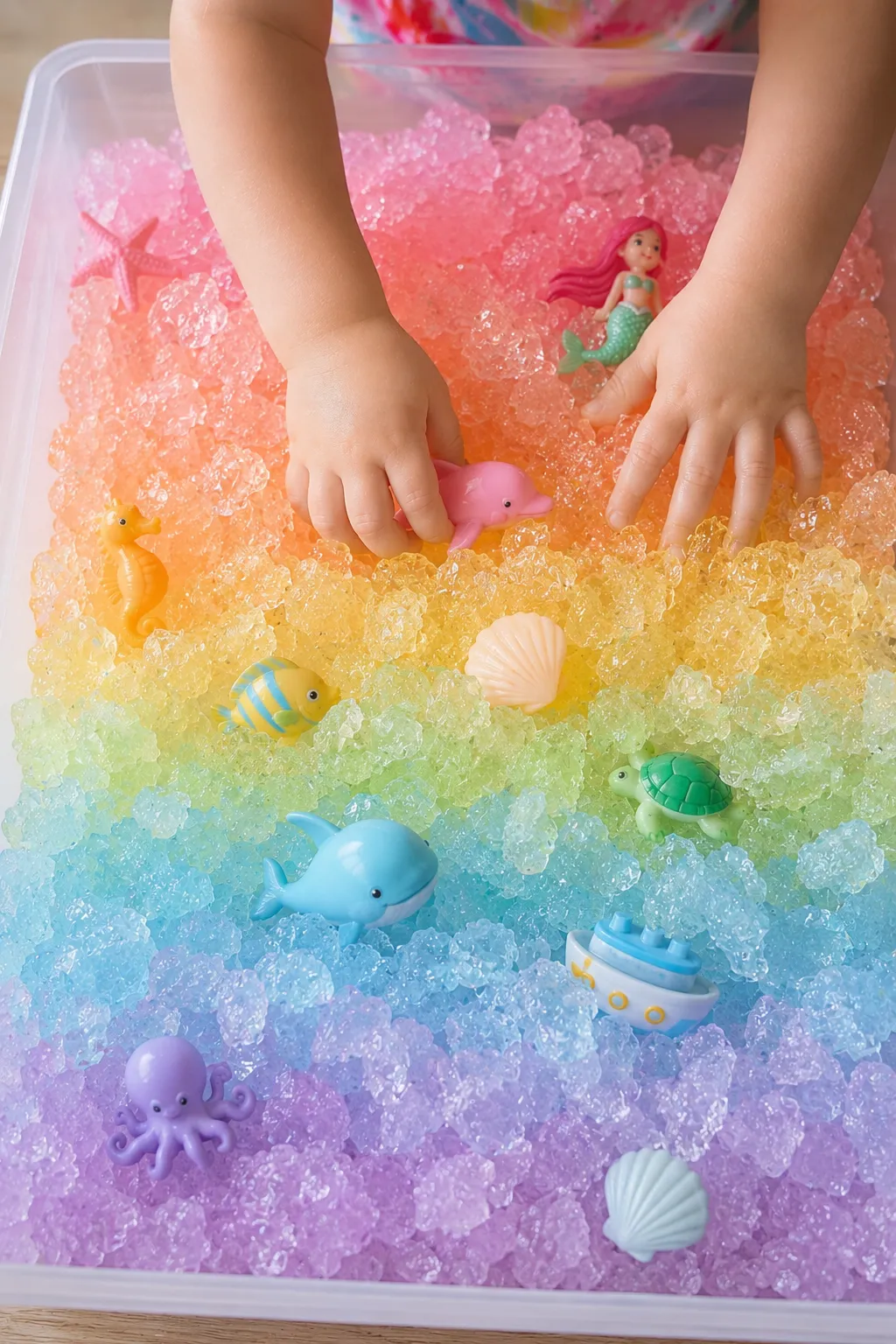
The rainbow Jello bin is the most popular Jello sensory bin for good reason—it’s visually stunning, uses Jello’s best quality (natural vivid color), and gives children the satisfaction of having multiple colors to explore, mix, and combine. Six colors of Jello set in separate sections of the bin creates a rainbow effect that looks impressive before a single scoop is taken.
How to make it:
- Choose six Jello flavors that correspond to rainbow colors—strawberry (red), orange (orange), lemon (yellow), lime (green), berry blue (blue), and grape or black cherry (purple). The natural colors of these flavors closely match the rainbow spectrum without needing any additional dye.
- Make each flavor separately using the firm concentration (slightly less water than directed) so the Jello holds its color sections clearly when set next to each other.
- Pour each color into a separate section of the sensory bin, or set in separate baking dishes and transfer as blocks when set.
- For defined color sections, allow each color to set fully before adding the next adjacent color—this prevents colors bleeding into each other at the boundaries. This requires pre-planning and sequential refrigeration over several hours.
- For a mixed rainbow effect, allow colors to touch and slightly blend at the boundaries—this is faster and still looks beautiful.
Setup and play: Present with scooping spoons, measuring cups, and small containers. The primary play instinct is to scoop and mix the colors—watching red and yellow Jello mix together to create an orange scoop is endlessly satisfying for toddlers. Add letter or number cookie cutters for preschoolers to press into the firm Jello sections and cut out shapes.
Extension: Set small amounts of each color in individual silicone muffin cups the night before. These individual Jello cups can be unmolded into the bin at the start of play—perfect domed shapes that wobble satisfyingly when the bin is nudged.
Best for: First Jello sensory bin experience, visual learners, color recognition and mixing play.
Idea 2: Ocean Jello Sensory Bin (Best Themed Bin)
The ocean Jello bin is one of the most visually impressive themed sensory bins you can make—blue Jello made with slightly less water than usual creates a luminous, translucent ocean that looks remarkably like clear water when light hits it. Plastic sea creatures and shells hidden in the Jello create a discovery element that keeps children digging long after the initial texture fascination fades.
How to make it:
- Make blue Jello using berry blue flavor at firm concentration—the blue color is particularly translucent and ocean-like at this concentration.
- For a deeper ocean effect, add a few drops of blue food coloring to deepen the color slightly beyond what the Jello packet produces naturally.
- Press plastic sea creatures (fish, sharks, turtles, octopuses, seahorses) into the Jello before it fully sets—when the Jello is at the consistency of loose pudding, place figurines at different depths throughout the bin, then refrigerate until fully set. The creatures will be encased in the Jello at various levels, visible through the translucent blue.
- Press clean shells and smooth pebbles into the Jello surface before setting for a sea floor effect.
- Pour a thin layer of blue Jello over everything and allow to set completely—this creates a smooth surface that children break through at the start of play, revealing the hidden creatures below.
Setup and play: Give children plastic spoons, tongs, and small nets for “fishing.” The primary activity is discovering and excavating the hidden creatures—digging through the Jello to find each figure, cleaning them off, and collecting them in a small bucket. Add a bowl of water alongside the bin for washing the excavated creatures.
Extension: Freeze small plastic creatures in ice cubes before the session. Add the ice cubes to the Jello bin—as the ice melts during play, it releases the creatures gradually, adding a secondary discovery element.
Best for: Children aged 18 months and up, ocean and sea creature themes, extended play with a discovery element.
Idea 3: Dinosaur Dig Jello Bin (Best for Excavation Play)
The dinosaur dig takes the discovery concept from the ocean bin and applies it to a prehistoric theme—dinosaur figurines and plastic “fossils” encased in earth-colored Jello create an excavation experience that older toddlers and preschoolers find genuinely thrilling. The archaeological framing (“there are dinosaurs buried in there—can you find them all?”) gives the play a narrative structure that extends engagement significantly.
How to make it:
- Choose earth-toned Jello flavors: orange, strawberry, or tropical punch produce warm amber and red tones that suggest prehistoric earth or lava. For a more realistic dirt-brown color, mix orange and grape Jello—the combination produces a muddy brown that’s surprisingly convincing.
- Make at firm concentration so the Jello is firm enough to require real digging effort—part of the satisfaction of the excavation experience is the resistance of the material.
- Bury dinosaur figurines at different depths in the Jello as it sets, exactly as with the ocean bin. Place larger dinosaurs deeper for more excavation effort; smaller ones near the surface for early discoveries that motivate continued digging.
- Add plastic eggs (the kind that open and close) containing tiny figurines inside—children dig up the eggs and open them to find the surprise inside.
- Sprinkle crushed graham crackers or chocolate cookie crumbs over the set Jello surface for a “dirt” effect. This is purely decorative and taste-safe.
Setup and play: Provide plastic excavation tools—spoons, craft sticks, small brushes. Frame the activity as a paleontological dig: “Can you find all the dinosaurs? How many are there?” A printed “collection chart” where children draw or place stickers for each discovered dinosaur adds a simple record-keeping element that appeals to preschoolers.
Best for: Preschoolers and older toddlers, dinosaur enthusiasts, children who enjoy goal-directed play with a collection element.
Idea 4: Jello Cutting and Cooking Bin (Best for Fine Motor Development)
This bin is less about sensory texture exploration and more about the specific satisfaction of cutting through firm Jello with a plastic knife—a deeply satisfying fine motor activity that children return to repeatedly. Firm Jello set in a large, flat layer and given to children with plastic knives and cookie cutters becomes an informal culinary play session that develops hand strength, precision, and coordination.
How to make it:
- Make Jello at firm concentration in a large flat baking dish—the Jello should be at least 3cm deep for satisfying cutting.
- Choose bold, single colors for visual clarity—red, green, blue, or yellow. Single colors show cut lines clearly and make the shapes children cut more visually satisfying than mixed colors.
- Set in the baking dish and unmold onto the sensory bin surface in one large flat block. To unmold cleanly: run a knife around the edges, place the bin over the dish, and flip—the block slides out in one piece.
- Provide: plastic knives (the kind in children’s kitchen sets), cookie cutters in various shapes, and a child-safe cutting board or the bin surface itself.
How children play: Cutting Jello with a plastic knife requires genuine effort and produces a deeply satisfying resistance-then-give sensation. Cookie cutters pressed into firm Jello produce clean-cut shapes that children then collect, arrange, and “serve” in a mud kitchen play scenario. A play plate, fork, and cup alongside the bin extends the play into a full pretend cooking session.
Extension: Set Jello in shaped silicone molds (stars, hearts, animals) and unmold individual shapes into the bin alongside the flat block. The pre-made shapes alongside the cutting experience gives children both found shapes and self-made shapes to work with.
Best for: Children aged two and up, fine motor development, children who enjoy cooking and kitchen play.
Idea 5: Layered Jello Sensory Bin (Best Visual Effect)
Layered Jello—set in distinct horizontal layers of different colors—is visually dramatic in a way that rewards the extra preparation time. Seen from the side through a clear bin, the layers look like a geological cross-section or a sunset. From above, each layer is revealed as children scoop through them—a kind of archaeological color surprise.
How to make it:
- Choose three to five colors with good visual contrast between adjacent layers. A classic combination: red, orange, yellow, green, blue—each layer is visible against the next.
- Make each color separately at firm concentration.
- Pour the first color into the bin or a large clear container and refrigerate until fully set—at least two hours.
- Allow the next color to cool to room temperature before pouring over the set layer—hot Jello poured onto set Jello melts the top surface and blurs the layer boundary. Room-temperature Jello maintains crisp layer lines.
- Pour the second color gently over the back of a spoon to cushion the flow and prevent breaking through the set layer below.
- Refrigerate until set before adding the next layer. Repeat until all layers are complete.
- The complete bin should have distinct, clearly visible horizontal color bands.
Setup and play: For maximum visual impact, use a clear-sided bin or container so the layers are visible from the outside. Provide large scooping spoons and let children discover the layers as they dig—each scoop reveals a new color, and scoops that contain multiple layers are particularly exciting.
Extension: Make individual layered Jello cups in clear plastic cups—visible from the side, these show the full layer effect in miniature. Children can scoop from both the large bin and their individual cups.
Best for: Children who respond strongly to visual stimuli, color learning, extended digging play with a discovery element.
Idea 6: Jello Sensory Bin With Ice (Best Temperature Contrast Play)
Adding ice to a Jello sensory bin creates a temperature contrast play experience—the cool, firm Jello against the cold, hard ice provides two distinct sensory inputs that children process simultaneously. As the ice melts during play, it also gradually changes the bin’s consistency, turning firm Jello progressively softer and creating a small amount of Jello-flavored water that adds a pouring and measuring element.
How to make it:
- Make Jello at standard concentration in the bin’s chosen color—choose a flavor that complements the color effect you want. Blue and white (blue Jello with clear or white ice) creates a winter effect; red Jello with ice suggests a lava and ice contrast.
- Just before play, add a generous layer of ice cubes over the set Jello surface.
- For colored ice, freeze Jello liquid in ice cube trays—the ice cubes are Jello-flavored and food-safe, and as they melt they release small amounts of colored liquid into the bin.
- For a winter/snow theme, use crushed ice rather than cubes and sprinkle over the surface—the crushed ice looks like snow on top of the Jello.
Setup and play: Provide cups and spoons for scooping both ice and Jello. As the session progresses and the ice melts, the bin transforms from a firm-Jello-and-ice experience to a softer Jello with liquid experience—the changing consistency is itself a sensory experience that children notice and comment on.
Best for: Sensory-seeking children who enjoy temperature contrast, summer outdoor play where the cold materials are especially appealing, extending a standard Jello bin with an additional sensory dimension.
Idea 7: Alphabet and Number Jello Bin (Best for Learning Play)
Jello sensory bins can be a vehicle for low-pressure letter and number learning—hiding foam or plastic letters and numbers in the Jello, or using letter-shaped molds to set individual letter Jello shapes, creates a discovery and recognition activity that combines the sensory appeal of the Jello with early literacy and numeracy.
How to make it:
Version A: Hidden letters
- Press foam bath letters or plastic letter tiles into Jello as it sets at the pudding-consistency stage. Letters at different depths throughout the bin.
- Set completely and present to children with the challenge of finding specific letters or all the letters of their name.
Version B: Jello letter shapes
- Use letter-shaped silicone ice cube trays (widely available and inexpensive) to set individual Jello letters.
- Make each letter in a different color for visual distinctiveness.
- Unmold the letters into the sensory bin and let children arrange them, spell words, and sort by color or letter.
Version C: Cutting activity
- Set a large flat block of Jello at firm concentration.
- Provide letter-shaped cookie cutters for children to press into the Jello and cut out letters—the physical effort of cutting Jello combined with the letter recognition creates a multi-sensory learning experience.
Setup and play: For letter-hiding versions, give children a checklist of letters to find—cross off each letter as it’s discovered and cleaned off. For letter-shape versions, call out letters and have children find and hold up the matching Jello letter.
Best for: Preschoolers working on letter and number recognition, children who resist structured learning activities but engage enthusiastically with sensory play.
Idea 8: Jello Sensory Bin With Bubbles and Foam (Best Combination Sensory Experience)
Combining Jello with bubble foam creates a multi-texture sensory bin that offers simultaneous access to two very different tactile experiences—the cool, firm, smooth Jello beneath and the light, fluffy, airy foam above. The contrast between the two materials is the defining sensory feature of this bin, and children typically alternate between the two textures rather than mixing them immediately.
How to make it:
- Set a base layer of Jello in the bin at standard concentration—use a complementary or contrasting color to the foam you’ll add. Blue Jello with white foam looks like ocean and sea foam; green Jello with white foam looks like grass and clouds; red Jello with pink foam creates a candy-themed visual.
- Make dish soap foam using the hand mixer method (¼ cup dish soap, 2 tablespoons warm water, mixed on high for 90 seconds) in the color of your choice.
- Pile the foam generously over the Jello just before the play session begins. The foam should be deep enough to obscure the Jello beneath—children discover the Jello by pushing through the foam, which is itself a satisfying discovery experience.
- For a rainbow foam and Jello combination, make multiple colors of foam in separate bowls and layer or section them over the Jello surface.
Setup and play: Provide large spoons for scooping through foam to reach Jello below. Children will naturally alternate between the two materials—burying hands in the foam, then digging through to the firm Jello, then scooping both simultaneously. The textures remain distinct for 20–30 minutes before the foam begins deflating into the Jello surface.
Extension: Hide objects in the Jello beneath the foam layer for double discovery—children push through foam to find Jello, then dig through Jello to find hidden figures.
Best for: Children who enjoy contrast and texture comparison, combining two sensory activities into one session, children who have done standard Jello bins before and need a fresh variation.
Jello Sensory Bin Ideas at a Glance
| Idea | Best Age | Prep Time | Play Duration | Learning Focus |
|---|---|---|---|---|
| Rainbow Jello bin | 12 months+ | Medium | 30–45 min | Color mixing |
| Ocean bin | 18 months+ | Medium | 45–60 min | Discovery, animals |
| Dinosaur dig | 2 years+ | Medium | 45–60 min | Discovery, counting |
| Cutting and cooking | 2 years+ | Low | 30–45 min | Fine motor |
| Layered Jello | 18 months+ | High | 30–45 min | Color, visual |
| Jello with ice | 12 months+ | Low | 20–30 min | Temperature, texture |
| Alphabet and numbers | 3 years+ | Medium | 30–45 min | Literacy, numeracy |
| Jello with foam | 18 months+ | Medium | 30–40 min | Texture contrast |
General Tips for Jello Sensory Bins
Make more than you think you need. Jello compresses and breaks apart during play—what looks like a full bin before play starts will reduce in volume within the first ten minutes. Err on the side of making extra.
Refrigerate until the last moment. Jello at room temperature softens significantly within 30–60 minutes. Keep the bin in the refrigerator right up until play time and set up outside or on a protected surface just before the child sits down.
Outdoor play is easier. Jello sensory bins are one of the messier sensory activities—not because cleanup is hard, but because Jello gets everywhere during enthusiastic play. Outdoor setup on a waterproof mat means splattered Jello can be hosed away rather than mopped up.
Clear bins show layers and colors best. A clear-sided storage bin lets children see the Jello from the side, which is particularly dramatic for layered bins and ocean-themed bins with embedded creatures visible through the translucent Jello.
Sugar-free Jello works exactly the same for sensory purposes and reduces sugar consumption for children who will eat significant quantities during play.
FAQ
How long does a Jello sensory bin last before it needs to be discarded? At room temperature during play, Jello sensory bins are at their best for the first 30–45 minutes before softening significantly. After the play session, the Jello can be refrigerated and reused for one additional session the following day—though it will be softer and more broken up than the first session. Discard after two play sessions or 48 hours, whichever comes first.
Can I reuse Jello after a sensory bin session? If it hasn’t been significantly contaminated by soil or non-food materials, yes—for one additional session. Scoop into a container, cover, and refrigerate. Don’t attempt to re-set melted Jello in new shapes; use it as-is in its broken-up state.
Is Jello sensory play appropriate for children with diabetes or sugar restrictions? Sugar-free Jello works identically for sensory purposes and is the appropriate choice for children with sugar restrictions. It sets with the same texture, comes in the same colors, and behaves identically during play.
What’s the best way to get Jello out of carpet? Scoop up as much as possible immediately while still firm. Blot the remaining residue with cold water—hot water sets the gelatin into the carpet fibers. A small amount of dish soap on the residue after cold water blotting handles any remaining color stain. Act quickly—Jello on carpet is much easier to remove when it’s still cool and firm than after it has warmed and dissolved.
The Bottom Line
Jello is one of the most underrated sensory bin materials available—taste-safe, visually vivid, texturally unique, and easier to clean up than almost anything else. The rainbow bin is the right starting point for most children. Add the dinosaur dig or ocean bin when you want a play session with a longer narrative arc. Use the cutting bin when fine motor development is the focus. And when you want to combine two sensory experiences in one session, the Jello and foam combination is one of the most texturally rich sensory bins you can set up in under ten minutes. Make it the night before, keep it cold until play time, and expect to remake it more often than you expect—because once children discover Jello sensory bins, they ask for them repeatedly.
Enjoyed this project? Get even more DIY ideas that save (and make) you money.
Join our free newsletter for profitable DIY projects, clever cleaning hacks, home ideas, and creative crafts delivered straight to your inbox.
✓ Free forever • No spam • Unsubscribe anytime