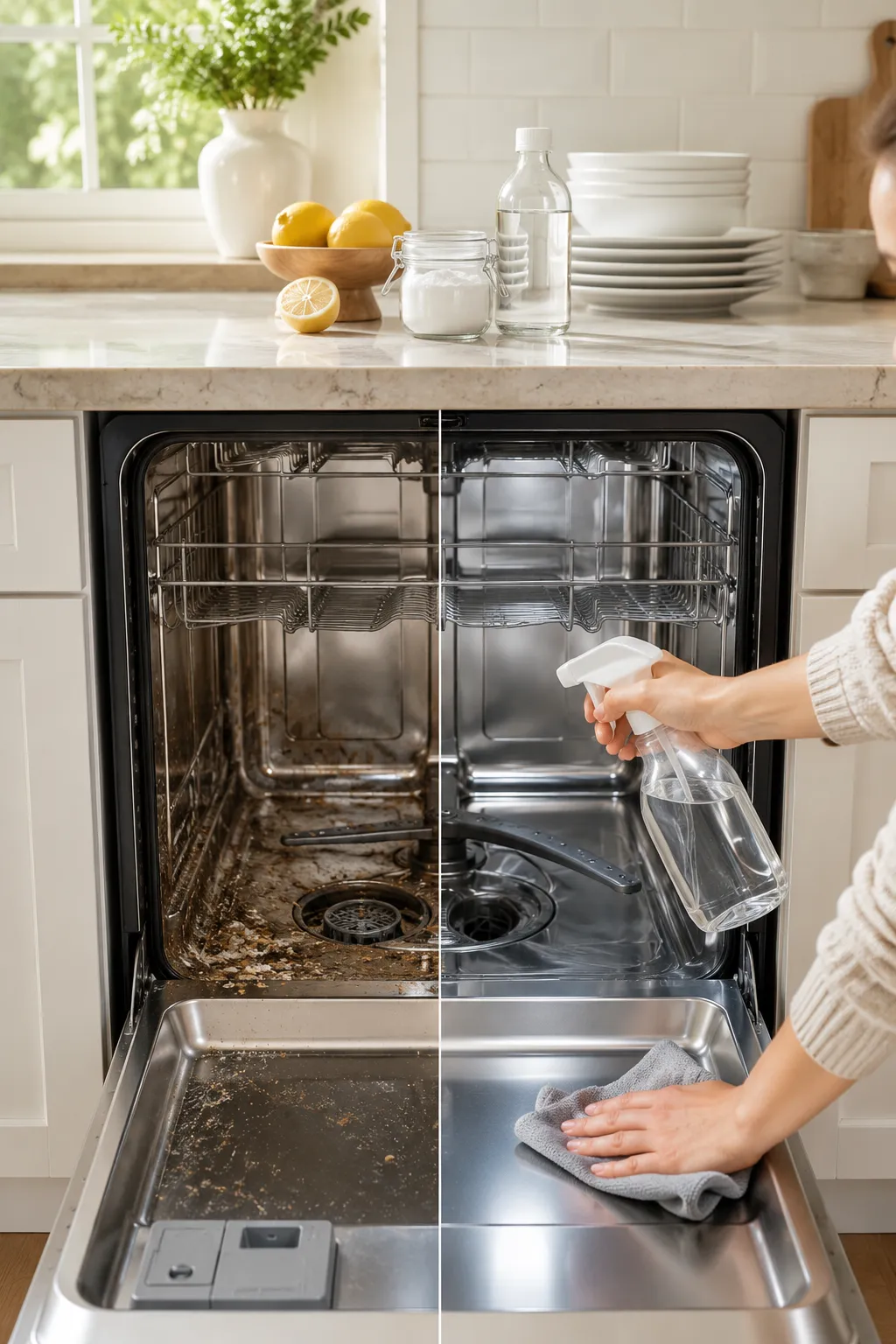
Your dishwasher cleans everything that goes into it—so it should clean itself, right? That’s the logic most people operate on, and it’s exactly why so many dishwashers smell like a combination of old food, mildew, and stale water.
The reality is that a dishwasher is one of the most neglected appliances in the kitchen. Food particles accumulate in the filter, grease builds up on the spray arms, mildew grows in the door gasket, and standing water sits in places that never fully dry between cycles. The machine that’s supposed to make your dishes clean is running them through a cycle that includes all of that.
The good news is that a smelly dishwasher is almost always fixable without calling anyone or buying expensive products. These eight methods address every source of dishwasher odor—from quick fixes to deep cleaning—so you can work through them systematically and get back to a machine that actually smells clean.
Why Dishwashers Smell in the First Place
Before treating the problem, it helps to know where the smell is actually coming from. Most dishwasher odors trace back to one or more of these sources:
- A dirty or clogged filter. Most modern dishwashers have a removable filter at the bottom of the machine that traps food debris. If it’s never cleaned, it becomes a decomposing food trap that smells worse with every cycle.
- Grease and food buildup on the spray arms and interior walls. Grease doesn’t rinse off with water alone—it accumulates in layers and eventually goes rancid.
- Mildew in the door gasket. The rubber seal around the door stays damp between cycles and is a prime location for mildew growth. It’s also one of the most commonly overlooked spots during cleaning.
- Standing water in the base or drain. A dishwasher that doesn’t drain completely between cycles holds stagnant water that quickly becomes a source of odor.
- Buildup in the detergent dispenser. Old detergent residue and hard water deposits accumulate in the dispenser and contribute to overall machine smell.
- The drain hose. Grease and food particles build up inside the drain hose over time and decompose slowly—a source of smell that most cleaning methods never reach.
What You’ll Need (Depending on the Method)
- White vinegar
- Baking soda
- Dish soap
- A soft brush or old toothbrush
- Microfiber cloths or clean rags
- Bleach (for white interiors only, and only when mildew is the primary issue)
- Commercial dishwasher cleaner (Affresh, Finish, or similar)
- Warm water
- Rubber gloves
- A toothpick or thin wire (for clearing spray arm holes)
Method 1: Clean the Filter (The Most Important Step)
If your dishwasher smells and you’ve never cleaned the filter, this is almost certainly the primary source of the odor. The filter catches food particles to prevent them from recirculating onto your dishes—but it doesn’t self-clean. Left unattended, it becomes a rotting food trap that gets rinsed with hot water during every cycle, spreading the smell throughout the machine and onto your dishes.
- Locate the filter. In most dishwashers, it sits at the bottom of the machine beneath the lower spray arm. It typically consists of a cylindrical upper filter and a flat mesh lower filter. Twist the cylindrical filter counterclockwise and lift it out, then remove the flat mesh filter beneath it.
- Take the filter to the sink and rinse it under warm running water to remove loose debris.
- Soak the filter in warm soapy water for 10–15 minutes if there is significant buildup. Grease and food residue that has hardened needs time to soften before it can be removed without damaging the mesh.
- Scrub gently with a soft brush or old toothbrush, paying close attention to the mesh screen where food particles lodge. Don’t use anything abrasive—metal scrubbers or rough sponges can damage the mesh and reduce its effectiveness.
- Rinse thoroughly under warm water until the water runs completely clear and no debris remains.
- Check the filter housing in the bottom of the machine while the filter is out. Use a paper towel or cloth to wipe out any debris, standing water, or slime from the cavity.
- Replace the filter, twisting the cylindrical portion clockwise until it locks into place. A loose filter allows food debris to bypass it entirely and clog the drain.
- Clean the filter monthly going forward. If you run your dishwasher daily, every two to three weeks is better.
Method 2: White Vinegar Cycle (Best All-Around Deodorizing Treatment)
White vinegar cuts through grease, dissolves mineral deposits from hard water, kills mildew, and neutralizes odor compounds—all in a single cycle. It’s the most effective single-ingredient treatment for a smelly dishwasher and the right follow-up after cleaning the filter.
- Make sure the dishwasher is empty. Remove all dishes, racks if necessary, and any debris from the bottom of the machine.
- Check and clean the filter first (Method 1) before running the vinegar cycle. Running vinegar through a machine with a clogged filter is less effective—clean the filter so the vinegar can circulate freely.
- Place a dishwasher-safe bowl or cup filled with one to two cups of white vinegar on the top rack of the empty machine. Don’t pour the vinegar into the detergent dispenser—it will release at the wrong point in the cycle and reduce effectiveness. Placing it on the rack allows it to distribute throughout the machine during the wash cycle.
- Run a full hot water cycle with no detergent. The hot water combines with the vinegar to cut through grease and mineral buildup on the interior walls, spray arms, and drain area.
- Leave the door closed until the cycle completes fully—including the drying phase. Opening it early interrupts the cleaning action.
- Open the door and allow the interior to air out for 15–30 minutes after the cycle ends. The vinegar smell will dissipate as it dries.
- Wipe down the interior walls and door with a clean cloth while still slightly warm to remove any loosened residue the cycle has lifted but not fully drained.
Method 3: Baking Soda Treatment (Best for Lingering Odor After Vinegar)
Baking soda works differently from vinegar in a dishwasher—rather than cutting through grease or dissolving deposits, it neutralizes acidic odor compounds directly and gently scrubs the interior surfaces. It’s most effective as a follow-up to the vinegar cycle, but it also works well on its own for mild odor between deeper treatments.
- Ensure the dishwasher is empty and has completed any previous cycle.
- Sprinkle one cup of baking soda evenly across the bottom of the dishwasher. Don’t put it in the detergent dispenser—sprinkling it on the bottom means it dissolves gradually throughout the cycle, maintaining contact with the interior surfaces.
- Run a short hot water cycle—a rinse cycle or the shortest available wash cycle works well here. A full long cycle isn’t necessary for baking soda; you’re not trying to clean heavy grease, just neutralize odor.
- Open the door after the cycle and allow the interior to air dry. The machine should smell noticeably cleaner and more neutral.
- For best results, run the baking soda treatment directly after the vinegar cycle in the same session—vinegar first, baking soda second. Don’t combine them in the same cycle, as they neutralize each other and reduce the effectiveness of both.
Method 4: Clean the Door Gasket (For Mildew Smell Specifically)
The rubber gasket that seals the dishwasher door is one of the most overlooked and most important spots to clean. It stays permanently damp between cycles, traps food debris in its folds, and is an ideal environment for mildew and bacteria growth. A dishwasher with a dirty gasket will continue to smell no matter how many cleaning cycles you run—because the smell source is never reached by the water.
- Open the dishwasher door fully and examine the gasket around the entire door frame. Pull it back gently in sections to check the inner fold—this is where mildew growth and food buildup concentrate, invisible from the outside.
- Mix a solution of equal parts white vinegar and warm water in a bowl or spray bottle.
- Dip an old toothbrush into the vinegar solution and scrub along the entire length of the gasket, including inside the fold. Work in small sections, scrubbing thoroughly before moving on.
- Use a damp microfiber cloth to wipe away the loosened mildew and debris after scrubbing each section.
- For stubborn mildew spots, apply undiluted white vinegar directly to the toothbrush and scrub again, then let the vinegar sit on the affected area for five minutes before wiping.
- Dry the gasket thoroughly with a clean cloth when finished. Leaving it wet immediately after cleaning reintroduces moisture—wipe it as dry as possible to slow mildew regrowth.
- Wipe the gasket after every few cycles as ongoing maintenance—a 30-second wipe with a damp cloth prevents the kind of buildup that requires scrubbing.
Method 5: Clean the Spray Arms (For Reduced Cleaning Performance and Odor)
The spray arms distribute water throughout the dishwasher during a cycle. Over time, the small holes in the spray arms get clogged with mineral deposits, food particles, and grease—reducing cleaning performance and contributing to overall machine odor. If your dishes aren’t coming out as clean as they used to, or if the machine smells despite other cleaning, blocked spray arms are likely a contributing factor.
- Remove the spray arms. Most dishwasher spray arms simply unscrew or pull off their central mount—consult your machine’s manual if they don’t come off easily. There is typically one lower arm and one upper arm, sometimes a third at the very top.
- Hold each spray arm over the sink and shake it to dislodge any loose debris from the holes.
- Soak the spray arms in a basin of warm water and white vinegar (equal parts) for 15–20 minutes. This loosens mineral deposits and softens grease buildup that’s blocking the holes.
- Use a toothpick, thin wire, or straightened paper clip to clear each hole individually after soaking. Work through every hole—even partial blockages affect water distribution and allow debris to accumulate.
- Scrub the exterior of each arm with a soft brush and dish soap, then rinse thoroughly under warm running water.
- Replace the spray arms and ensure they spin freely by hand before running a cycle. A spray arm that doesn’t rotate properly means uneven water coverage and reduced cleaning.
Method 6: Deodorize the Drain Area (For Persistent Odor at the Bottom)
The drain area at the base of the dishwasher—where water collects before draining—is a common source of persistent smell that cleaning cycles don’t always reach. Grease, food particles, and standing water accumulate here and decompose over time. If the smell seems to be coming specifically from the bottom of the machine, this is where to focus.
- Remove the lower rack to access the base of the dishwasher fully.
- Remove the filter (as in Method 1) and set aside.
- Use paper towels to soak up any standing water in the base. The goal is to work on a relatively dry surface so cleaning solutions aren’t immediately diluted.
- Sprinkle baking soda generously over the entire base of the dishwasher, including around and inside the drain area.
- Pour a small amount of white vinegar directly into the drain opening. The fizzing reaction between the baking soda and vinegar helps loosen debris and grease that has accumulated inside the drain.
- Let the reaction sit for 10–15 minutes without disturbing it.
- Use an old toothbrush to scrub around the drain opening and the base of the machine, working the baking soda into corners and crevices.
- Wipe everything clean with a damp cloth, removing all loosened debris and cleaning residue.
- Replace the filter and run a hot rinse cycle to flush the drain area clean.
Method 7: Commercial Dishwasher Cleaner (Best for Heavy Buildup)
For dishwashers that haven’t been cleaned in a long time—or where home remedies haven’t fully resolved the smell—a commercial dishwasher cleaner is the most thorough single-product option. Products like Affresh, Finish Dishwasher Cleaner, and similar tablets are specifically formulated to dissolve grease, remove limescale, and eliminate odor-causing bacteria from the areas that standard cycles and home remedies don’t fully reach, including the pump, hoses, and internal components.
- Clean the filter first before using a commercial cleaner. A clogged filter limits the cleaner’s circulation through the machine.
- Follow the product instructions exactly. Most dishwasher cleaning tablets are placed in the bottom of the machine (not in the detergent dispenser) and run on a hot, full cycle with an empty machine. Some products have different placement or cycle requirements.
- Run the hottest cycle available on your machine. Commercial cleaners are formulated to activate at high temperatures—a cooler cycle won’t fully release the cleaning agents.
- Don’t open the machine mid-cycle. Let it run completely, including the drying phase.
- Wipe down the interior after the cycle with a clean cloth to remove any residue the cleaner has loosened but not drained.
- Use a commercial cleaner monthly for ongoing maintenance if your machine is prone to buildup, or every two to three months as preventative cleaning.
Method 8: Bleach Treatment (For Mildew-Heavy Machines With White Interiors)
Chlorine bleach is the most powerful mildew and bacteria killer available for dishwasher cleaning—but it comes with significant restrictions. It should never be used in dishwashers with stainless steel interiors, as bleach permanently damages and discolors stainless steel. It’s only appropriate for machines with plastic white interiors, and even then should be used sparingly and never combined with vinegar in the same cycle.
- Confirm your dishwasher has a plastic white interior, not stainless steel. Check the manual or look inside—stainless steel has a metallic sheen; plastic interiors are uniformly white or off-white.
- Clean the filter and door gasket first so the bleach can reach the actual machine surfaces rather than being absorbed by debris.
- Place a dishwasher-safe bowl containing half a cup of bleach on the bottom rack of the empty machine. Don’t pour bleach directly into the detergent dispenser or the drain.
- Run a full hot wash cycle with no detergent or other cleaning agents. Never combine bleach with vinegar—the combination produces chlorine gas, which is toxic.
- Run an additional rinse cycle after the bleach cycle to ensure all bleach residue is completely flushed from the machine before running dishes.
- Reserve this method for genuine mildew problems rather than general odor maintenance—the vinegar and baking soda methods handle routine odor more safely and with less risk to the machine.
Method Comparison at a Glance
| Method | Best For | Frequency | Works on All Machines |
|---|---|---|---|
| Clean the filter | Food odor, primary source | Monthly | Yes |
| White vinegar cycle | General odor, grease, mineral deposits | Monthly | Yes |
| Baking soda treatment | Lingering odor, mild smell | Monthly | Yes |
| Clean the door gasket | Mildew smell from seal | Monthly | Yes |
| Clean the spray arms | Reduced performance, blockage | Every 3 months | Yes |
| Deodorize drain area | Persistent bottom odor | Every 2–3 months | Yes |
| Commercial cleaner | Heavy buildup, long-neglected machines | Monthly or as needed | Yes |
| Bleach treatment | Severe mildew, plastic interiors only | Sparingly | Plastic interiors only |
Why Your Dishwasher Might Still Smell After Cleaning
If you’ve worked through the methods above and still have a persistent odor, consider these less obvious causes:
- The drain hose. Grease and food residue accumulates inside the drain hose over time. If the smell persists despite thorough cleaning, the drain hose may need to be disconnected and flushed—or replaced if it’s old and saturated with buildup. This is worth checking before calling an appliance technician.
- The air gap or garbage disposal connection. If your dishwasher drains through an air gap (a small fitting on the sink) or into a garbage disposal, buildup in either location can cause odor that gets drawn back into the machine. Clean the air gap and run the disposal before and after the dishwasher cycle.
- The machine isn’t draining fully. If there’s consistently standing water in the bottom of the machine after a cycle, there’s a drainage problem—either a clogged drain, a failing pump, or an installation issue. Standing water that doesn’t drain between cycles will smell no matter how often you clean. This is worth a service call if cleaning the filter and drain area doesn’t resolve it.
- The water temperature is too low. Dishwashers should heat water to at least 120–140°F to properly dissolve grease and kill bacteria. If your hot water supply isn’t reaching that temperature, bacteria and grease build up faster. Run the kitchen tap until hot water arrives before starting a dishwasher cycle to help.
How to Keep Your Dishwasher Smelling Fresh
Prevention requires less effort than treatment. A few consistent habits make the difference:
- Scrape plates before loading. You don’t need to pre-rinse—modern dishwashers are designed to handle food residue—but large chunks of food should be scraped off. The filter isn’t designed to catch pieces that large, and they end up decomposing in the base of the machine.
- Run the dishwasher regularly. A dishwasher that sits full of dirty dishes for several days before running is a smell factory. Run it every day or every other day if possible.
- Leave the door ajar after a cycle. Leaving the door cracked open after the cycle ends allows the interior to dry and air out rather than trapping warm, damp air inside—the exact environment mildew needs to grow.
- Clean the filter monthly. This alone prevents the majority of dishwasher odor problems. Set a reminder and make it part of your regular kitchen cleaning routine.
- Run a maintenance vinegar cycle monthly. One cup of white vinegar on the top rack, empty machine, hot cycle—it takes less than a minute to set up and keeps grease and odor from building up between deep cleans.
FAQ
Can I put vinegar and baking soda in the dishwasher at the same time? No. Vinegar and baking soda neutralize each other when combined, producing water and carbon dioxide rather than doing any meaningful cleaning. Run them in separate cycles—vinegar first, baking soda second—to get the benefit of both.
Is it safe to run an empty dishwasher for cleaning? Yes—and it’s actually the correct way to run most cleaning treatments. An empty machine allows the cleaning solution to circulate freely and reach all interior surfaces without dishes blocking coverage.
How often should I clean my dishwasher? The filter should be cleaned monthly. A vinegar cycle and door gasket wipe-down monthly keeps most machines odor-free. A deeper clean including spray arms and drain area every two to three months is sufficient for regular use.
My dishwasher smells like rotten eggs specifically—what causes that? A sulfur or rotten egg smell usually indicates bacterial buildup in the drain or filter, or a problem with the drain connection to the garbage disposal. Clean the filter and drain area thoroughly first. If the smell persists, check the garbage disposal connection and consider running the disposal before starting the dishwasher.
Can I use essential oils to deodorize my dishwasher? Essential oils don’t address the source of the smell and aren’t recommended—they can leave residue in the machine and on dishes. Vinegar and baking soda neutralize odor at the source rather than masking it, which is always the more effective approach.
The Bottom Line
A smelly dishwasher is almost always a maintenance problem, not a mechanical one—and it’s almost always fixable at home without products you don’t already have. Start with the filter, because that’s where most of the smell originates. Follow up with a vinegar cycle for general deodorizing, clean the door gasket for mildew, and use baking soda for lingering odor. Leave the door cracked after every cycle and clean the filter monthly, and you’ll rarely need to do anything more intensive than that.
Enjoyed this project? Get even more DIY ideas that save (and make) you money.
Join our free newsletter for profitable DIY projects, clever cleaning hacks, home ideas, and creative crafts delivered straight to your inbox.
✓ Free forever • No spam • Unsubscribe anytime