There are science experiments that impress for about thirty seconds, and then there are experiments that kids genuinely cannot stop watching. The walking water experiment falls firmly in the second category. Something about seeing colored water slowly “walk” from one cup to another through nothing but a paper towel captures children — and honestly, most adults — in a way that feels almost hypnotic.
But here’s what most guides don’t tell you: there’s a surprisingly common setup mistake that causes the water to move too slowly, stop halfway, or produce colors so muddy they lose all their visual impact. Getting this experiment right comes down to understanding the actual science driving it, not just following a recipe blindly.
This video shows the Walking Water Science Experiment for Kids:
Here’s the Real Reason Water “Walks” at All
The walking water experiment works because of two powerful physical forces working together: capillary action and cohesion.
Capillary action is the ability of a liquid to flow through narrow spaces without — and sometimes against — the help of gravity. It happens because water molecules are attracted to the molecules in the paper towel fibers. The water essentially “climbs” into the tiny gaps between the fibers because it’s more attracted to the paper than it is pulled down by gravity. This is the same force that pulls water up from the roots of a tree into its leaves dozens of feet above the ground.
Cohesion is water’s tendency to stick to itself. Water molecules form weak chemical bonds with each other called hydrogen bonds. These bonds mean that when one water molecule gets pulled up into the paper towel, it drags the molecules behind it along for the ride — like a chain of people holding hands, where pulling the first person forward pulls everyone else too.
Together, these two forces allow water to travel from a full cup, up through a paper towel bridge, over the rim, and down into an empty cup next to it — completely unaided by pumps, gravity, or any other external force. That’s legitimately remarkable, and kids who understand why it’s happening appreciate the experiment on a completely different level.
What You’ll Need
This experiment is wonderfully low-cost and low-prep. Everything on this list is either already in your home or costs almost nothing to pick up:
- Seven clear plastic or glass cups (identical size works best)
- Six sheets of paper towels (full-sized, not half-sheets — this matters more than most guides admit)
- Food coloring in red, yellow, and blue
- Water (room temperature)
- A measuring cup or jug for consistent water levels
- Optional: White vinegar (to make colors slightly more vivid) and a timer if you want to turn it into a proper experiment with observations
Don’t Ignore the Setup — It Makes or Breaks the Whole Thing
Before walking through the steps, here are the most important setup rules that are almost always glossed over:
Water level consistency matters enormously. If one cup has significantly more water than another, the water will rush toward the empty cup too fast and unevenly. Fill each starting cup to the same level — roughly halfway is ideal.
Paper towel quality affects speed. Cheap, thin paper towels have fewer fibers and smaller capillary channels, which means water moves more slowly and may not make it over the rim. A standard kitchen paper towel brand works well. Avoid recycled or “eco” paper towels for this one — they’re often too coarse and loosely fibered.
The fold matters. A single flat sheet draped over the rim won’t work as well as a paper towel folded lengthwise into thirds, creating a thicker, narrower strip with more surface area touching both the water and the cups’ interior walls.
Step-by-Step: How to Set Up the Walking Water Experiment
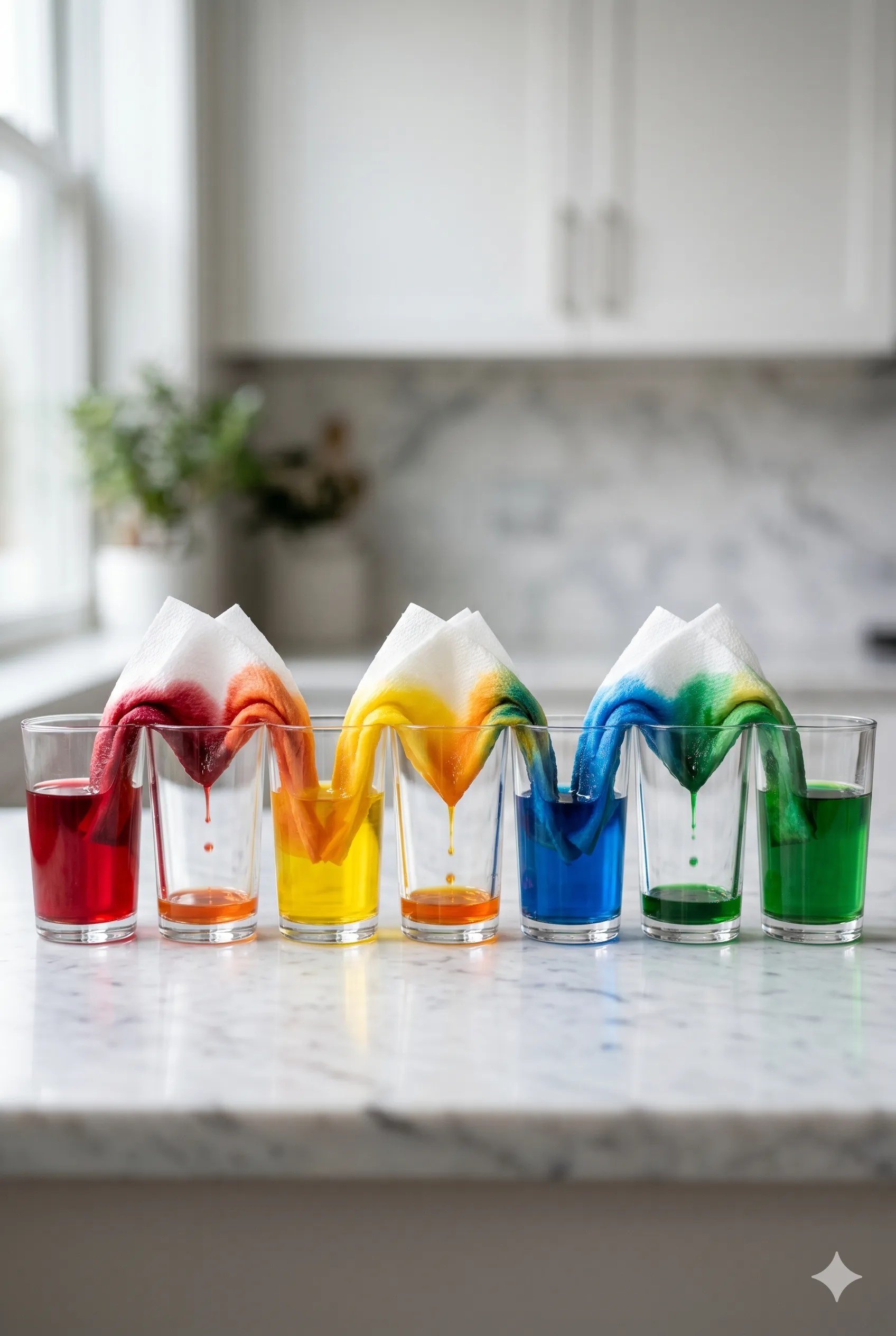
Step 1: Line up your seven cups in a row and fill cups one, three, and five halfway with water. Leave cups two, four, and six completely empty. Cup seven can be left aside — you’ll only need six in the main rainbow setup, but having a spare is useful.
Step 2: Add food coloring to the filled cups. Add red food coloring to the first cup, yellow to the third, and blue to the fifth. Use enough drops to make the color deep and vivid — at least ten to fifteen drops per cup. Pale, washed-out color is the number one reason this experiment looks underwhelming in photos and in person.
Step 3: Fold each paper towel lengthwise into thirds to create a long, narrow strip. You should end up with a strip roughly two to three inches wide and as long as the paper towel. If the paper towel is very long, you can fold the ends under slightly so the strip fits neatly between two cups without sagging too far.
Step 4: Bend each paper towel strip into a gentle U-shape and place one end into a colored cup and the other end into the empty cup beside it. The ends of the paper towel should dip a couple of inches into the water — not just rest on the rim. Make sure the ends are actually submerged in the colored water, not just touching the surface.
Step 5: Repeat for all six gaps between the seven cups so every colored cup is connected to the empty cups on both sides of it via a paper towel bridge. You should have six paper towel bridges total.
Step 6: Now the hardest part — wait. This is where most kids (and parents) give up too early. In the first five to ten minutes, you may not see much movement at all. The paper towels need to fully saturate before water begins flowing over the rim into the empty cups. Set a timer for thirty minutes for the first check-in, and encourage kids to make predictions: which color will arrive in the middle cups first? What color will the middle cups turn?
Step 7: Observe the results over the next one to two hours. The empty cups will gradually fill with water, and — this is the genuinely exciting part — the water mixing in those cups will create secondary colors. The cup between red and yellow will turn orange. The cup between yellow and blue will turn green. The cup between blue and red will turn purple. You’ve accidentally created a color wheel.
You’re Probably Doing This Wrong: Common Mistakes and How to Fix Them
The paper towel isn’t submerged deeply enough. If the end of the paper towel is just resting on top of the water, capillary action has very little surface area to work with. Push the paper towel ends down so at least an inch to two inches is sitting in the colored water.
The cups are too far apart. If the gap between cups is larger than the paper towel strip can comfortably bridge without stretching taut, the strip pulls away from the water surface on one or both sides. Keep cups close together — just an inch or two of gap is plenty.
The room is too cold. Water moves through capillary channels more slowly at lower temperatures because the reduced thermal energy of the molecules slows the hydrogen bonding process slightly. If you’re running this experiment in a cold room and seeing very little movement after an hour, try moving it somewhere warmer.
You’re using too little food coloring. This doesn’t affect the science, but it dramatically affects the visual payoff. Don’t be shy with the food coloring — more vivid starting colors mean more dramatic secondary color mixing in the middle cups.
Fun Variations to Extend the Experiment
The Speed Test
Set up two identical walking water experiments side by side — one with cold water and one with warm water. Time how long it takes for water to appear in the first empty cup in each setup. This turns the demonstration into a proper scientific investigation with a hypothesis, a variable, and measurable results.
The Absorption Race
Test different types of paper towel against each other. Does a premium brand really move water faster than a budget brand? Does a cloth dish towel work at all? Does a piece of cotton fabric? This explores the relationship between material structure and capillary efficiency.
The Uphill Challenge
Once kids understand that capillary action works against gravity on a flat surface, ask them: what happens if we tilt the empty cup higher than the full cup? Will the water still walk uphill? (Answer: yes, within limits — and working out those limits is a great extended experiment.)
Four-Color Mixing
Instead of the classic three-color rainbow setup, try using four cups with color in every other one: red, empty, blue, empty, red, empty, yellow. The results get more complex and spark great conversations about color theory and mixing.
What Kids Learn From This Experiment
The walking water experiment quietly delivers a surprising amount of real scientific content:
Capillary action is directly relevant to understanding how plants absorb water, how towels dry dishes, how ink spreads on paper, and even how the human body moves fluids through certain tissues. It’s not an obscure concept — it shows up everywhere once you know to look for it.
Cohesion and adhesion are two of the fundamental properties of water that appear in virtually every elementary and middle school science curriculum. Seeing them in action makes the abstract definition stick.
Color theory and mixing get a chemistry twist here. Kids learn that red and yellow make orange not just as an art rule, but as a physical, observable process happening in real time in a cup in front of them.
Patience and observation — arguably the most underrated scientific skills — are built naturally into an experiment where the most interesting results take an hour or two to develop.
Quick Troubleshooting Guide
| Problem | Most Likely Cause | Fix |
|---|---|---|
| Water isn’t moving after 20 minutes | Paper towel end not submerged | Push ends deeper into the water |
| Water stops halfway up the bridge | Paper towel strip too dry or thin | Use a thicker fold or double up the strip |
| Middle cups are turning brown, not a clean color | Too many colors mixed at once | Use less paper towel overlap or reset with fresh water |
| Colors are too faint to see mixing | Not enough food coloring used | Add 10–15 drops minimum per cup |
| One side is filling faster than the other | Unequal water levels in starting cups | Use a measuring cup to ensure equal starting volumes |
FAQ
How long does the walking water experiment take to complete? The first signs of water movement usually appear within fifteen to thirty minutes, but the full effect — with the middle cups filling and showing mixed colors — takes between one and two hours depending on temperature, paper towel quality, and water level.
Can you use liquids other than water? You can experiment with other water-based liquids like diluted juice or very weak saltwater, though salt water moves slightly slower due to its higher density. Avoid thick liquids like oil or syrup — they won’t work because their molecules don’t form the hydrogen bonds that make capillary action possible.
Does the color in the original cups run out? Yes, eventually. Over several hours, the water level in the starting cups will drop as water migrates into the empty cups. This is a great observation point — the rate at which the original cup empties tells you something about the speed of capillary flow.
Is this experiment safe for very young children? Completely. There are no heat sources, no chemicals, and no sharp tools involved. Even a three or four year old can participate in filling the cups and adding food coloring drops, making it one of the most genuinely inclusive science activities available.
Conclusion
The walking water experiment earns its place as a kitchen science classic because it delivers on every level: it’s visually dramatic, scientifically meaningful, completely safe, and costs almost nothing to set up. The key is taking the setup seriously — submerge those paper towel ends, use bold food coloring, and match your water levels. Do those three things, and you won’t be watching a slow, underwhelming trickle. You’ll be watching a color wheel build itself, one cup at a time, powered by nothing but the remarkable chemistry of water molecules doing what they’ve always done.
Enjoyed this project? Get even more DIY ideas that save (and make) you money.
Join our free newsletter for profitable DIY projects, clever cleaning hacks, home ideas, and creative crafts delivered straight to your inbox.
✓ Free forever • No spam • Unsubscribe anytime