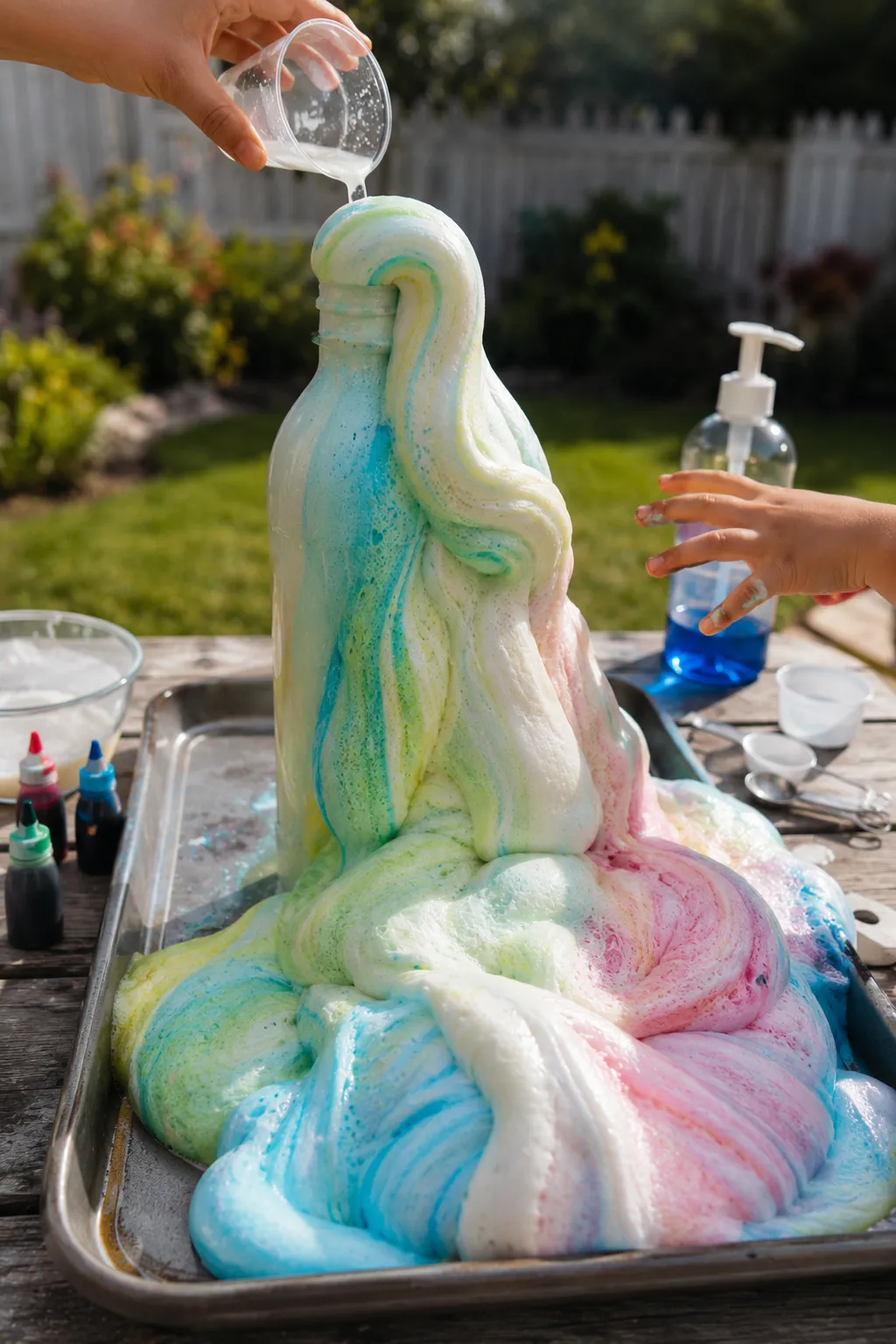
If you’ve ever wanted to watch a volcano of foam erupt right out of a bottle, elephant toothpaste is your answer. It’s one of those science experiments that sounds almost too good to be true — a giant, colorful, foamy explosion that shoots up in seconds and leaves kids (and honestly, most adults) completely mesmerized.
The name comes from the result: a thick, squiggly tube of foam that looks like it could belong to a very large elephant’s bathroom cabinet. It’s dramatic, it’s visual, and it happens fast — which makes it just about perfect for kids who have a short window of patience before they’re ready to move on to the next thing.
But here’s what makes it genuinely valuable beyond the wow factor: there’s real science happening inside that bottle. Elephant toothpaste is a fantastic, hands-on way to introduce kids to chemical reactions, catalysts, and exothermic processes without any textbook required.
Watch this short video to learn how to make elephant toothpaste right away:
What Is Elephant Toothpaste, Exactly?
Before you gather your supplies, it helps to understand what’s actually going on. When hydrogen peroxide breaks down, it releases water and oxygen gas. Normally that process happens slowly — too slowly to see. A catalyst is a substance that speeds a chemical reaction up without being consumed in the process. In this experiment, yeast acts as that catalyst, dramatically accelerating the decomposition of hydrogen peroxide and releasing a rapid burst of oxygen.
The dish soap traps all that oxygen into bubbles, and the result is the enormous, fast-rising foam column you see shooting out of the bottle. Because the reaction releases energy as heat, the foam will actually feel warm to the touch — making it a great way to explain exothermic reactions to older kids.
What You’ll Need
Gather everything before you start. The reaction happens quickly once it’s triggered, so you don’t want to be scrambling for supplies mid-experiment.
- Hydrogen peroxide — standard 3% (from any pharmacy) works for the kid-friendly version; 6% or 12% produces a bigger, more dramatic reaction but requires adult supervision
- Active dry yeast — one packet (about 2¼ teaspoons)
- Warm water — a few tablespoons to activate the yeast
- Dish soap — about one tablespoon of plain liquid dish soap
- Food coloring — optional, but makes the foam much more visually exciting
- A clean plastic bottle — a 16 oz or 500ml bottle works well; taller and narrower produces a more dramatic “column” effect
- A small bowl or cup — for mixing the yeast solution
- A funnel — helpful for pouring without spilling
- A tray or baking sheet — place the bottle on this to catch overflow, because there will be overflow
- Measuring spoons and a measuring cup
Step-by-Step: How to Make Elephant Toothpaste
Prepare Your Space First
- Set up your experiment area. Place a tray or rimmed baking sheet on a flat, stable surface — a table outside or a kitchen counter works well. This will catch the foam, which can spread quite a bit depending on the amount of hydrogen peroxide you use.
- Put on any protective gear if using higher-concentration hydrogen peroxide. For the standard 3% version, no special precautions are needed beyond basic common sense. For anything above 6%, adults should wear gloves and safety glasses and handle the hydrogen peroxide themselves.
Make the Yeast Mixture
- Dissolve the yeast in warm water. Pour two to three tablespoons of warm water (not hot — hot water will kill the yeast) into your small bowl or cup. Add the yeast and stir gently. Let it sit for about one to two minutes until it becomes frothy and active. This step is important — if your yeast doesn’t activate, the reaction will be weak or won’t happen at all.
Prepare the Bottle
- Pour the hydrogen peroxide into the bottle. Measure out about half a cup (roughly 120ml) of hydrogen peroxide and pour it into your plastic bottle using a funnel. If you want colored foam, add five to ten drops of food coloring directly into the hydrogen peroxide at this stage and swirl the bottle gently to mix.
- Add the dish soap. Squeeze about one tablespoon of dish soap into the bottle on top of the hydrogen peroxide. Swirl gently to combine — you want them mixed together but not overly bubbly yet.
Trigger the Reaction
- Pour the yeast mixture into the bottle quickly. This is the moment of truth. Pour your activated yeast solution into the bottle (a funnel helps here too), step back, and watch. Within a few seconds, the foam will begin rising rapidly out of the bottle’s mouth. It will be warm, so warn kids before they touch it — but touching it is perfectly safe with the standard 3% version.
- Let the foam fully expand. The main burst happens in the first 10 to 20 seconds, but the foam may continue to ooze out slowly for another minute or two. Let it run its course before touching or cleaning up.
- Explore the result. Encourage kids to feel the foam — it’s warm! Ask them why they think it feels warm. Squeeze the foam between fingers and notice that it’s mostly just soap bubbles. Talk about what the yeast did and why the reaction happened so fast.
The Science Behind It (Kid-Friendly Explanation)
Here’s a simple way to explain the chemistry to kids of different ages:
For younger kids (ages 4–7): “The yeast is like a helper that made the hydrogen peroxide work super fast. It made so much oxygen so quickly that the soap trapped it all into bubbles — and that made our big, fluffy foam tower!”
For older kids (ages 8–12): “Hydrogen peroxide slowly breaks down into water and oxygen on its own. The yeast acts as a catalyst — it speeds that process up massively. The oxygen gas gets trapped in the dish soap, forming bubbles so fast they pile up into foam. And because the reaction releases energy, the foam feels warm — that’s called an exothermic reaction.”
For teens: You can go further and discuss decomposition reactions, enzyme chemistry (the yeast contains an enzyme called catalase that drives the reaction), and introduce the idea of reaction rates and activation energy.
Variations to Try
Once you’ve done the basic version, there are several ways to extend the experiment and keep the curiosity going.
Change the hydrogen peroxide concentration. Compare the foam produced by 3% hydrogen peroxide versus 6% (available at beauty supply stores). The difference in size and speed is significant and makes for a great visual comparison.
Try different amounts of yeast. Use half a packet versus a full packet and observe how the reaction changes. More catalyst means a faster, more vigorous reaction.
Experiment with water temperature. Does warm water in the yeast mixture make a difference compared to cool water? (Yes — warmer water activates the yeast faster.)
Add glitter. Mix glitter into the hydrogen peroxide before starting. The foam will carry it up and out, creating a sparkly effect that younger kids love.
Use different bottle shapes. A wide-mouth jar versus a narrow bottle creates a very different foam shape. A tall, narrow bottle creates a dramatic column; a wide container creates a spreading foam blanket.
Safety Notes
- The foam produced with standard 3% hydrogen peroxide is completely safe to touch and is non-toxic. It’s essentially just soap, water, and oxygen bubbles.
- Higher concentrations of hydrogen peroxide (above 6%) can irritate skin and eyes. These should only be handled by adults and are not necessary for a kid-friendly version of the experiment.
- The foam will feel warm — remind kids of this before they touch it so they’re not startled.
- Always do this experiment on a surface that’s easy to clean, or take it outside. The foam can spread further than you expect.
Quick Troubleshooting
| Problem | Likely Cause | Fix |
|---|---|---|
| Barely any foam produced | Yeast wasn’t activated properly | Use fresher yeast; ensure water is warm, not cold or hot |
| Reaction is very slow | Hydrogen peroxide may be old or diluted | Use a fresh bottle; try a higher concentration |
| Foam comes out but quickly deflates | Too little dish soap | Add an extra squeeze of dish soap next time |
| No reaction at all | Yeast may have been killed by hot water | Use lukewarm water — around body temperature |
| Foam is very small | Using too little hydrogen peroxide | Scale up to a full cup and a larger bottle |
FAQ
Is elephant toothpaste safe for young children? The kid-friendly version using standard 3% hydrogen peroxide is safe for children of all ages to watch and touch, with basic adult supervision. Avoid higher concentrations for young children.
Can you reuse the foam? The foam itself is just soapy water after the reaction is complete — there’s no hydrogen peroxide left in it. You can’t re-trigger the reaction with the leftover foam, but it’s perfectly safe to play with.
How long does the experiment take? Setup takes about five minutes, and the actual reaction lasts about 15 to 30 seconds of dramatic foam production. It’s a great quick activity that doesn’t require a long attention span.
Does it actually work with just 3% hydrogen peroxide? Yes — the foam won’t be as towering as the viral videos you may have seen online (those typically use 30% hydrogen peroxide, which is a professional-grade chemical), but the reaction is still very visible, satisfying, and genuinely exciting for kids.
Can you do this experiment indoors? Yes, as long as you use a tray to contain the overflow and don’t mind a bit of cleanup. Outside is easier, but it’s perfectly manageable at a kitchen table with a large rimmed baking sheet underneath.
Conclusion
Elephant toothpaste is one of those rare experiments that delivers on every front — it’s fast, dramatic, easy to set up, and actually teaches real science along the way. Whether you’re a parent looking for a rainy afternoon activity, a teacher planning a classroom demo, or a kid who just wants to make something explode (safely), this experiment never disappoints.
Start with the basic version using 3% hydrogen peroxide, let the kids get hands-on with the warm foam afterward, and then challenge them to change one variable and predict what will happen. That’s the real magic of a good science experiment — not just the wow moment, but the questions it leaves behind.
Enjoyed this project? Get even more DIY ideas that save (and make) you money.
Join our free newsletter for profitable DIY projects, clever cleaning hacks, home ideas, and creative crafts delivered straight to your inbox.
✓ Free forever • No spam • Unsubscribe anytime