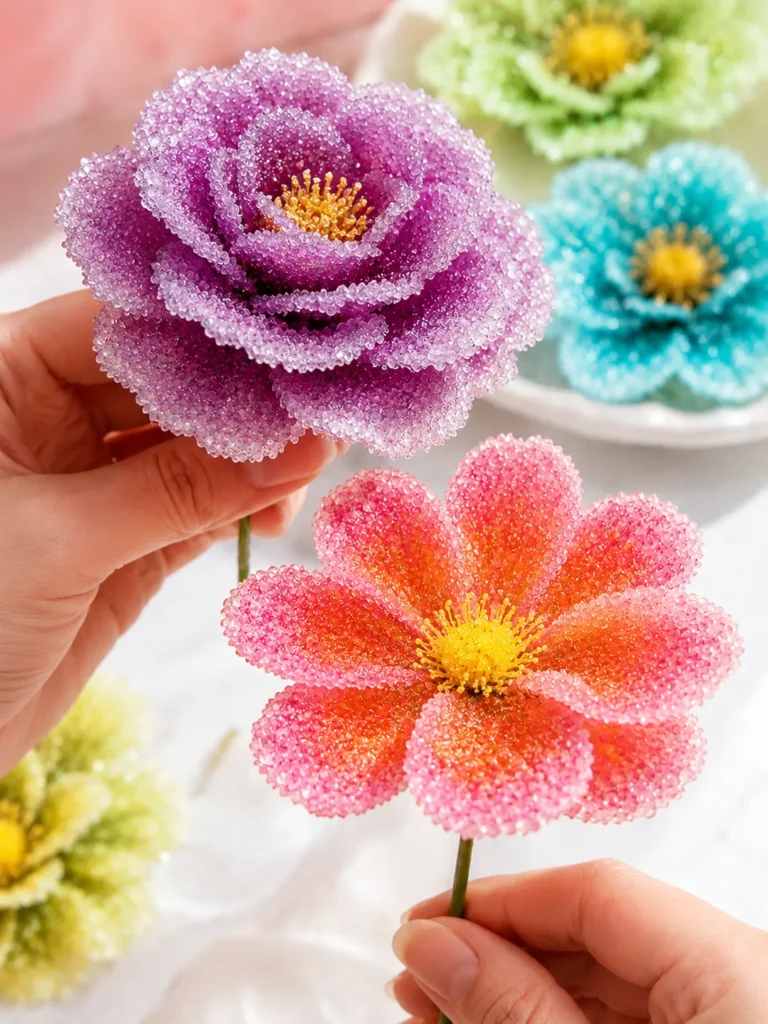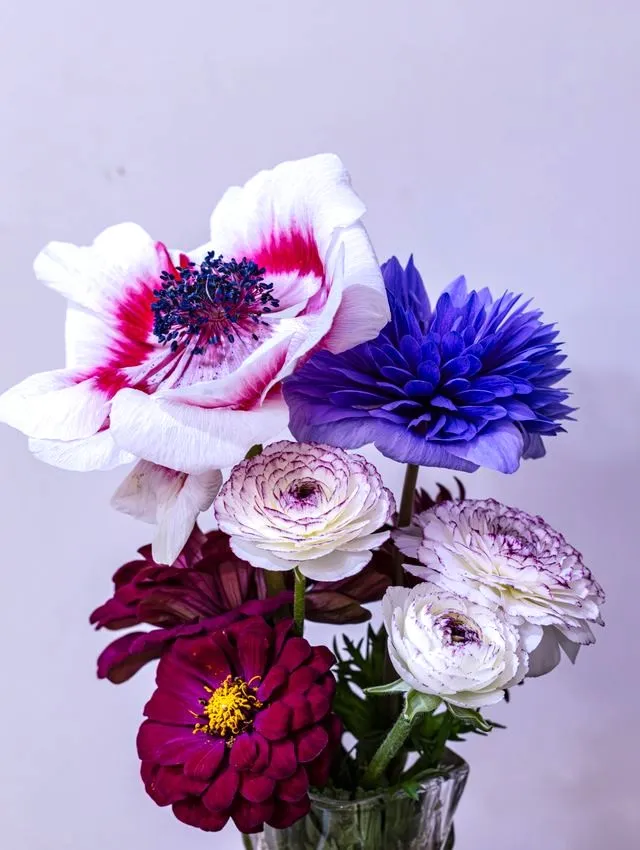
Crepe paper flowers have a reputation for being a craft for patient, skilled people. That reputation is completely undeserved. The material itself does most of the work—crepe paper stretches, curves, and holds shape in ways that regular paper never does, which means even a beginner’s first attempt produces something that looks genuinely beautiful. The texture catches light differently at every angle, the colors are rich and saturated, and the finished flowers hold their shape for months or even years without drooping or fading.
The range of what’s possible with crepe paper is also wider than most people realize. You can make a convincingly realistic rose in about 15 minutes. A full peony takes longer but looks extraordinary. Streamers from the dollar store turn into cheerful party flowers in under five minutes. There’s a version here for every skill level, every occasion, and every amount of time you have.
Here are eight different crepe paper flowers with full instructions for each, plus everything you need to know about materials and technique before you start.
What Makes Crepe Paper Different
Before diving into the flowers, it helps to understand why crepe paper behaves the way it does—because once you understand it, you can use it intentionally rather than just following instructions blindly.
Crepe paper is made by crinkling regular paper under pressure during manufacturing, which gives it a grain direction (like wood grain) and the ability to stretch significantly in one direction while barely stretching in the other. When you pull across the grain, the paper stretches and cups, creating natural curves. When you roll the edge around a pencil or dowel, it curls. When you cup a petal between your thumbs and stretch the center, it domes. These three techniques—stretching, curling, and cupping—are the entire foundation of realistic crepe paper flowers.
There are also two main types of crepe paper worth knowing about. Craft crepe paper (sometimes called crepe streamers) is the lightweight, inexpensive roll you find at dollar stores and party supply shops. It works beautifully for simple flowers and is perfect for kids’ crafts and party decorations. Italian or florist-grade crepe paper is significantly heavier, more richly colored, and more stretchable—it produces more realistic, luxurious-looking flowers and is worth buying for any project where the quality of the finished flower matters.
What You’ll Need Across Most Projects
- Crepe paper rolls in your chosen colors—both craft and florist-grade depending on the project
- Scissors – sharp scissors make cleaner cuts; small craft scissors are useful for detail work
- Floral wire in various gauges – 18-gauge for sturdy stems, 22 or 24-gauge for lighter work
- Floral tape – the stretchy, self-adhesive green tape that wraps stems and holds everything together
- Wire cutters – for cutting floral wire cleanly
- Hot glue gun and glue sticks – for securing petals quickly and firmly
- Pencil or dowel – for curling petal edges
- Green crepe paper – for leaves and calyxes
- Stamens – optional but available cheaply online; adds realism to the center of flowers
Flower 1: Classic Crepe Paper Rose
The rose is the gateway flower for most people who get into crepe paper crafts, and it deserves that position. A well-made crepe paper rose is convincing enough that people regularly do a double take when they see one up close. This method builds the rose by wrapping petals around a central bud, which is exactly how a real rose grows.
Step 1: Cut 8–12 petal shapes from red, pink, or cream crepe paper. Each petal should be roughly teardrop-shaped, about 3 inches tall and 2 inches wide at the widest point. Cut them with the grain of the paper running vertically so the petals will stretch and cup correctly.
Step 2: Shape each petal by placing your thumbs in the center of the petal and gently stretching outward—the paper will dome and cup naturally. Then curl the top edge of each petal backward over a pencil to create a realistic outward-flaring tip.
Step 3: Make the central bud by rolling a small piece of crepe paper into a tight cone shape and securing it to the top of a length of floral wire with floral tape. This becomes the unopened center of the rose that all petals wrap around.
Step 4: Attach the first three petals tightly around the bud, overlapping them slightly and wrapping the base of each one with floral tape to secure. These inner petals should cup inward around the bud rather than flaring open.
Step 5: Add the remaining petals in rings, each ring sitting slightly lower and more open than the previous one. The outer petals should be cupped more fully and their tips curled back more dramatically than the inner ones—this gradation from tight center to open outer petals is what gives the rose its realistic depth.
Step 6: Cut a calyx from green crepe paper—a small star shape with five pointed tips—and slide it up the wire to sit beneath the flower head. Secure with hot glue.
Step 7: Wrap the entire stem with green floral tape, stretching it slightly as you spiral downward to activate its adhesive. Add a leaf or two cut from green crepe paper and secured at the stem with floral tape.
Flower 2: Crepe Paper Peony
The peony is the showiest flower on this list and one of the most popular for weddings, home decor, and gift wrapping. It’s more time-consuming than the rose but the result is extraordinary—full, lush, and completely convincing.
Step 1: Cut approximately 30–40 petals from soft pink, coral, or white crepe paper in two sizes—smaller petals for the center (about 2 inches tall) and larger petals for the outer layers (about 3–4 inches tall). Peonies are full flowers so don’t be tempted to use fewer petals.
Step 2: Shape every petal by stretching the center outward between your thumbs to create a full dome, then curl the top edge back with a pencil. The more thoroughly you shape each petal, the more realistic the finished flower.
Step 3: Create a center cluster by bunching several small shaped petals together tightly and wrapping their bases firmly with floral tape around the top of a heavy gauge floral wire.
Step 4: Build the flower outward by adding petals in rings, working from smallest to largest. Each ring should sit slightly below the previous one and open more fully outward. Secure each petal at the base with hot glue or wrap the whole ring with floral tape before adding the next.
Step 5: Add the outer petals in the largest size, pulling them slightly downward and outward so they create the characteristic open bowl shape of a full peony bloom.
Step 6: Cut and attach a calyx of green sepals beneath the flower and wrap the stem with green floral tape.
Step 7: Fluff and adjust the petals after assembly—gently ease them apart, re-curl any tips that have flattened, and adjust the overall shape so it looks full and natural rather than symmetrical and stiff.
Flower 3: Crepe Paper Poppy
The poppy is the most dramatic-looking flower for the least effort—large, bold, tissue-thin petals in vivid red or orange with a dark center that creates a striking contrast.
Step 1: Cut 4–6 large petal shapes from vivid red, orange, or hot pink crepe paper. Poppy petals are wide and rounded, almost circular—think of a wide fan shape with a narrow base.
Step 2: Gently crinkle and bunch each petal in your hands, then smooth it back out. This creates a natural wrinkled texture that mimics real poppy petals perfectly.
Step 3: Lightly dust or paint the base of each petal with a small amount of black paint or black chalk pastel blended with a fingertip. This dark base is one of the most distinctive features of a poppy and immediately makes the flower recognizable.
Step 4: Make the center by cutting a circle of black crepe paper, gathering it into a dome shape, and securing it to the top of a floral wire with hot glue. Fringe the edges of a thin strip of yellow or green crepe paper to create stamens and wrap them around the black dome.
Step 5: Attach petals around the center one at a time using hot glue, pressing the narrow base of each petal firmly against the wire just below the black dome. Alternate petal positions so they don’t all line up at the same points.
Step 6: Cup and adjust the petals after assembly—real poppies have softly cupped, slightly irregular petals rather than symmetrically arranged ones. Embrace imperfection here.
Step 7: Wrap the stem with green floral tape and bend the wire slightly at the top so the flower head nods forward naturally—poppies on stems always have a slight droop that makes them look alive.
Flower 4: Dollar Store Streamer Flower
This is the five-minute version—the one you make when you need fifty flowers for a party backdrop by tomorrow morning. Crepe paper streamers from the dollar store become surprisingly lovely flowers with almost no technique required.
Step 1: Cut a length of crepe paper streamer about 24 inches long. Fold it accordion-style back and forth into a stack of roughly 2-inch segments.
Step 2: Round the top corners of the folded stack with scissors to create petal shapes. Cut all layers at once—much faster than cutting individually.
Step 3: Open the accordion stack into a long strip of connected petals. Apply a thin line of hot glue along the bottom edge of the entire strip.
Step 4: Roll the glued strip tightly from one end to the other, pressing the glued base together as you roll. The rounded tops will splay outward automatically as you roll, creating a layered flower effect.
Step 5: Secure the end with a dab of hot glue and hold for a few seconds until set. Gently fan the petals outward with your fingers.
Step 6: For a stem, hot glue the base to a floral wire or wooden dowel. For wall decorations or wreaths, leave stemless and attach with a loop of tape or wire on the back.
Step 7: Make multiples in different colors and cluster them together—a single streamer flower looks simple but a group of twelve in varying colors looks like a professional party installation.
Flower 5: Crepe Paper Dahlia
The dahlia’s geometric, layered structure translates beautifully to crepe paper and the result looks complex and impressive despite being entirely made from simple strip-folding.
Step 1: Cut long strips of crepe paper about 1.5 inches wide, with the grain running along the length of each strip. You’ll need approximately 6–8 strips per flower.
Step 2: Fold each strip into petal units by folding a small section diagonally to one side, then back diagonally the other way to create a pointed petal tip that stands up from the strip base.
Step 3: Begin building the flower by hot gluing the first strip into a tight spiral at the center, with the petal tips pointing inward toward the center of the flower.
Step 4: Continue adding strips in concentric rings, each ring sitting slightly lower than the previous one and the petal tips gradually shifting from pointing inward to pointing outward as you move toward the outer rings.
Step 5: The outer rings should have their petals curving outward and slightly downward—use a pencil to curl each tip backward before attaching the final outer strips.
Step 6: Back the flower with a circle of cardstock or stiff paper cut to the size of the flower base, hot glued to the underside to give it rigidity and a clean back.
Step 7: Attach a stem or a pin back depending on whether you’re making a flower for a vase, a hair accessory, or a boutonniere.
Flower 6: Crepe Paper Sunflower
The sunflower is one of the most recognizable flowers in the world and one of the most satisfying to make from crepe paper because the construction is logical and the result is immediately recognizable even to a child.
Step 1: Cut two layers of yellow petals—about 16 petals per layer, cut in a long pointed oval shape approximately 3 inches long. Having two layers of petals rather than one is what gives the sunflower its characteristic full, realistic look.
Step 2: Shape each petal by pinching and twisting the base slightly so it narrows, then curling the tip forward with a pencil.
Step 3: Make the center from dark brown or chocolate brown crepe paper—cut a wide strip, fringe it deeply along one edge, then roll it tightly and secure with hot glue to form a full, domed disc approximately 2 inches across.
Step 4: Hot glue the first ring of petals around the outside of the brown center disc, evenly spaced with petals pointing outward. The base of each petal should tuck just under the edge of the center disc.
Step 5: Add the second ring of petals slightly behind and between the first ring’s petals—this staggered double layer creates the full, overlapping petal arrangement of a real sunflower.
Step 6: Add green sepals underneath the flower—cut pointed green shapes and glue them between the outer petals pointing backward from the center.
Step 7: Attach to a thick-gauge floral wire stem and wrap with green floral tape. Sunflowers have thick stems so use the heaviest floral wire available or wrap a thinner wire multiple times with floral tape to build it up.
Flower 7: Crepe Paper Anemone
The anemone is less commonly made than roses or peonies but produces one of the most striking results—vivid jewel-colored petals surrounding a dramatic dark center with a ring of contrasting stamens.
Step 1: Cut 6–8 petals from deep purple, magenta, red, or royal blue crepe paper. Anemone petals are wide, rounded, and relatively flat—more open than a rose petal.
Step 2: Very gently stretch the center of each petal just slightly—anemone petals are flatter than roses or peonies so don’t dome them heavily.
Step 3: Make the center from black crepe paper—cut a circle, dome it slightly, and secure it to a floral wire with hot glue. This black center is the defining feature of the anemone.
Step 4: Create the stamen ring by cutting a thin strip of crepe paper in deep purple or blue, fringing it very finely along one edge, and wrapping it around the black center dome to create a ring of fine stamens between the center and the petals.
Step 5: Attach petals around the outside of the stamen ring using hot glue, pressing each one firmly at the base. Anemones typically have two visible layers of 4–5 petals each.
Step 6: Adjust the petals so they lie relatively flat and open, like a cup rather than a sphere—anemones are wide-open flowers that face upward toward the light.
Step 7: Finish with a calyx and wrapped stem, and consider adding a small leaf of deeply divided green crepe paper—anemone leaves have a distinctive lacy, finely cut shape that adds authenticity.
Flower 8: Crepe Paper Cherry Blossom Branch
This isn’t a single flower but a full branch—and it’s one of the most beautiful finished pieces possible with crepe paper. A cherry blossom branch makes a stunning standalone decoration, a table centerpiece, or a wall installation.
Step 1: Create the branch structure by twisting several lengths of heavy floral wire together into a main branch, then separating individual wires at intervals to create smaller branches. Wrap the entire structure with brown floral tape to look like bark.
Step 2: Cut small five-petal blossom shapes from very pale pink or white crepe paper—each blossom is small, about the size of a quarter, with rounded petals. You’ll need 30–50 blossoms for a full branch.
Step 3: Cup each blossom gently by pressing between your thumbs just enough to give a slight bowl shape—cherry blossoms are delicate and barely three-dimensional.
Step 4: Add a small cluster of stamens to the center of each blossom by knotting or fringing a tiny piece of yellow or pale green crepe paper and gluing it to the center.
Step 5: Attach blossoms to the branch by wrapping the base of each one around a branch wire and securing with a tiny piece of floral tape or a dab of hot glue. Cluster 3–5 blossoms together at each point on the branch the way real cherry blossoms grow.
Step 6: Add a few small buds that haven’t opened yet—tiny, tight cone shapes wrapped in deep pink crepe paper—interspersed among the open blossoms for realism.
Step 7: Display the branch in a tall vase, lean it against a wall, or wire it to a wreath form. Add a few loose petals scattered at the base of the vase for the classic cherry blossom aesthetic that makes this display so striking.
Quick Fixes for Common Problems
| Problem | Most Likely Fix | Alternative Approach |
|---|---|---|
| Petals lose their shape after cupping | Use florist-grade crepe paper which holds shaping far better than craft streamers | Lightly mist shaped petals with water and let dry in position to set the shape |
| Hot glue strings are visible on finished flower | Work quickly and use less glue—a tiny amount goes further than expected | Use a toothpick to apply glue precisely rather than the gun tip directly |
| Flower head droops on the stem | Use heavier gauge floral wire or double up two wires twisted together | Wrap the neck of the flower tightly with extra floral tape to stiffen it |
| Petals tear when stretching | Stretch more slowly and gently—crepe paper tears when pulled too fast | Switch to florist-grade paper which has significantly more stretch capacity |
| Colors look flat and unrealistic | Blend two shades of the same color within the same flower for depth | Use chalk pastels dusted at petal bases and tips to add shading and dimension |
| Floral tape won’t stick properly | Stretch it more as you wrap—floral tape only activates when pulled taut | Warm it briefly between your fingers before applying to activate the adhesive |
Tips for Taking Crepe Paper Flowers to the Next Level
Blend two colors in one flower. Real flowers are never a single flat color—they have gradients, shading, and variation. Cutting some petals from a slightly darker or lighter shade of the same color and mixing them in a single flower immediately makes it look more sophisticated.
Use chalk pastels for shading. A soft chalk pastel in a contrasting color dusted at the base of each petal with a fingertip mimics the color gradation that makes real flowers so beautiful. Pink petals with a yellow or green base, red petals with a deep maroon center—this single technique makes the biggest difference in realism.
Vary petal sizes within the same flower. Real flowers don’t have perfectly uniform petals. Cutting petals in two or three slightly different sizes and mixing them as you assemble creates organic variation that reads as natural rather than handmade.
Make flowers in groups, not one at a time. Making three or five of the same flower simultaneously is actually faster than making them one by one because you can cut multiple petals at once and move through each step assembly-line style.
FAQ
What’s the difference between craft crepe paper and Italian crepe paper?
Craft crepe paper (the lightweight rolls at dollar stores) is fine for simple flowers and party decorations. Italian or florist-grade crepe paper is heavier, more richly pigmented, and stretches much more—it produces more realistic flowers with better shape retention. For anything you want to display long-term or give as a gift, florist-grade is worth the extra cost.
How long do crepe paper flowers last?
Kept away from direct sunlight and moisture, crepe paper flowers can last for years. Direct sunlight fades the colors over time and humidity causes the paper to soften and lose its shape. Keep them in a cool, dry spot and they’ll hold up remarkably well.
Can kids make these flowers?
The streamer flower (Flower 4) is genuinely easy enough for kids aged 5 and up with minimal adult help. The rose and peony require more dexterity and are better suited to ages 10 and up or adults. The sunflower and poppy fall somewhere in between—kids aged 7–8 can manage them with adult guidance on the hot glue steps.
Do I need a hot glue gun or can I use regular craft glue?
A hot glue gun makes the process significantly faster and holds more securely. Regular craft glue works but takes much longer to dry between steps, which slows the whole process considerably. If working with children who can’t use a hot glue gun safely, white craft glue is a workable substitute—just plan for longer drying times between stages.
Can I use crepe paper flowers in a wedding?
Absolutely—crepe paper wedding flowers have become increasingly popular because they last forever (unlike real flowers that wilt within days), can be made months in advance, and can be created in exact colors to match any theme. Italian crepe paper roses and peonies are especially convincing and popular for bouquets, boutonnieres, and table arrangements.
Conclusion
Crepe paper flowers reward the time you put into them disproportionately—even a first attempt produces something worth keeping. Start with the streamer flower if you want immediate results with no learning curve, move to the rose or sunflower once you’re comfortable with basic petal shaping, and work up to the peony or cherry blossom branch when you’re ready for a project that genuinely impresses. The material does the heavy lifting once you understand how it stretches and curves—everything else is just practice.
Enjoyed this project? Get even more DIY ideas that save (and make) you money.
Join our free newsletter for profitable DIY projects, clever cleaning hacks, home ideas, and creative crafts delivered straight to your inbox.
✓ Free forever • No spam • Unsubscribe anytime