Soy candles with essential oils sound straightforward until you make your first batch, burn it, and smell almost nothing. This is the most common frustration with natural candle making, and it’s not your fault—it’s just that essential oils and soy wax are a genuinely tricky combination that most beginner guides don’t address honestly.
Essential oils are volatile. They evaporate at lower temperatures than synthetic fragrance oils, which means a portion of your scent burns off during the pour and more of it disappears during burning. Soy wax compounds this because it already has weaker hot throw than paraffin. You’re stacking two limitations on top of each other.
That doesn’t mean it can’t be done well. It means you need to be more deliberate about which essential oils you choose, how much you use, how you add them, and how long you wait before burning. Get those things right and soy candles with essential oils can smell genuinely good—just not in the same way a synthetic fragrance candle does. The scent is lighter, more diffuse, and real. Some people prefer it.
Here’s how to do it properly.
What You’ll Need
Soy wax: For container candles, use a container-specific soy wax like Golden Brands 464 or 444, or NatureWax C-3. These are formulated for jar candles, have better fragrance binding than pillar soy wax, and are what most experienced soy candle makers use. Avoid generic bulk soy wax with no spec sheet—you won’t know its fragrance load limit or ideal pour temperature.
Essential oils: More on choosing these below, but buy from reputable suppliers. Cheap essential oils are often diluted or adulterated, which means weaker scent and unpredictable burning behavior. Good sources include Plant Therapy, Rocky Mountain Oils, Bulk Apothecary, and Brambleberry.
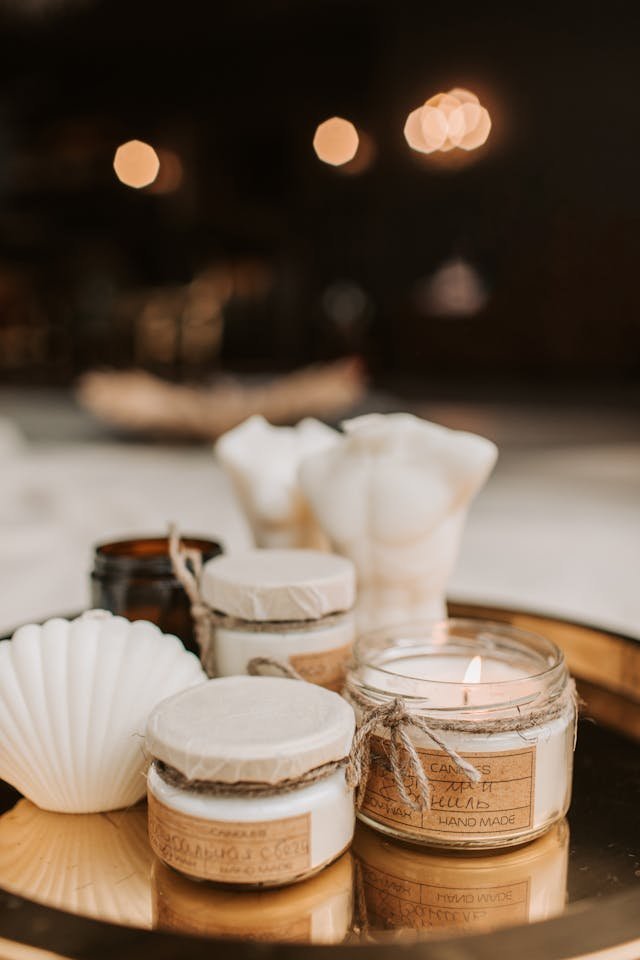
Glass container jars: Wide-mouth jars work better for soy candles because the larger surface area creates a bigger melt pool, which releases more scent. A 3-inch diameter jar throws more scent than a 2-inch one with the same wax and oil. Ball mason jars work perfectly and are inexpensive.
Wicks: Cotton wicks are standard for soy candles. Wick sizing depends on jar diameter—most wick suppliers (Candlescience, Aztec Candle) have sizing charts. For soy with essential oils specifically, some makers go one wick size up from the recommendation because essential oils produce slightly less scent throw and the larger wick generates a bigger melt pool.
Everything else:
- Kitchen scale (grams, not cups—essential oils especially need to be weighed)
- Pouring pitcher or pour pot
- Saucepan for double boiler setup
- Thermometer — a digital probe or infrared thermometer, not a candy thermometer
- Wick stickers or hot glue
- Wick bars or clothespins to center wicks
- Stir stick
Choosing Essential Oils for Candles: What Actually Works
This is where most soy + essential oil guides let you down. They list essential oils without telling you which ones actually perform in candles and which ones burn off in minutes.
Strong performers — essential oils with good heat stability:
- Cedarwood — one of the best for candles; woody, warm, holds well through burning
- Patchouli — heavy, earthy base note; excellent staying power in wax
- Vetiver — smoky, woody, fixes other scents and extends their throw
- Eucalyptus — holds reasonably well; one of the better light/fresh oils for candles
- Clove bud — spicy and strong; use sparingly, it dominates blends
- Cinnamon bark or leaf — similar to clove; strong and stable but can discolor wax
- Vanilla (oleoresin or CO2 extract) — holds well, but standard vanilla essential oil is often a synthetic anyway; look for vanilla CO2 or vanilla oleoresin for a true natural option
- Sandalwood — warm, creamy, holds reasonably well
- Frankincense — resinous, complex; good stability in candles
Weak performers — oils that fade fast in candles:
- Citrus oils (lemon, orange, grapefruit, bergamot) — high volatility; they smell great in the jar and during the first few minutes of burning, then disappear. If you want citrus, use it as a top note in a blend anchored by something heavier
- Lavender — mild throw in candles; fine in blends but weak on its own
- Peppermint — fades faster than expected; works better blended with something stable
- Most florals (rose, jasmine, ylang ylang) — true floral essential oils are expensive and often perform poorly in heat; most “floral” candles use synthetic fragrance for good reason
- Tea tree — medicinal and sharp cold, fades quickly when burning
The practical approach is to build blends with a strong base note (cedarwood, patchouli, vetiver), a mid note (eucalyptus, clove, sandalwood), and a top note (citrus, lavender, peppermint) knowing the top note will fade first. That’s normal—it’s how perfumery works. The candle will smell slightly different at different stages of the burn.
How Much Essential Oil to Use
Soy wax has a maximum fragrance load of around 10% by weight, but essential oils don’t perform at the same level as synthetic fragrance oils even at maximum load. Most experienced makers use 6–10% essential oil by weight for soy candles, leaning toward the higher end to compensate for the volatility.
The calculation: multiply your wax weight in grams by your chosen percentage.
- 200g wax × 0.08 (8%) = 16g essential oil
For blends, you can split this total between multiple oils. A common starting blend ratio is 50% base note / 30% mid note / 20% top note—but adjust based on your nose. Always mix your essential oil blend separately in a small bottle first so you know what you’re adding before it goes into the wax.
Step-by-Step: How to Make Soy Candles with Essential Oils
Step 1: Set up your workspace and weigh everything out before you start. Weigh your wax, weigh your essential oil blend, have your jars prepped with wicks secured and centered, and have your thermometer ready. Candle making moves fast once the wax is melted—you don’t want to be hunting for the essential oils while the wax cools past its addition window.
Warm your empty jars slightly—set them on a warm (not hot) surface or briefly run warm water over the outside and dry thoroughly. Cold jars cause the wax to pull away from the glass as it cools, leaving visible gaps around the edges.
Step 2: Melt the soy wax using a double boiler. Add your wax to the pour pot and place it in a saucepan with a few inches of water. Heat over medium, stirring occasionally, until the wax is fully melted. Soy wax melts around 120–130°F for most container waxes. Don’t rush it with high heat—scorched soy wax discolors and smells off.
Step 3: Monitor temperature carefully. For soy wax with essential oils, you want to add the oils at around 160–170°F—lower than you would for synthetic fragrance oils. Essential oils start to volatilize above 170°F, so adding them to wax that’s too hot wastes your scent before the candle is even made. Remove the pot from heat when the wax reaches about 175°F and let it cool to 160–170°F before adding essential oils.
Step 4: Add essential oils and stir thoroughly. Pour your pre-measured essential oil blend into the wax slowly and stir continuously for a full 2 minutes. This isn’t optional—thorough mixing is what distributes the oil evenly through the wax. Uneven mixing means some parts of the candle will have too much oil and others too little, which causes inconsistent throw and potential pooling.
Step 5: Add color if desired. If you’re coloring your candles, soy-specific liquid dye or dye chips work best. Add color after the essential oils. Natural colorants like mica powder can be used but some don’t mix evenly into wax. Avoid crayons—the pigment clogs wicks.
Step 6: Cool to pouring temperature and pour. Continue monitoring temperature. For most container soy waxes, the ideal pouring temperature is 130–145°F. Pouring too hot causes sinkholes and bubbles. Pouring too cool causes uneven surfaces and poor glass adhesion. Pour slowly and steadily down the side of the jar to minimize air bubbles.
Step 7: Leave them completely alone while cooling. Set the jars on a flat, level surface and don’t touch them. Don’t put them in the fridge to speed up cooling—rapid cooling causes cracking and sinkholes. Don’t move them to a cold room. Let them cool at room temperature for at least 24 hours before trimming the wick.
Soy wax often develops a rough or pitted surface on top as it cools—this is normal and doesn’t affect performance. Some makers do a small second pour to smooth the surface; heat a small amount of wax to about 10°F above pouring temperature and fill in any sinkholes or depressions.
Step 8: Cure for at least two weeks. With synthetic fragrance oils, curing for a week is often enough. With essential oils, two weeks minimum is the recommendation, and some oils—especially heavier base notes like patchouli and cedarwood—continue improving up to four weeks. Put the lids on and store in a cool, dark place during curing. The lid traps scent and slows evaporation.
Burning a soy + essential oil candle before it’s cured is the fastest way to be disappointed and conclude the recipe doesn’t work. It probably just needs more time.
You’re Probably Doing This Wrong: The Curing Mistake
Most people make a batch, wait a day or two, burn one to test it, smell almost nothing, and either add more essential oil or give up. The candle wasn’t ready. Essential oils need time to fully bind into the soy wax matrix, and this process continues well past when the candle looks finished.
If you’ve made a batch you’re not sure about, put the lids on, leave them for two full weeks, and test again. The difference in scent throw is often significant enough that you’ll feel like you made a completely different candle.
Blends That Work Well in Soy Candles
A few starting-point blends, all using heat-stable oils:
Woodsy + warm: 50% cedarwood, 30% sandalwood, 20% clove bud. Strong, masculine, holds well through burning.
Spa/eucalyptus: 50% eucalyptus, 30% cedarwood, 20% peppermint. The peppermint fades but the eucalyptus and cedar carry it through the full burn.
Earthy + grounding: 40% patchouli, 40% vetiver, 20% frankincense. Heavy and long-lasting. Not for everyone but excellent throw.
Warm citrus (accepts fading): 40% cedarwood, 30% orange, 20% clove, 10% cinnamon. The citrus top note fades within the first 30 minutes but the spice and wood base carry the rest of the burn.
Holiday spice: 40% cinnamon bark, 30% clove bud, 20% cedarwood, 10% orange. Strong—use at the lower end of your fragrance load. Cinnamon and clove can discolor wax slightly.
Troubleshooting Weak Scent Throw
The candle smells great cold but weak when burning: Usually a wick sizing issue. The wick is too small, creating a small melt pool that doesn’t release fragrance efficiently. Try the next wick size up and burn for at least 3–4 hours to get a full melt pool reading.
The candle barely smells cold or hot: Check cure time first—if it’s under two weeks, wait. If it’s fully cured, you may be under-fragranced. Recalculate your essential oil weight and make sure you’re actually hitting 8–10%.
Strong cold throw but scent disappears within minutes of burning: The essential oils are too volatile. Swap to heavier base notes or add cedarwood/vetiver as a fixative to anchor the blend.
Scent is there at first but gone halfway through the candle: The top layers of wax often have slightly more fragrance than the bottom (settling during cooling). Better stirring during the pour and making sure fragrance is evenly distributed helps. Also check that your wick isn’t too large—an oversized wick burns through wax so fast the fragrance doesn’t have time to release gradually.
FAQ
Can I use any essential oil in soy candles? You can use any skin-safe essential oil, but not all perform equally. High-volatility oils like citrus and lavender fade fast. Heavier oils like cedarwood, patchouli, and vetiver last much longer. Building blends with at least one heavy base note extends the overall throw significantly.
Why does my soy candle look bumpy or rough on top? This is called frosting and it’s natural to soy wax—it’s actually a sign of natural, unprocessed soy. It doesn’t affect burn quality or scent throw. If it bothers you aesthetically, pour at a slightly higher temperature, or do a second pour to smooth the surface.
Is it safe to burn essential oil candles indoors? Yes, when made and burned correctly. Keep wicks trimmed to ¼ inch before each burn, don’t burn for more than 4 hours at a time, and keep out of drafts. Some essential oils like cinnamon and clove can produce more soot than lighter oils—trim the wick if you see black smoke.
Why does my candle have white spots on the sides of the jar? This is called wet spots—areas where the wax has pulled away from the glass. It’s caused by the wax contracting unevenly during cooling and is purely cosmetic. Pouring at a slightly lower temperature and warming the jars before pouring reduces it.
Can I mix essential oils with fragrance oils in the same candle? Yes, and it can actually improve throw. The fragrance oil provides a stable base while the essential oil contributes a natural scent. Many small-batch candle makers use a 50/50 or 70/30 fragrance-to-essential oil split to balance throw strength with natural ingredients.
Wrapping Up
Soy candles with essential oils will never throw scent as aggressively as a paraffin candle loaded with synthetic fragrance—that’s just chemistry. But they can smell genuinely good if you pick the right oils, use enough of them, add them at the right temperature, and wait for the candle to cure fully before judging the result. Most failed batches weren’t bad candles. They were just burned too soon.
Enjoyed this project? Get even more DIY ideas that save (and make) you money.
Join our free newsletter for profitable DIY projects, clever cleaning hacks, home ideas, and creative crafts delivered straight to your inbox.
✓ Free forever • No spam • Unsubscribe anytime