Orchids have a reputation for being difficult, temperamental plants that only thrive in the hands of experienced gardeners. That reputation is mostly undeserved — but it does contain a grain of truth. Orchids are not like most houseplants. They don’t follow the same rules about watering, potting, and light that work for a pothos or a peace lily. When something goes wrong, they don’t dramatically wilt or yellow overnight. They quietly decline, and by the time most people notice, the damage has been building for weeks.
The good news is that orchids are remarkably resilient. A plant that looks completely dead — bare stem, shriveled leaves, soggy or bone-dry roots — can often be brought back with the right intervention. The key is identifying what went wrong before you start treating it, because an overwatered orchid and an underwatered orchid can look almost identical on the surface, yet require completely opposite responses.
Here’s the Real Reason Your Orchid Is Struggling
Most orchid problems trace back to one of four causes: too much water, too little light, the wrong potting medium, or a pot that doesn’t allow for proper drainage and airflow. Orchids in their natural habitat grow anchored to tree bark in tropical forests, where their roots are exposed to bright filtered light, regular rainfall, and fast-drying conditions. When we pot them in dense soil, place them in dim corners, and water them on a rigid schedule, we’re working directly against their biology.
Understanding this is the foundation of every successful orchid revival. You’re not just treating symptoms — you’re recreating the conditions the plant is designed to thrive in.
Don’t Ignore These Early Warning Signs
Orchids give subtle signals long before they reach a crisis point. Catching these early makes the recovery process far simpler.
Yellowing leaves can indicate overwatering, too much direct sunlight, or natural aging of the lower leaves. Context matters — if only the lowest, oldest leaf is yellowing, that’s normal. If multiple leaves are yellowing from the center outward, that points to root rot.
Wrinkled or leathery leaves almost always signal dehydration. The leaves lose their turgidity when the roots can no longer supply adequate moisture — either because they are too dry, or paradoxically, because root rot has destroyed their ability to absorb water even when it’s present.
Brown, mushy roots are the clearest sign of overwatering and root rot. Healthy orchid roots are firm and green or silver-white. If you squeeze a root and it collapses or feels hollow, it is dead and needs to be removed.
No blooms for over a year usually points to insufficient light or a lack of the temperature differential that triggers blooming. This is less of an emergency and more of an environmental adjustment.
A loose, wobbly plant in its pot suggests the root system has been significantly compromised. If the orchid moves freely when you touch it, it has likely lost most of its functional roots.
What You’ll Need
Before you begin the revival process, gather your supplies so you can work efficiently without interrupting the process midway.
For Assessment and Repotting:
- Transparent plastic orchid pot with drainage holes (allows you to monitor root health without disturbing the plant)
- Fresh orchid bark or a specific orchid potting mix (never regular potting soil)
- Sterilized scissors or pruning shears
- Rubbing alcohol or a flame to sterilize your cutting tools between cuts
- Cinnamon powder (a natural antifungal that seals cut root ends beautifully)
For Watering and Recovery:
- A clean bowl or basin for soaking
- Filtered or rainwater at room temperature (tap water with high fluoride or chlorine content can stress orchid roots over time)
- A balanced, water-soluble orchid fertilizer (look for a 20-20-20 or a bloom-boosting formula)
- Hydrogen peroxide diluted to 3% (for treating root rot)
For Environment:
- A spot near an east or west-facing window
- A humidity tray or small pebble tray filled with water
- A sheer curtain if your only available window faces south and receives intense direct sun
You’re Probably Doing This Wrong: The Watering Mistake Almost Everyone Makes
The single most damaging habit in orchid care is watering on a fixed schedule. “Water once a week” is advice repeated so often that it has become accepted wisdom — but it is fundamentally wrong for orchids, because the actual watering frequency depends entirely on your environment: the temperature, humidity, pot size, potting medium, and season all affect how quickly an orchid’s roots dry out.
The correct method is to water based on what you observe, not what the calendar says. Before watering, lift the pot — a pot that feels light is dry and ready for water. A pot that still feels heavy has retained moisture and doesn’t need more yet. Alternatively, push a wooden chopstick an inch into the bark — if it comes out damp, wait. If it comes out dry, it’s time to water.
When you do water, do it thoroughly. Take the pot to the sink and run room-temperature water through it for 30–40 seconds, ensuring it flows freely out of the drainage holes. Then let it drain completely before returning it to its spot. Never let an orchid sit in standing water.
Step by Step: How to Revive an Orchid
Work through these steps methodically. Resist the urge to do everything at once — assess first, then act.
- Step 1 — Remove the orchid from its pot and assess the roots. Gently slide the plant out of its container and shake away the old potting medium. Take a close look at every root. Healthy roots are firm, plump, and either bright green (if recently watered) or silver-white (if dry). Dead roots are brown, hollow, mushy, or completely desiccated and stringy. Don’t be alarmed if there are many dead roots — orchids can recover from significant root loss as long as some healthy roots remain.
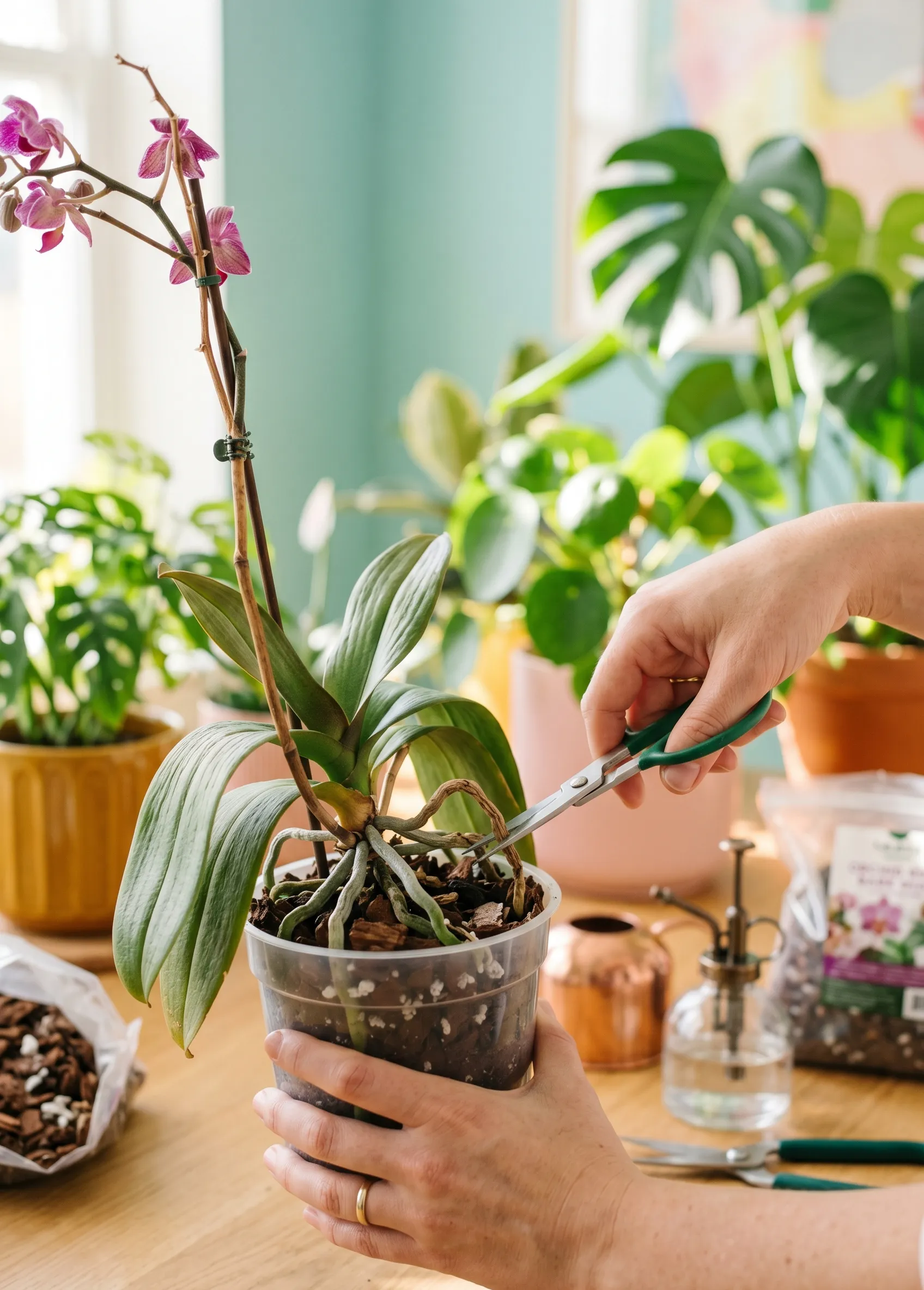
- Step 2 — Remove all dead and damaged roots. Using your sterilized scissors, cut away every root that is brown, mushy, hollow, or completely dried out. Cut cleanly at the base of the dead section, getting back to firm, healthy tissue. After each cut, dust the wound with a light sprinkle of cinnamon powder to prevent fungal infection from taking hold in the open tissue. If you’re dealing with root rot, dip the remaining healthy roots briefly in a diluted 3% hydrogen peroxide solution before repotting.
- Step 3 — Trim any dead or severely damaged leaves and stems. If any leaves are fully brown, papery, or mushy, remove them cleanly at the base. For the flower spike (the stem that held the blooms), cut it back to just above a node — the small triangular bumps along the stem — if the spike is still green. If the spike is completely brown and dried, cut it all the way back to the base. A green spike may rebloom from a node; a dead spike will not.
- Step 4 — Let the roots air dry for 30–60 minutes. After trimming, allow the roots to dry slightly before repotting. This reduces the risk of bacterial or fungal issues taking hold in the fresh cuts. Use this time to rinse your new pot and prepare your fresh orchid bark.
- Step 5 — Repot into fresh orchid bark in a clean, transparent pot. Place a small amount of fresh orchid bark in the bottom of the pot, then position the orchid so the base of the leaves sits just at or slightly above the rim. Fill in around the roots with more bark, pressing gently but not packing it tightly — airflow through the potting medium is essential. Transparent pots are strongly recommended because they allow you to see the root color and assess moisture levels without disturbing the plant.
- Step 6 — Water lightly and place in the right location. Give the orchid a gentle, thorough watering immediately after repotting, then allow it to drain fully. Place it in a spot with bright, indirect light — an east or west-facing windowsill is ideal. Avoid south-facing windows with intense direct midday sun, which can scorch the leaves. Avoid dark corners, which will prevent any chance of reblooming.
- Step 7 — Begin a gentle fertilizing routine after two weeks. Give the plant two weeks to recover from the shock of repotting before introducing fertilizer. After that, feed it with a diluted orchid fertilizer (at half the recommended strength) every two weeks during the growing season. The common orchid grower’s rule is “weakly, weekly” — a dilute feed applied frequently is far gentler and more effective than occasional heavy doses.
- Step 8 — Be patient and monitor without interfering. This is genuinely the hardest step. After repotting, an orchid may look completely still for weeks or even months. It is directing its energy underground, rebuilding its root system before putting out new growth above the surface. Resist the urge to repot again, move it repeatedly, or over-fertilize to “speed things up.” Consistent conditions and patient observation are what ultimately bring an orchid back.
How to Get an Orchid to Rebloom
Reviving an orchid’s health and getting it to rebloom are two related but distinct goals. Once your orchid has healthy roots, firm leaves, and is growing actively again, you can begin encouraging it toward a new flower spike.
The trigger for blooming in most common orchid varieties — particularly Phalaenopsis, the moth orchid most people grow indoors — is a drop in nighttime temperature. Moving the orchid to a slightly cooler location at night (around 55–60°F or 13–16°C) for four to six weeks in autumn signals to the plant that it is time to initiate a flower spike. Many growers achieve this simply by moving the orchid near a window where nighttime temperatures are naturally cooler.
Once a new spike appears — a small, green, pointed growth emerging from the base of the leaves — move the orchid back to its regular warm spot and resume your regular care routine. Do not move the plant once the spike is developing, as orchids orient their spikes toward the light source and repositioning can cause the spike to grow at an awkward angle or abort entirely.
Quick Fixes for Common Orchid Problems
| Problem | Potential Solution | Alternative Suggestion |
|---|---|---|
| Yellowing leaves across the whole plant | Check roots for rot — remove all brown, mushy roots and repot in fresh bark | Move away from direct sun, which can cause yellowing from heat stress |
| Wrinkled, leathery leaves despite regular watering | Root rot may be preventing water uptake — assess and trim roots | Soak the pot in room-temperature water for 30 minutes to rehydrate stressed roots |
| No new blooms after more than a year | Introduce a 10-degree nighttime temperature drop for 4–6 weeks in autumn | Move to a brighter location — insufficient light is the second most common reason for bloom failure |
| Roots growing out of the pot and over the sides | This is healthy and normal — aerial roots are how orchids absorb humidity | Only repot if the potting medium has broken down, not because of aerial roots alone |
| White cottony spots on leaves or roots | Treat for mealybugs with a cotton swab dipped in rubbing alcohol | Apply neem oil solution weekly until the infestation clears |
| Brown leaf tips | Usually caused by fluoride in tap water or low humidity — switch to filtered or rainwater | Place the pot on a pebble tray filled with water to increase ambient humidity |
| Plant collapses and wobbles in the pot | Major root loss — unpot, remove all dead roots, and repot with careful staking | Place a thin bamboo stake alongside the stem and secure loosely with a soft tie |
Stop Doing This: Habits That Slowly Kill Orchids
Potting orchids in regular houseplant soil. Standard potting soil holds too much moisture and doesn’t allow for the airflow that orchid roots need. It suffocates the roots and leads almost inevitably to rot. Always use bark-based orchid mix or a specialist orchid medium.
Placing orchids in full direct sunlight. Orchids in their natural habitat grow under the canopy of trees and receive bright, dappled, filtered light — not harsh, direct sun. A south-facing windowsill with no sheer curtain in summer can scorch the leaves within days.
Using ice cubes to water. This widely circulated tip causes genuine harm. Orchids are tropical plants — cold water stresses the roots and can cause cold damage. Always use room-temperature water.
Cutting the flower spike all the way back immediately after blooming. If the spike is still green after the flowers drop, leave it. It may produce a secondary bloom from one of the nodes. Only remove the spike once it has turned fully brown and dried.
Misting the leaves and crown. Water sitting in the crown — the center where the leaves meet — can cause crown rot, which is one of the fastest ways to lose an orchid. If you want to increase humidity, use a pebble tray instead.
FAQ
Can a completely leafless orchid be saved? Sometimes, yes — if the roots are still alive. An orchid without leaves can still produce new growth from a healthy root system, though recovery takes many months. Keep the roots moist with regular light watering and provide bright indirect light.
How long does it take for an orchid to recover? Root recovery and new leaf growth typically take two to six months depending on how severely the plant was stressed. Reblooming after a full recovery can take an additional six to twelve months. Orchids operate on their own timeline and cannot be rushed.
Should I fertilize a sick orchid? No — not immediately. Fertilizer applied to a stressed plant with compromised roots can cause chemical burn and worsen the damage. Wait until the plant shows clear signs of new, healthy root or leaf growth before beginning a gentle fertilizing routine.
Why do my orchid’s aerial roots look silver and shriveled? Silver aerial roots are simply dry — they turn bright green immediately upon contact with water. This is normal and healthy. Shriveled aerial roots that remain wrinkled even after watering may indicate chronic dehydration or root problems below the surface worth investigating.
Conclusion
Reviving an orchid is less about doing the right dramatic thing and more about stopping the wrong everyday habits. Most struggling orchids are victims of too much water, too little light, or the wrong growing medium — problems that are entirely fixable once you understand what the plant actually needs. Unpot it, assess the roots honestly, remove what’s dead, give it fresh bark and the right light, and then — most importantly — leave it alone to recover. Orchids reward patience and consistency above all else. The day you see a new root tip or a fresh leaf pushing through is one of the most satisfying moments in houseplant gardening, and it’s completely within reach.
Enjoyed this project? Get even more DIY ideas that save (and make) you money.
Join our free newsletter for profitable DIY projects, clever cleaning hacks, home ideas, and creative crafts delivered straight to your inbox.
✓ Free forever • No spam • Unsubscribe anytime