Looking for a fun, hands-on science activity that feels like magic?
This lava lamp science experiment is colorful, exciting, and secretly packed with real science concepts like density, chemical reactions, and gas formation.
Best part? You probably already have everything at home.
Watch this video to see how to recreate the lava lamp science experiment:
What Kids Will Learn
This experiment teaches:
- Density (why oil and water don’t mix)
- Chemical reactions
- Gas formation
- Buoyancy
- Observation skills
It’s perfect for elementary and middle school learners.
Supplies You’ll Need
- Clear bottle or tall glass
- Vegetable oil
- Water
- Food coloring
- Alka-Seltzer tablets (or any effervescent tablets)
- Flashlight (optional, for glow effect)
Optional:
- Glitter for extra sparkle
Step-by-Step Instructions
Step 1: Fill the Bottle with Oil
Fill your bottle about ¾ full with vegetable oil.
Step 2: Add Water
Slowly pour water into the bottle until it’s nearly full.
Wait and watch — you’ll see the water sink below the oil.
Why? We’ll explain in a minute.
Step 3: Add Food Coloring
Add 8–10 drops of food coloring.
Notice how the coloring passes through the oil and mixes only with the water layer.
That’s another science clue!
Step 4: Drop in the Tablet
Break an Alka-Seltzer tablet into smaller pieces.
Drop one piece into the bottle.
Stand back and watch the lava effect begin!
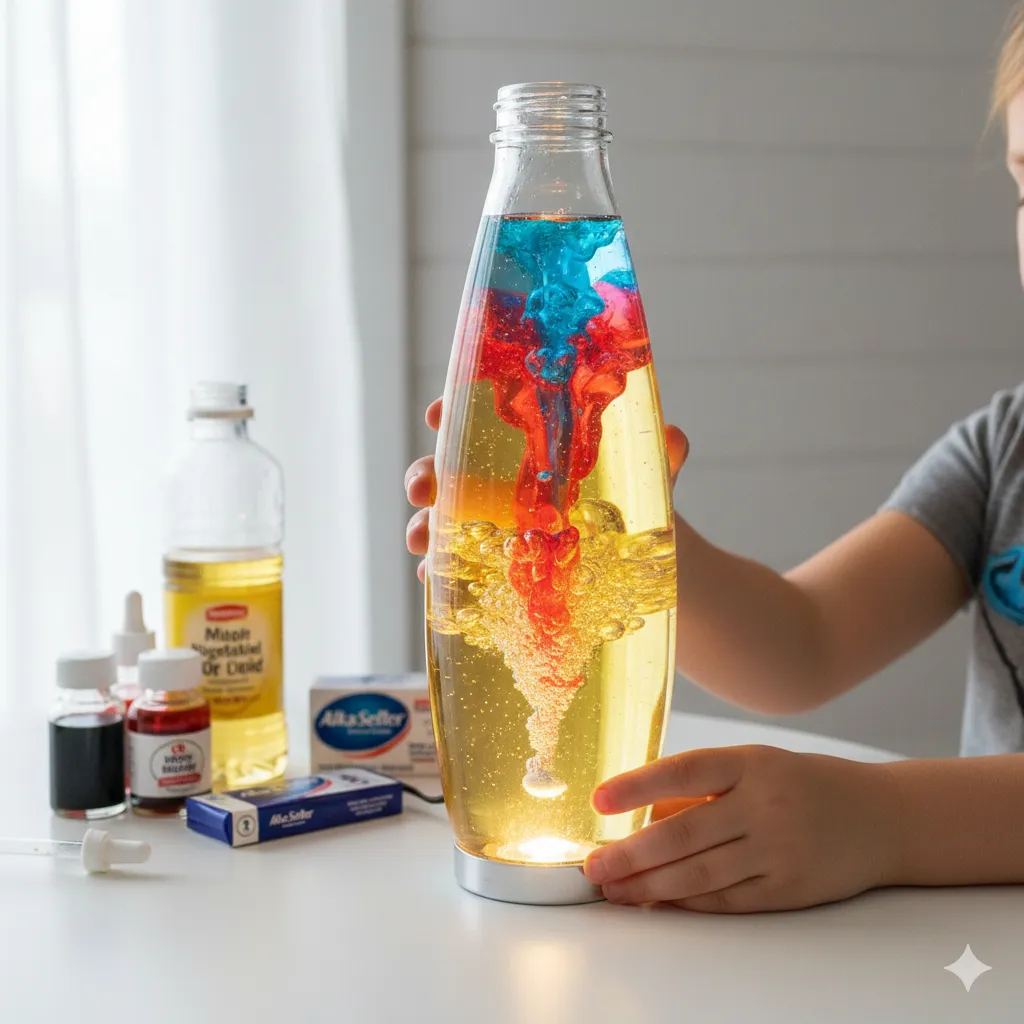
Colorful bubbles will rise and fall like a real lava lamp.
Step 5: Add Light (Optional)
Shine a flashlight under the bottle in a dark room for a glowing lava lamp effect.
The Science Behind the Lava Lamp
Here’s what’s really happening:
1. Oil and Water Don’t Mix
Oil is less dense than water, so it floats on top.
Water sinks to the bottom because it’s heavier.
2. Food Coloring Mixes with Water
Food coloring is water-based, so it passes through the oil and dissolves in the water layer.
3. The Chemical Reaction
When the tablet hits the water, it reacts and produces carbon dioxide gas.
Those gas bubbles attach to the colored water and carry it upward.
When the bubbles pop at the top, the colored water sinks back down.
This creates the lava effect!
Why It Looks Like a Real Lava Lamp
Real lava lamps (like the ones made famous in the 1960s) use heat to move wax blobs up and down.
This experiment mimics that movement using gas bubbles instead of heat.
Safety Tips
- Adult supervision recommended for younger kids
- Do not drink the mixture
- Keep the lid off while reacting (pressure can build)
- Clean up spills immediately
How to Make It Last Longer
- Add another piece of tablet when the bubbling stops
- Don’t use too much water — oil should remain dominant
- Use a clear container for best visibility
Quick Fixes for Common Problems
| Problem | Quick Solution | Pro Tip |
|---|---|---|
| No bubbling | Make sure tablet touches the water layer | Break tablet into smaller pieces |
| Weak lava effect | Use more food coloring and fresh tablet | Old tablets lose fizz strength |
| Oil and water look cloudy | Use clean container and fresh oil | Avoid shaking too hard |
| Coloring stuck in oil | Gently tap bottle to help it sink | Use liquid food coloring, not gel |
| Reaction stops quickly | Add another tablet piece | Smaller pieces create longer effects |
| Too much foam | Use smaller tablet portion | One small chunk works best |
Fun Variations to Try
- Use different food coloring colors
- Try glitter for sparkle
- Use tonic water and a blacklight for glow
- Compare different oils (olive vs vegetable)
Turn it into a mini science investigation!
Questions to Ask Kids During the Experiment
- Why does the oil stay on top?
- What do you think the bubbles are made of?
- Why does the colored water rise and fall?
- What would happen if we shook it?
Encourage predictions before testing.
Frequently Asked Questions
Can you reuse the lava lamp?
Yes. Just add more tablet pieces to restart the reaction.
Can I seal the bottle?
Do not seal it while reacting. Gas buildup can cause pressure.
Can we use baking soda and vinegar instead?
That creates a reaction too, but it’s harder to control inside oil.
Final Thoughts
The lava lamp science experiment is one of the easiest and most exciting ways to introduce real scientific concepts to kids.
It looks magical — but it’s powered by chemistry and physics.
Fun + colorful + educational = the perfect hands-on science activity.
Try it today and watch science come to life!