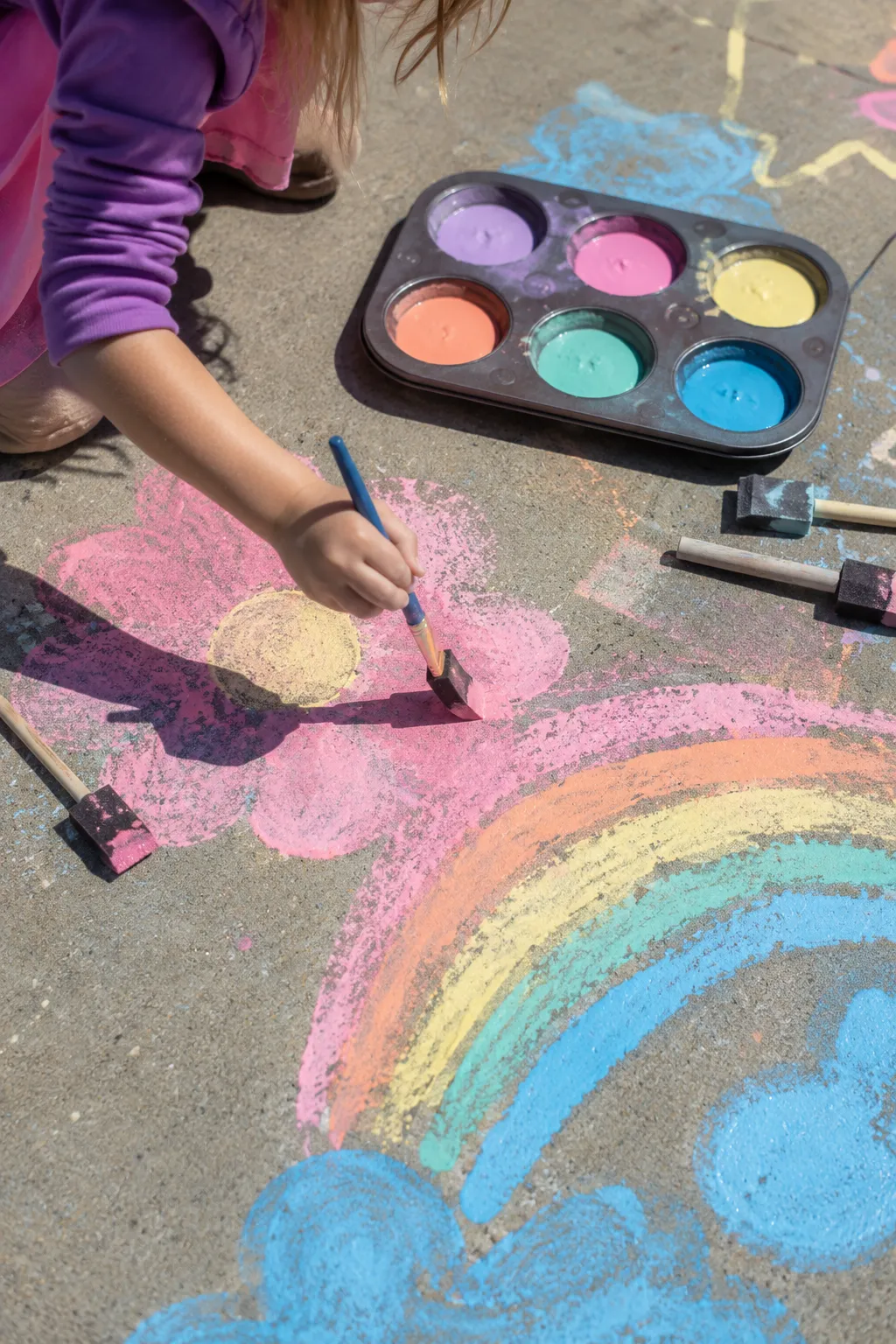
Sidewalk chalk is great. Sidewalk chalk paint is better. It goes on smoother, covers more ground, dries with a matte chalky finish, and the colors come out significantly more vibrant than anything you get from dragging a stick across concrete. Kids who barely glance at a box of regular chalk will spend an entire afternoon with a brush and a muffin tin full of this stuff.
The recipes are all simple—most use cornstarch or flour, water, and whatever food coloring you have. But each version has a slightly different texture, consistency, and finish, so it’s worth knowing which one suits your situation before you mix up a batch.
Here are five ways to make it, from the classic two-ingredient version to a few that add extra creaminess, staying power, or a foamy twist that kids go absolutely wild for.
What Is Sidewalk Chalk Paint?
It’s exactly what it sounds like: a paintable version of sidewalk chalk that you apply with a brush instead of drawing with a stick. When it dries on concrete or pavement, it leaves a matte, chalky finish that looks like colored chalk and washes off just as easily with rain or a garden hose.
It’s not the same as regular exterior paint—it has no staying power, which is entirely the point. Kids can cover the driveway in color, you hose it down, and the next day it’s a blank canvas again. That cycle of making and erasing is part of what makes it so compelling for repeated play.
It works best on concrete and asphalt. It doesn’t adhere well to wood, plastic, or brick, and it won’t show up on dark surfaces. A light-colored, slightly rough concrete driveway or sidewalk is the ideal canvas.
What You’ll Need Across Most Recipes
Before you start, gather these basics. Most recipes share the same core supply list:
- Cornstarch or flour – the base for most versions
- Water – warm water dissolves and mixes faster
- Food coloring or liquid watercolors – gel food coloring gives the most vibrant results
- Muffin tin or small cups – perfect for making multiple colors at once
- Foam brushes or cheap paintbrushes – foam brushes give the smoothest coverage
- Spoon or small whisk – for mixing without lumps
Optional but useful: a squeeze bottle for kids who want more control over where the paint goes, and a tray to carry everything outside without spills.
Recipe 1: Classic 2-Ingredient Sidewalk Chalk Paint (Cornstarch + Water)
This is the baseline recipe—the one most people start with and often stick to because it genuinely works. Equal parts cornstarch and water, plus food coloring.
To make it: Combine ¼ cup cornstarch with ¼ cup warm water and stir until fully smooth with no lumps. Add 15–20 drops of food coloring and mix again. Pour into a muffin tin section and repeat for as many colors as you want.
The consistency should be like thick cream—pourable but not watery. If it feels too thin, add a little more cornstarch. If it’s too thick to brush smoothly, add a splash more water.
This version dries fairly quickly, gives a clean chalky finish, and the colors are bright without being overwhelming. It’s also the easiest to scale up if you’re making a large batch for a party or group activity.
Recipe 2: Flour-Based Sidewalk Chalk Paint
If you’re out of cornstarch, all-purpose flour works as a substitute and produces a slightly thicker, creamier paint. The finish is a bit more opaque than the cornstarch version, which some kids prefer because the color looks bolder while wet.
To make it: Mix ½ cup flour with ½ cup warm water and whisk until smooth. Flour tends to clump more than cornstarch, so take an extra minute here to get it fully lump-free. Add food coloring, mix, and divide into colors.
One thing to know: flour-based paint takes a little longer to dry than cornstarch-based, and it can flake slightly as it dries on a hot day. It still washes off cleanly, but the texture while playing is slightly different—a bit more like tempera paint than chalk. Great option when cornstarch isn’t available.
Recipe 3: Creamy Sidewalk Chalk Paint with Dish Soap
Adding a small amount of dish soap to the basic cornstarch recipe changes the texture in a way kids really notice—it becomes smoother, slightly glossy while wet, and easier to spread in large strokes. It also makes cleanup even faster since the soap is already in the paint.
To make it: Combine ¼ cup cornstarch, ¼ cup water, and 1 tablespoon of dish soap. Stir until fully combined, then add food coloring. The soap will make it slightly foamy as you stir—that’s normal and settles down once it sits for a minute.
This version is especially good for younger kids or toddlers who are still developing brush control, because it glides more easily and forgives a heavy hand. It also tends to produce slightly brighter dried color than the plain cornstarch version.
Recipe 4: Foamy Sidewalk Chalk Paint (with Shaving Cream)
This one has a completely different personality from the others. It’s thick, puffy, and almost 3D when first applied—kids describe it as painting with clouds. As it dries, the foam collapses and leaves a soft, matte chalk finish on the pavement.
To make it: Mix equal parts cornstarch and shaving cream—start with ¼ cup of each—and stir together until combined. Add food coloring and mix gently. The texture will be light and airy, almost like whipped cream.
Because of the foam, this version doesn’t spread as far and works better for textured or detailed painting rather than covering large areas. It’s best used on a calm day—wind can literally blow it off the brush. Kids love the sensory experience of handling it as much as painting with it, so set expectations that this one is as much about process as product.
Recipe 5: Sidewalk Chalk Paint with Tempera Paint
If you want the most vibrant, saturated colors possible and you happen to have tempera paint on hand, this version delivers the best results by far. The tempera adds pigment depth that food coloring alone can’t match.
To make it: Combine ¼ cup cornstarch, ¼ cup water, and 2 tablespoons of tempera paint in your chosen color. Stir until smooth. Because tempera is already colored, you don’t need food coloring—just adjust the amount of tempera to make the color darker or lighter.
This version dries the most vividly of all five recipes and shows up best on older, weathered concrete that tends to absorb color quickly. It still washes off with water, though it may take slightly more rinsing than the food-coloring versions. Worth it for the color payoff.
Quick Fixes for Common Problems
| Problem | Most Likely Fix | Alternative Approach |
|---|---|---|
| Paint is too watery and spreads without color | Add more cornstarch or flour a teaspoon at a time | Use gel food coloring instead of liquid for stronger pigment |
| Paint dries too fast before kids finish | Work in a shaded area and cover unused portions with plastic wrap | Add a few extra drops of water to thin it slightly and slow drying |
| Colors look dull or washed out when dry | Switch to gel food coloring or liquid watercolors for stronger pigment | Try the tempera paint version for maximum color saturation |
| Paint won’t wash off the pavement | Scrub with a stiff brush and water—it will come off | Avoid letting it sit for multiple days in direct sun before rinsing |
| Lumpy texture that won’t smooth out | Mix cornstarch with warm water first before adding color | Use a small whisk instead of a spoon for lump-free results |
| Kids going through paint too fast | Double the batch from the start | Give each child a defined “canvas” area to slow consumption |
How to Get the Best Results
Use foam brushes over regular paintbrushes. Foam brushes hold more paint, cover more ground, and are much easier for small hands to control. They’re also cheap enough that you don’t have to stress about them getting ruined.
Make more colors than you think you need. Each muffin tin section goes faster than you expect, especially once kids start mixing colors together. A batch of 6–8 colors lasts much longer than a batch of 3.
Add glitter to any recipe for a version that sparkles in the sun while wet. It settles into the pavement as it dries and still washes off cleanly—just gives the finished artwork an extra dimension.
Work early morning or late afternoon on hot days. Midday heat dries the paint almost as fast as kids can apply it, which frustrates younger painters. Cooler temperatures give the paint more working time on the pavement.
Fun Ways to Use Sidewalk Chalk Paint
The paint itself is the activity for most kids, but a few simple prompts can take it further and extend the play session considerably.
Set up a life-size body tracing station where kids lie down on the pavement, you trace their outline, and they fill themselves in with chalk paint. This one routinely lasts 45 minutes or more.
Create a numbered hopscotch grid and let kids paint each square a different color before playing. They made it, so they’re significantly more invested in using it.
Use squeeze bottles instead of brushes for driveway murals—older kids especially love the precision and control. Recycled condiment bottles work perfectly.
Set out leaves, stencils, or cookie cutters as templates for younger kids who want to make shapes without the pressure of drawing freehand.
FAQ
Does sidewalk chalk paint stain concrete permanently? No—it washes off with water just like regular sidewalk chalk. A garden hose handles most of it, and any remaining residue disappears with the next rain. The tempera paint version may need a light scrub, but it still comes off cleanly.
Can I make sidewalk chalk paint without cornstarch? Yes, the flour-based recipe (Recipe 2) works well as a substitute. The texture is slightly different—thicker and more opaque—but it performs similarly and washes off just as easily.
How long does sidewalk chalk paint last once mixed? Oil-free versions like these don’t store particularly well. The cornstarch settles to the bottom within a few hours and needs to be restirred. It’s best made fresh on the day you plan to use it, but you can refrigerate leftovers for up to 24 hours if tightly covered.
What age is this appropriate for? Any age that can hold a brush. Toddlers as young as 18 months enjoy it with supervision. The foamy shaving cream version is especially popular with sensory-seeking toddlers. Older kids (5 and up) tend to gravitate toward the tempera version for its stronger colors and more “serious” finish.
Is it safe if kids get it in their mouths? The cornstarch-and-water base is non-toxic, but food coloring and dish soap aren’t meant to be eaten. For babies and toddlers who mouth everything, stick to the plain cornstarch-and-water base with natural food coloring and skip the dish soap version.
Conclusion
Any of these five recipes will give you a batch of chalk paint that keeps kids genuinely busy for the better part of an afternoon. Start with the classic cornstarch version if you want foolproof and simple, move to the tempera version if color is your priority, and pull out the shaving cream recipe when you want a sensory experience as much as a painting one. Make more than you think you need, grab a pack of foam brushes, and hand over the driveway—it all washes off.
Enjoyed this project? Get even more DIY ideas that save (and make) you money.
Join our free newsletter for profitable DIY projects, clever cleaning hacks, home ideas, and creative crafts delivered straight to your inbox.
✓ Free forever • No spam • Unsubscribe anytime