You’re getting ready for a big day—an interview, a wedding, a first date—and you pull your favorite shirt out of the wardrobe only to find it looks like it spent the last three weeks crumpled at the bottom of a suitcase. You reach for the iron, then realize with a sinking feeling that there’s no ironing board in sight. Maybe you’re staying at a hotel, living in a small apartment with nowhere to store one, visiting family, or you simply never owned one to begin with.
Here’s the thing most people don’t know: an ironing board is a convenience, not a necessity. People have been pressing clothes smooth for centuries, long before the ironing board was even invented. With the right surface, the right technique, and a few precautions, you can get results that are just as good—sometimes better—without one.
This guide covers every reliable method for ironing without an ironing board, from improvised flat surfaces to completely iron-free techniques that remove wrinkles without any heat tool at all.
Here’s the Real Reason an Ironing Board Isn’t Actually Essential
Understanding what an ironing board actually does helps you replace it intelligently. A standard ironing board serves three functions: it provides a flat, stable surface; it has a heat-resistant padded cover that protects the garment and the surface below; and its narrow tapered shape helps you maneuver around collars, sleeves, and shoulders.
Every one of those functions can be replicated with common household items. A firm, flat surface substitutes for stability. A folded towel or blanket substitutes for the heat-resistant padding. And careful maneuvering with the iron—moving the garment rather than the board—handles the shaping. Once you know what you’re actually replacing, the whole process becomes straightforward.
What You’ll Need
- A clothes iron (or a hair straightener, steamer, or kettle—see the iron-free methods below)
- A thick towel or two (clean, dry, and large enough to lay the garment flat)
- A flat, heat-tolerant surface (options detailed below)
- A spray bottle filled with water or a damp cloth (for dampening stubborn wrinkles)
- Optional: A pressing cloth (a thin cotton tea towel works perfectly) to protect delicate fabrics
Stop Doing This Before It’s Too Late: Mistakes That Damage Clothes and Surfaces
Before diving into the methods, a few important warnings that apply any time you’re ironing on an improvised surface:
Never iron directly on a wooden surface without padding. Even a heat-resistant iron left briefly on bare wood can scorch, stain, or warp the finish. Always place a thick protective layer between the iron and any surface.
Don’t use a surface that has a textured or embossed cover. Ironing on a textured tablecloth, a patterned blanket, or a rough towel can transfer that texture onto the fabric of your garment—especially on silks, satins, and synthetic fabrics.
Never leave the iron face-down on any surface, even briefly. Always stand the iron upright or rest it on its heel between passes. A hot iron left flat for even fifteen seconds can scorch fabric, melt synthetic fibers, and damage whatever surface it’s sitting on.
Don’t iron damp garments on surfaces that can’t tolerate moisture. Steam and moisture released by the iron can damage certain surfaces—particularly wooden desks, laminate furniture, and hardwood floors. Use a towel as a buffer and check the surface after each ironing session.
Check your iron’s heat setting before you touch it to the garment. Without an ironing board’s height giving you a moment to pause and assess, it’s easy to rush and apply too much heat to the wrong fabric. Always check the care label first and start with a lower heat setting than you think you need.
Method 1: A Flat Surface With a Thick Towel (The Best All-Around Alternative)
This is the most reliable general-purpose method and works in almost any situation. It mimics the function of an ironing board most closely and works on virtually any garment.
Best surfaces to use:
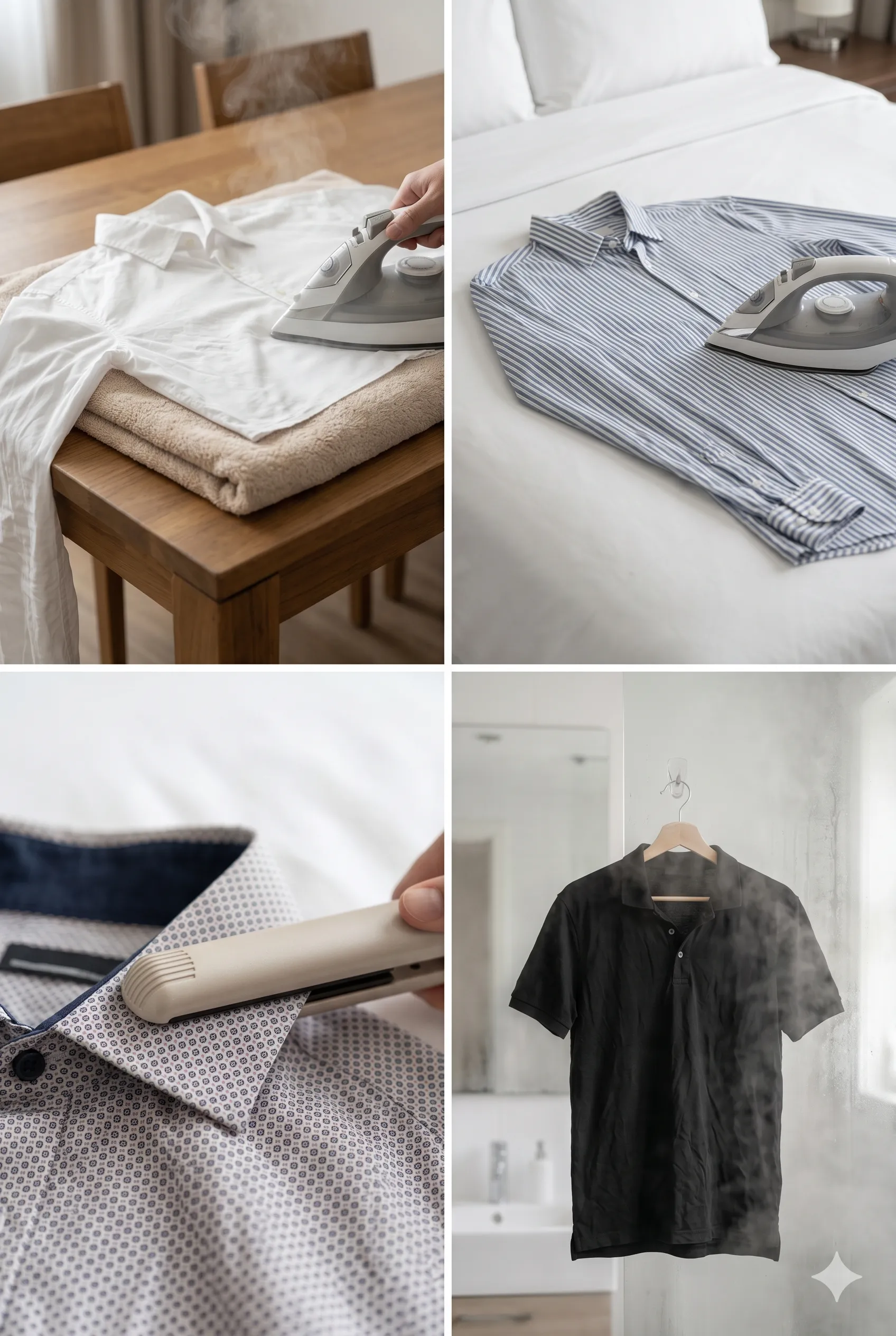
A sturdy dining table or kitchen table is the ideal choice—it’s the right height for comfortable ironing, has a large flat surface, and is stable enough to handle pressure. Protect it with a thick folded towel.
A hard floor (tile, hardwood, or laminate) works well for large items like shirts and trousers—you have unlimited space and no risk of the surface moving. Kneel beside it and work in sections.
A kitchen counter works for smaller items and is at a comfortable working height. Use extra towel padding because counters can be damaged by prolonged heat and steam.
A sturdy wooden or melamine desk works in a pinch but requires good padding—wooden desks are vulnerable to heat damage.
What doesn’t work:
Avoid glass surfaces—they don’t absorb heat and can crack from thermal stress. Avoid upholstered furniture like sofas or beds—the soft, uneven surface means your iron never makes full contact and wrinkles just redistribute rather than releasing. Avoid any surface that wobbles or moves under pressure.
Step-by-step:
- Fold a large, thick towel in half twice to create a firm, padded layer at least four layers of towel thick. Lay it flat on your chosen surface and smooth out any wrinkles in the towel itself—any bumps will transfer to your garment.
- Lay the garment flat on the towel and smooth it with your hands before applying the iron. Taking thirty seconds to smooth the fabric by hand before ironing significantly reduces the work the iron has to do.
- Fill your iron’s water reservoir and set it to the appropriate heat for the fabric you’re ironing. If you’re uncertain, start on the lowest steam setting and work up. Cotton and linen need high heat; synthetic fabrics and delicate items need low heat.
- Iron in long, smooth strokes following the grain of the fabric, moving the iron continuously and never letting it rest stationary on the fabric. Work in sections, moving the garment on the towel as needed to reach different areas.
- For stubborn wrinkles, lightly mist the area with a spray bottle and iron over it immediately. The moisture helps relax the fabric fibers so the heat can press them smooth.
- Hang the garment immediately after ironing on a hanger or smooth surface. Folding or bunching a freshly ironed garment creates new wrinkles before the fabric has cooled and set.
Method 2: Ironing on a Bed (For Large Items Like Shirts and Trousers)
A firm mattress with a clean flat sheet stretched over it is a surprisingly effective ironing surface for larger garments. Hotel guests have been using this trick for decades.
- Use a mattress that is firm rather than soft. A very soft or pillow-top mattress won’t provide enough resistance and the iron’s pressure will just push the garment down into the softness rather than pressing it smooth.
- Stretch a clean, dry, flat sheet tightly over the surface where you’ll be ironing. The sheet serves as your smooth, heat-tolerant surface layer. A fitted bottom sheet works well because it stays taut.
- Place your garment flat on the sheet, smoothing it by hand before you begin.
- Iron normally, but use slightly less pressure than you would on a firm surface. Let the steam and heat do more of the work instead of pressing down hard.
- Work in sections and reposition the garment as needed. Be especially careful with steam settings—too much steam soaking into a mattress can leave moisture and smell. Keep steam to a medium setting.
- Hang immediately once you’re done.
Method 3: Ironing on the Floor (For Larger Garments and Items)
The floor is underrated as an ironing surface. It’s completely flat, completely stable, and gives you unlimited room to spread out large items like shirts, trousers, and jackets.
- Choose a clean, hard floor section—tile or hardwood works best. Avoid ironing on carpet, which is a fire hazard and melts when touched by a hot iron.
- Lay a large, folded towel on the floor to protect both your garment and the flooring from heat and moisture.
- Lay your garment on the towel and smooth it flat by hand.
- Kneel or crouch beside the garment and iron in long horizontal strokes, working systematically across the garment. The floor’s total flatness and stability makes it easy to get sharp creases in trousers and clean lines on collars.
- Reposition the garment by sliding it on the towel rather than lifting it, which can undo your work.
- Stand up and hang the garment immediately when you’re done.
Method 4: Using a Hair Straightener (For Collars, Cuffs, and Tight Spaces)
A hair straightener is one of the most useful wrinkle-removal tools most people already own without realizing it. It excels at precisely the areas that are hardest to reach with a full iron—shirt collars, button plackets, cuffs, and hems.
- Check that your hair straightener is clean on both plates before using it on clothing. Any product residue will transfer to fabric.
- Set the straightener to a medium heat—roughly equivalent to a low-to-medium iron setting. Hair straighteners typically reach 350–450°F, which is hot enough for most fabrics but can scorch delicate ones. Test on an inside hem or hidden seam first.
- Clamp the straightener plates around the fabric, just as you would a strand of hair, and glide it smoothly along the fabric in one direction. For collars, work from the collar points inward. For cuffs, work from the edge toward the sleeve.
- For shirt button plackets (the strip of fabric where the buttons sit), weave the straightener between each button, pressing the fabric flat section by section.
- For creased trouser legs, the straightener can sharpen a crease very effectively—align the crease and run the straightener along it with firm pressure.
- Hang the garment immediately and allow the fabric to cool before wearing.
Method 5: The Shower Steam Method (No Iron Needed)
This is the best technique for when you need wrinkle removal without any heat tool at all—and it requires zero effort on your part.
- Hang the wrinkled garment on a hanger and hook it from the shower rail or bathroom door so it hangs freely without touching any surfaces.
- Run the shower on its hottest setting and close the bathroom door to trap the steam inside the room. Do not let the shower water hit the garment directly—the goal is to fill the room with steam, not to wet the clothes.
- Leave the garment hanging in the steamy bathroom for 10 to 15 minutes. The hot steam relaxes the fabric fibers, allowing gravity and the garment’s own weight to pull the wrinkles smooth.
- Remove the garment and give it a firm shake to help the fibers settle into place, then smooth any remaining creases with your hands.
- Hang it to finish drying in a well-ventilated space—the fabric will be slightly damp from the steam and needs to dry completely before wearing or folding.
- This method works best on cotton shirts, linen trousers, and lightweight synthetic fabrics. It is less effective on thick wools, heavy denim, or garments with sharp pressed creases that need to be reformed rather than simply relaxed.
Method 6: The Damp Towel and Flat Press Method (No Iron Needed)
This technique uses the weight and moisture of a damp towel to press wrinkles smooth—no iron, no electricity, no steamer required.
- Lay the wrinkled garment flat on a smooth, clean surface such as a table or clean floor.
- Dampen a clean towel with warm water and wring it out thoroughly so it’s damp but not dripping.
- Lay the damp towel flat on top of the garment and smooth it down firmly with your hands, pressing from the centre outward to work the wrinkles toward the edges.
- Press down firmly with both palms and hold for ten seconds, then lift and reposition on the next section of the garment. The combination of moisture and pressure relaxes the fabric fibers.
- Remove the damp towel and hang the garment immediately to air dry. The wrinkles should be significantly reduced as the garment dries.
Method 7: The Pot of Hot Water Method (Emergency Hack, No Iron)
This is the oldest trick in the book and genuinely works for light to moderate wrinkles when there’s no iron, steamer, or shower available.
- Boil a full kettle or pot of water. You need enough water to generate meaningful steam.
- Hold the wrinkled section of the garment taut with one hand, stretching it smooth.
- Hold the garment above the steam rising from the hot water—close enough to feel the steam on your hand but far enough that condensation doesn’t soak the fabric. Work in sections, moving the garment steadily through the steam.
- Smooth each section with your free hand immediately after steaming to press the relaxed fibers flat.
- Hang immediately and allow to cool and dry before wearing.
How to Get Sharp Creases Without an Ironing Board
Sharp creases in trouser legs and shirt sleeves are harder to achieve on an improvised surface but not impossible.
For trouser creases, fold the trouser leg carefully along the existing crease line, lay it flat on a firm towel-covered surface, and iron firmly along the fold with a dry iron (no steam). For a particularly crisp crease, place a slightly damp pressing cloth over the crease before ironing and press firmly with a dry iron—the steam created by the pressing cloth going through the fabric produces a sharper, longer-lasting crease than steam from the iron alone.
For shirt sleeve creases, lay the sleeve flat on the surface, fold it along the seam line, and iron from shoulder to cuff in one smooth stroke.
You’re Probably Doing This Wrong: Ironing Order Matters
Most people iron garments in random order, which means they create new wrinkles as they work. The correct order minimizes this:
For shirts and blouses: start with the collar (both sides), then the cuffs, then the sleeves, then the back panel, then the front panels. Doing the large flat sections last means you’re not dragging them over already-wrinkled areas.
For trousers: start with the pockets and waistband, then the legs. Iron the inside of each leg first, then the outside—the outside pressing locks in any crease you’ve formed on the inside.
For dresses: start with any structured sections (bodice, collar, sleeves) before the skirt, which is the largest and flattest section and easiest to do last.
Quick-Reference Method Guide
| Situation | Best Method | What You Need |
|---|---|---|
| At home, need a full press | Flat surface with thick towel | Iron, towel, flat table |
| Hotel or travel, no board | Bed sheet method or shower steam | Iron or just a shower |
| Only collar and cuffs need pressing | Hair straightener | Hair straightener |
| Light wrinkles, no tools available | Shower steam method | Hot shower |
| No iron, no shower, emergency | Damp towel press or hot water steam | Towel, kettle |
| Sharp creases in trousers | Floor method with pressing cloth | Iron, towel, pressing cloth |
Tips to Reduce Wrinkles Before They Need Ironing
Remove clothes from the dryer immediately. The biggest cause of wrinkled laundry is leaving clothes sitting in a hot dryer after the cycle ends. Pulling them out and hanging them within five minutes of the cycle finishing prevents the majority of wrinkles from setting.
Try the “shake and hang” method. When taking laundry out of the washing machine, give each item a firm shake to loosen the fibers before hanging it to dry. Clothes that air-dry on a hanger wrinkle far less than those dried in a bundle or on a flat surface.
Don’t overstuff your washing machine or dryer. Overcrowded machines leave clothes balled up and pressed together throughout the cycle, creating wrinkles that are set by heat and difficult to remove.
Use the steam function on your dryer. Many modern dryers have a steam or wrinkle-release cycle. Adding a few slightly damp items to a hot dryer with a dry towel for ten minutes can also release wrinkles without any ironing at all.
Fold or hang clothes immediately after ironing. Freshly pressed fabric is warm and pliable—it wrinkles easily until it cools. Hanging immediately locks in your work.
FAQ
Can you iron clothes on a carpet?
You should not iron directly on carpet. The carpet provides no firm resistance, meaning the iron doesn’t press properly, and the heat can melt synthetic carpet fibers. There’s also a fire risk if the iron shifts or tips. If the floor is your only option, use a hard floor section or place a thick wooden board over the carpet as a firm base with a towel on top.
Can you use a flat hair iron on all fabric types?
Not on all fabrics. Hair straighteners work safely on cotton, linen, denim, and most synthetics on a medium setting. Avoid using them on silk, velvet, and very delicate or embellished fabrics—the concentrated direct heat from the narrow plates can scorch or permanently mark these materials.
What’s the best no-iron method for travel?
The shower steam method is the best option for travel—it requires no equipment, uses what’s already in a hotel bathroom, and works well on most business and casual fabrics. Hanging your garment the moment you arrive and steaming it before you dress removes the majority of suitcase wrinkles.
Does putting clothes in the dryer with a damp towel actually work?
Yes, and quite well for light to moderate wrinkles. Place the wrinkled garment in the dryer with one or two damp (not soaking) towels on a medium-high heat setting for 10 to 15 minutes. The steam generated by the damp towels relaxes the fibers. Remove immediately when the cycle ends and hang straight away.
How do you iron a shirt without an ironing board and without getting new wrinkles?
The key is to iron in the correct order (collar and cuffs first, large panels last) and to hang the garment immediately after each section is pressed rather than folding it back on the surface. Moving the garment on the padded surface rather than lifting it also helps prevent re-wrinkling.
Conclusion
Not having an ironing board is a minor inconvenience at most—and once you know your options, it barely registers. A thick folded towel on a firm table handles the vast majority of everyday ironing jobs just as effectively as a dedicated board. When you need wrinkle removal without any iron at all, a steamy bathroom or a damp towel and some patience gets the job done. The real keys to wrinkle-free clothes are acting quickly after washing, hanging garments while they’re still warm, and having a reliable backup method ready for those moments when your clothes need attention and your usual setup isn’t available.
Enjoyed this project? Get even more DIY ideas that save (and make) you money.
Join our free newsletter for profitable DIY projects, clever cleaning hacks, home ideas, and creative crafts delivered straight to your inbox.
✓ Free forever • No spam • Unsubscribe anytime