This post contains affiliate links. We may earn a small commission if you buy through them.
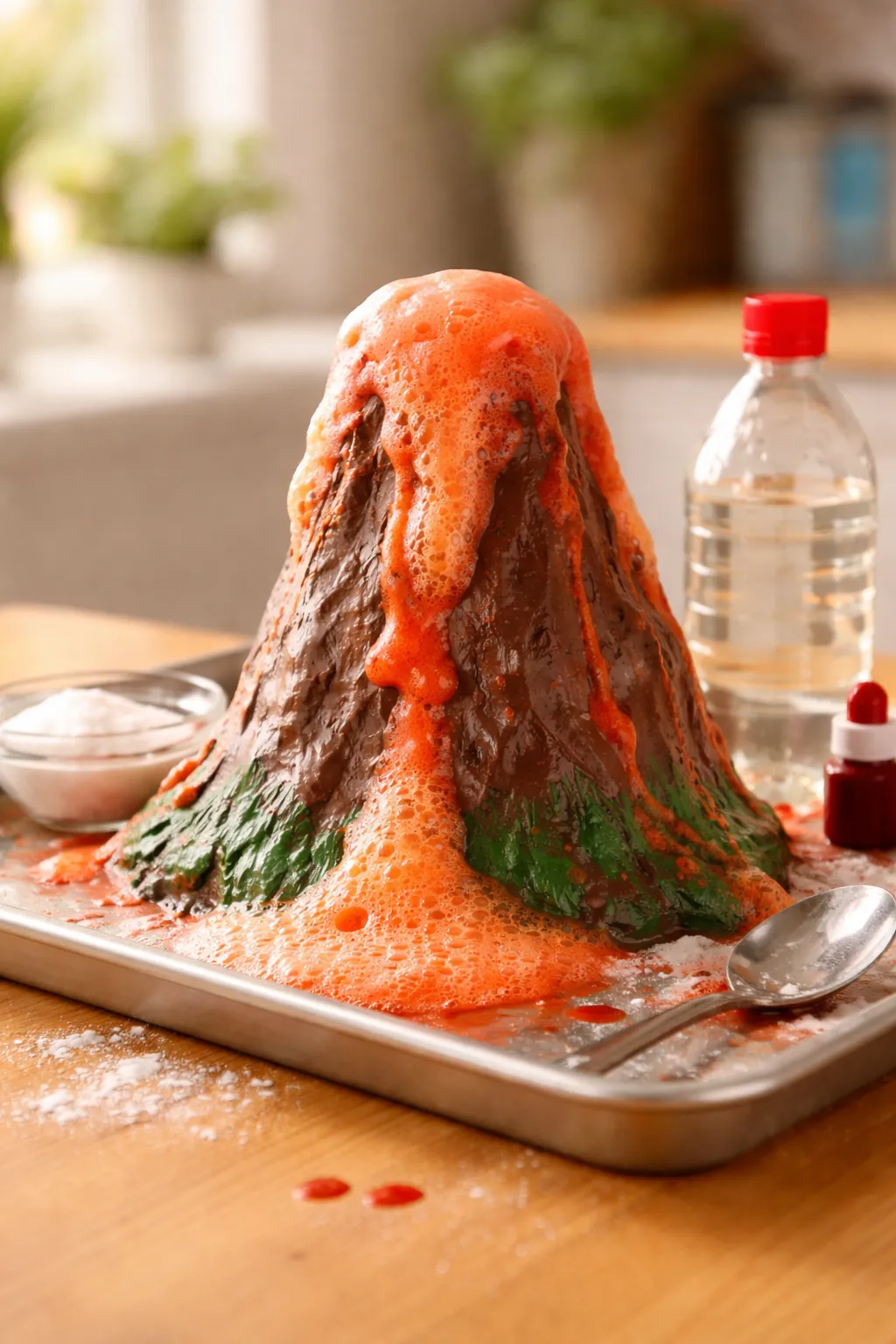
If you’ve ever wanted to make your own erupting volcano, the classic vinegar and baking soda experiment is the perfect way to start. It’s messy, exciting, and teaches kids about chemical reactions in a fun, visual way.
You don’t need any fancy chemicals—just a few household items can turn a simple bottle into a fizzing, bubbly volcano that looks like it’s erupting in real life.
This video shows how to make a volcano with vinegar and baking soda.
Here’s how to do it step by step.
What You’ll Need
Before starting, gather these materials:
- Safety Goggles
- Small plastic bottle or container
- Baking soda (about 2–3 tablespoons)
- Vinegar (about ½ cup)
- Dish soap (optional, for foamy eruption)
- Food coloring (optional, for lava effect)
- Playdough, clay, or paper mache to build the volcano
- Tray or surface to catch spills
Recommended Ready-To-Use Kit: National Geographic Ultimate Volcano Kit
Step-by-Step: How to Make a Volcano with Baking Soda
Follow these steps to create an erupting volcano:
- Step 1: Build Your Volcano
Place the bottle on a tray. Shape clay, playdough, or paper mache around the bottle to form a mountain. Leave the bottle opening clear at the top. - Step 2: Add Baking Soda
Spoon 2–3 tablespoons of baking soda into the bottle. For bigger eruptions, you can add more. - Step 3: Add Dish Soap (Optional)
A few drops of dish soap will make the eruption foamier and more dramatic. - Step 4: Add Food Coloring (Optional)
Red or orange food coloring makes the lava look more realistic. - Step 5: Pour Vinegar
Slowly pour vinegar into the bottle and step back! The mixture will react immediately, producing a fizzy eruption that flows out of your volcano. - Step 6: Observe the Reaction
Watch how the carbon dioxide gas creates bubbles that push the colored foam upward—just like a real volcanic eruption.
How It Works (The Science Behind the Experiment)
When vinegar and baking soda combine, a chemical reaction occurs:
NaHCO₃ + CH₃COOH → CO₂ + H₂O + Na⁺ + CH₃COO⁻
- Baking soda (NaHCO₃) reacts with vinegar (CH₃COOH)
- Carbon dioxide gas (CO₂) is produced, creating fizz and bubbles
- Water (H₂O) and other ions are left behind
This is a simple acid-base reaction that creates gas and movement, which mimics the lava flow of a volcano.
Tips to Make Your Volcano More Exciting
- Use warm vinegar for a faster, more vigorous eruption
- Build a taller volcano for a dramatic effect
- Experiment with the amount of baking soda and vinegar to see how the eruption changes
- Add multiple bottles for a chain reaction volcano effect
Common Mistakes (Stop Doing This…)
- Not enough baking soda or vinegar: Your eruption will be small and disappointing
- Pouring too slowly: You might not see the full reaction
- Using a weak container: Thin bottles can leak or spill
- Skipping the tray: Expect a mess—this reaction is not contained unless you have a tray
Fix these, and your experiment will be both exciting and clean (mostly).
Quick Fixes for Common Problems
| Problem | Step-by-Step Solution | Alternative Suggestion |
|---|---|---|
| Small eruption | Add more baking soda and vinegar | Use warm vinegar for faster reaction |
| Messy eruption | Use a tray to catch overflow | Build volcano taller with stronger clay walls |
| Lava not colorful | Add more food coloring | Mix colors for realistic lava effect |
| Reaction ends too fast | Add baking soda gradually | Pour vinegar slowly for continuous eruption |
Volcano Eruption Variations at a Glance
Want to switch things up? Here’s how each twist changes the eruption.
| Variation | How To | Effect |
|---|---|---|
| Layered Colors | Pour different colors of vinegar in sequence | Rainbow-layered lava flow |
| Foamy Eruption | Add extra dish soap | Bigger, bubblier overflow |
| Multiple Eruptions | Build several volcanoes on one tray | Chain-reaction effect |
| Glow-in-the-Dark Lava | Use glow-in-the-dark paint | Eruption glows for night viewing |
Tips for Best Results
- Always conduct the experiment on a tray or washable surface
- Wear old clothes or an apron—this is messy science
- Supervise young kids to avoid spills and ingestion
- Practice the reaction once before doing it for a presentation or science fair
FAQ
Can I use any container for the volcano?
Yes, but small plastic bottles work best. Avoid glass unless you’re very careful.
Is this safe for kids?
Absolutely. The reaction is non-toxic and safe, but adult supervision is recommended for young children.
Why does the eruption foam instead of just fizzing?
The dish soap traps the carbon dioxide bubbles, creating foamy lava that flows out of the bottle.
Can I reuse the volcano?
Yes! Just refill with baking soda and vinegar for another eruption.
Conclusion
The volcano vinegar and baking soda experiment is one of the easiest, most visually exciting ways to explore chemistry. It’s fast, safe, and requires only simple household items.
Whether you’re teaching a lesson, doing a science fair project, or just having fun at home, this experiment teaches important scientific concepts while creating a wow moment for everyone watching.
Once you try it, you’ll see why this classic experiment has stood the test of time—and why it’s still one of the most popular science activities for kids of all ages.
Next, check out this Tornado in a Bottle Science Experiment For Kids.
Enjoyed this project? Get even more DIY ideas that save (and make) you money.
Join our free newsletter for profitable DIY projects, clever cleaning hacks, home ideas, and creative crafts delivered straight to your inbox.
✓ Free forever • No spam • Unsubscribe anytime