There is a moment in this experiment — the exact second you tip a bottle of perfectly still, perfectly clear water and watch it crystallize into ice right before your eyes — that makes even the most unimpressed kid go completely silent. It looks like a magic trick. It feels like one too. But it is one hundred percent real science, and once you understand what is actually happening inside that bottle, the whole thing becomes even more impressive than the trick itself.
The problem is that this experiment has a reputation for being finicky. People try it, it doesn’t work, they assume they did something wrong, and they give up. Almost every failure comes down to one or two small but critical details that most guides skim right past. This article covers everything — the real science, the precise steps, the common failure points, and several variations that extend this into a full afternoon of experimentation.
This video shows the Instant Ice Science Experiment for Kids:
Here’s the Real Reason Water Can Freeze Instantly
To understand instant ice, you need to understand a concept called supercooling.
Under normal circumstances, water freezes at 0°C (32°F). But “normal circumstances” includes something most people never think about: the presence of a nucleation site. A nucleation site is any tiny imperfection, particle, or surface irregularity that gives water molecules a place to begin organizing themselves into the structured crystal lattice of ice. Dust particles, mineral deposits, tiny air bubbles, scratches on the inside of a container — all of these can act as nucleation sites.
When water is completely pure and kept in a very smooth container, and cooled very carefully without any vibration or disturbance, something unexpected happens: it can drop well below 0°C without freezing. The water becomes supercooled — colder than its normal freezing point, but still liquid because it has nothing to trigger the crystallization process.
The instant you disturb that supercooled water — by pouring it, tapping the bottle, dropping an ice crystal into it, or even just exposing it to a small vibration — you give the water molecules the nudge they need to start forming crystals. And because the water is already well below freezing temperature, crystallization happens almost instantaneously, spreading through the liquid in a visible wave.
That is the science behind the trick. The water isn’t being frozen by the pouring — it was already cold enough to freeze. You’re just giving it permission.
What You’ll Need
Getting the right materials is genuinely half the battle with this experiment. Shortcuts here are the number one reason it fails.
- Purified or distilled water bottles — standard store-bought purified water in smooth plastic bottles works very well. Do not use tap water; the minerals dissolved in tap water act as nucleation sites and will cause the water to freeze before you want it to.
- A freezer with consistent temperature — ideally set to around -24°C (-11°F), though a standard home freezer set to its coldest setting will usually work
- A flat, stable surface in the freezer with no vibration from a rattling shelf or a nearby compressor cycle
- A bowl of regular ice cubes or crushed ice for the dramatic pouring reveal
- A thermometer (optional but useful for the extended experiment version)
- A timer or phone alarm
- Extra bottles — you will almost certainly need more than one attempt, so having three to six bottles ready is strongly recommended
Don’t Ignore This Before You Start
There are a few non-negotiable rules about this experiment that separate the people who get a spectacular result from those who end up with a perfectly ordinary cold bottle of water.
Do not shake, jostle, or bump the bottles at any point during freezing. Even placing them in the freezer with a slight knock against the shelf can introduce enough vibration to trigger premature crystallization. Open the freezer door as gently as you possibly can.
Remove the bottles before they freeze solid. The timing window is surprisingly narrow — usually between two and two and a half hours in a standard home freezer, though this varies. Too short and the water isn’t cold enough to supercool properly. Too long and it freezes solid in the bottle, which is useless for the demonstration.
Use new, unopened bottles when possible. A bottle that has already been opened and resealed has been exposed to air, which can introduce particles. If you’re reusing bottles, make sure they are extremely clean and filled with distilled water.
Step-by-Step: How to Do the Instant Ice Experiment
Step 1: Place two to four unopened bottles of purified water flat on a stable freezer shelf. Laying them flat increases the surface area of water in contact with the cold air, which helps them cool more evenly. Make sure the shelf is level and that the bottles won’t roll or be disturbed when the freezer door is opened or the compressor kicks on.
Step 2: Set a timer for two hours and do not open the freezer before it goes off. Every time the freezer door opens, warm air rushes in, the temperature fluctuates, and the bottles may experience slight vibration. Discipline here pays off dramatically later.
Step 3: At the two-hour mark, open the freezer very slowly and carefully check one bottle. Gently — and the word gently cannot be overstated — pick up one bottle and look at it. It should still appear completely liquid and clear, with no ice crystals visible anywhere. If it’s already frozen solid, your freezer is running colder than average; reduce the time by fifteen minutes on your next attempt. If it’s still completely liquid, you may have a supercooled bottle on your hands.
Step 4: Test your bottle with a gentle tap. Hold the bottle still and tap the side firmly with one finger. If it’s successfully supercooled, you should see a cloud of ice crystals burst outward from the tap point and race through the water in a visible wave, turning the entire bottle into a slushy, crystallized mass within one to two seconds. This is the payoff moment.
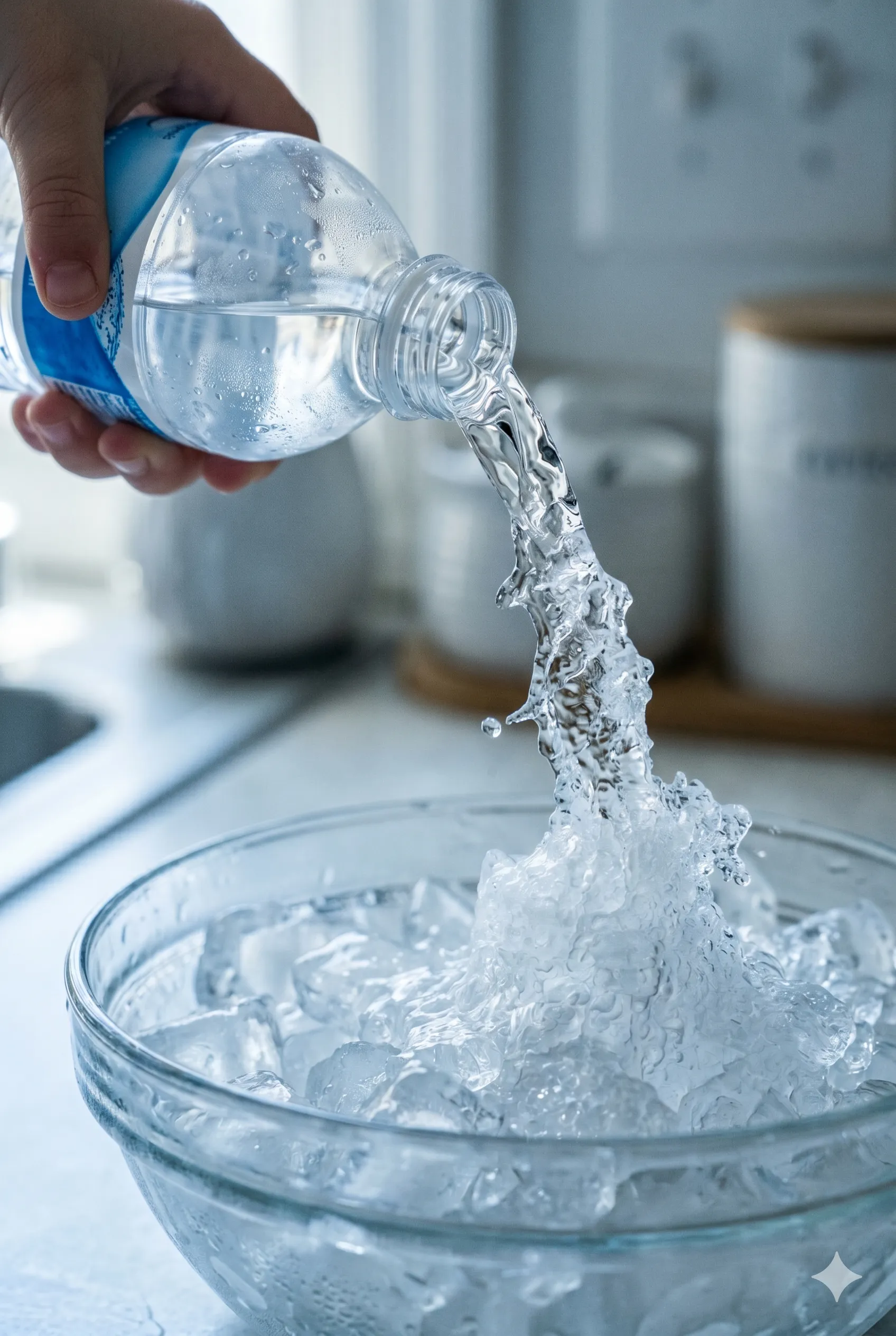
Step 5: For the most dramatic version of the reveal, carefully carry an untapped bottle to a bowl of ice. Pour the supercooled water slowly onto the ice. As it makes contact with the ice surface — which acts as a nucleation site — the water will freeze on impact, building up a mound of instant ice that you can actually shape slightly before it fully solidifies.
Step 6: Try the “ice tower” version. Place a single ice cube on a plate. Pour supercooled water over the top of it slowly and steadily. The water freezes on contact and begins building upward, creating a small translucent tower of ice rising from the base cube. This is the single most visually striking version of the demonstration.
Step 7: Document the results. Encourage kids to note which bottles worked, which ones froze prematurely, and whether the timing or freezer position made any difference. This turns a cool trick into genuine scientific observation.
You’re Probably Doing This Wrong: Why Your Water Keeps Freezing Too Early
This is the most common complaint about the instant ice experiment, and it almost always comes down to one of these causes:
Your water isn’t pure enough. Tap water, filtered-but-not-distilled water, and even some brands of “purified” water contain enough dissolved minerals to act as nucleation sites. Switch to a brand that explicitly says “distilled” or “purified through reverse osmosis” for the best results.
Your freezer has too much vibration. Older freezers, freezers with loose shelves, or freezers sitting on an uneven surface all vibrate more than average. If your bottles keep freezing solid before you can do the reveal, try placing them on a folded cloth or a silicone mat to dampen vibration from the shelf.
You’re opening the freezer too often. Every door opening is a source of temperature change and minor vibration. Set your timer, walk away, and trust the process.
The bottles aren’t smooth enough inside. Some plastic bottles have molded text, ridges, or seam lines on the inside surface that act as nucleation sites. Try switching brands to find a bottle with a very smooth interior wall.
Fun Variations That Turn This Into a Full Science Investigation
The Nucleation Site Test
Set up four identical supercooled bottles. Trigger each one differently: tap the bottle, drop in a grain of salt, drop in a small ice chip, and pour it over a rough surface versus a smooth one. Which method triggers the fastest crystallization? Which produces the clearest ice? This is a proper variable-controlled experiment.
Supercooled Water vs. Tap Water Race
Freeze one bottle of distilled water and one of tap water simultaneously. Observe which one freezes solid first during the cooling phase. The tap water should freeze sooner, demonstrating how impurities raise the effective freezing point in context.
The Temperature Variable
If you have a thermometer and a cooler, try chilling bottles to different temperatures — just below 0°C versus further below — and compare how fast crystallization spreads when triggered. Colder supercooled water crystallizes visibly faster.
Colored Instant Ice
Add a single drop of food coloring to a bottle of distilled water before freezing. The color makes the crystallization wave dramatically more visible as it spreads through the bottle, which is particularly effective for demonstrations to larger groups or for filming.
What Kids Learn From the Instant Ice Experiment
Phase transitions and the states of matter — the point at which a liquid becomes a solid — is one of the cornerstone concepts in elementary and middle school physical science. Most kids learn this as a number on a chart (water freezes at 0°C, full stop). This experiment shows them that the real world is more complicated and more interesting than that.
Nucleation is a concept that extends far beyond water. It applies to how bubbles form in carbonated drinks, how crystals grow in geological formations, how certain metals solidify during manufacturing, and even how certain biological processes in cells are triggered. Kids who encounter this concept early have a genuine head start in understanding physical chemistry later.
The scientific method gets a natural workout here. The experiment requires a hypothesis (will this bottle be supercooled?), a controlled setup, an observation, and an interpretation of results — especially when some bottles succeed and others don’t.
Quick Troubleshooting Guide
| Problem | Most Likely Cause | Fix |
|---|---|---|
| Bottle freezes solid before reveal | Freezer too cold or too much vibration | Reduce freezing time or add a vibration-dampening mat |
| Water doesn’t freeze when tapped | Not cold enough yet | Return bottles and add another 20–30 minutes |
| Crystallization only happens in one spot | Tap wasn’t firm enough | Use a sharper, more deliberate tap or drop in a small ice crystal |
| Ice tower collapses during pouring | Pouring too fast | Slow the pour to a thin, steady trickle |
| Experiment never works despite multiple attempts | Water isn’t pure enough | Switch to a different brand of distilled water |
| Only some bottles supercool | Inconsistent freezer temperature zones | Move bottles to the back center of the freezer shelf |
FAQ
Why does the water stay liquid below freezing? Because liquid water needs a nucleation site — a physical trigger — to begin forming ice crystals. Without one, the molecules remain in liquid form even when the temperature drops well below 0°C. The supercooled state is unstable, which is why the slightest disturbance causes instant crystallization.
Is supercooled water dangerous? Not in the quantities used in this experiment. Supercooled water exists naturally in clouds at high altitude, and understanding it is actually important in aviation and meteorology. At home experiment scale, there is no risk involved.
Can you eat or drink the instant ice that forms? Yes — it’s just water and ice. The ice that forms from purified water is perfectly safe to touch and taste, which makes the ice tower version particularly fun for younger kids who want to interact with the result.
What happens if you put the supercooled bottle back in the freezer without triggering it? It will eventually freeze solid on its own as natural vibrations from the compressor cycle or minute impurities in the water slowly trigger nucleation. The supercooled state is always temporary — it’s a race against natural disturbances.
Does this work with other liquids? Many liquids can be supercooled under the right conditions, though water is by far the easiest and safest to work with at home. Some soft drinks and juices can be supercooled in a similar way, though the dissolved sugars and gases make the effect less reliable and less visually clean than pure water.
Conclusion
The instant ice experiment rewards patience and precision in a way that few kitchen science activities can match. Get the water pure, get the freezer cold, keep everything still, and time it right — and what you get in return is one of the most genuinely jaw-dropping moments you can create with nothing but a plastic bottle and a home freezer. More importantly, the science behind it is real, substantial, and connects directly to concepts kids will encounter for the rest of their scientific education. Supercooling, nucleation, phase transitions — these aren’t small ideas. They’re just dressed up here as an incredibly satisfying trick, which is, honestly, the best possible way to meet them for the first time.
Enjoyed this project? Get even more DIY ideas that save (and make) you money.
Join our free newsletter for profitable DIY projects, clever cleaning hacks, home ideas, and creative crafts delivered straight to your inbox.
✓ Free forever • No spam • Unsubscribe anytime