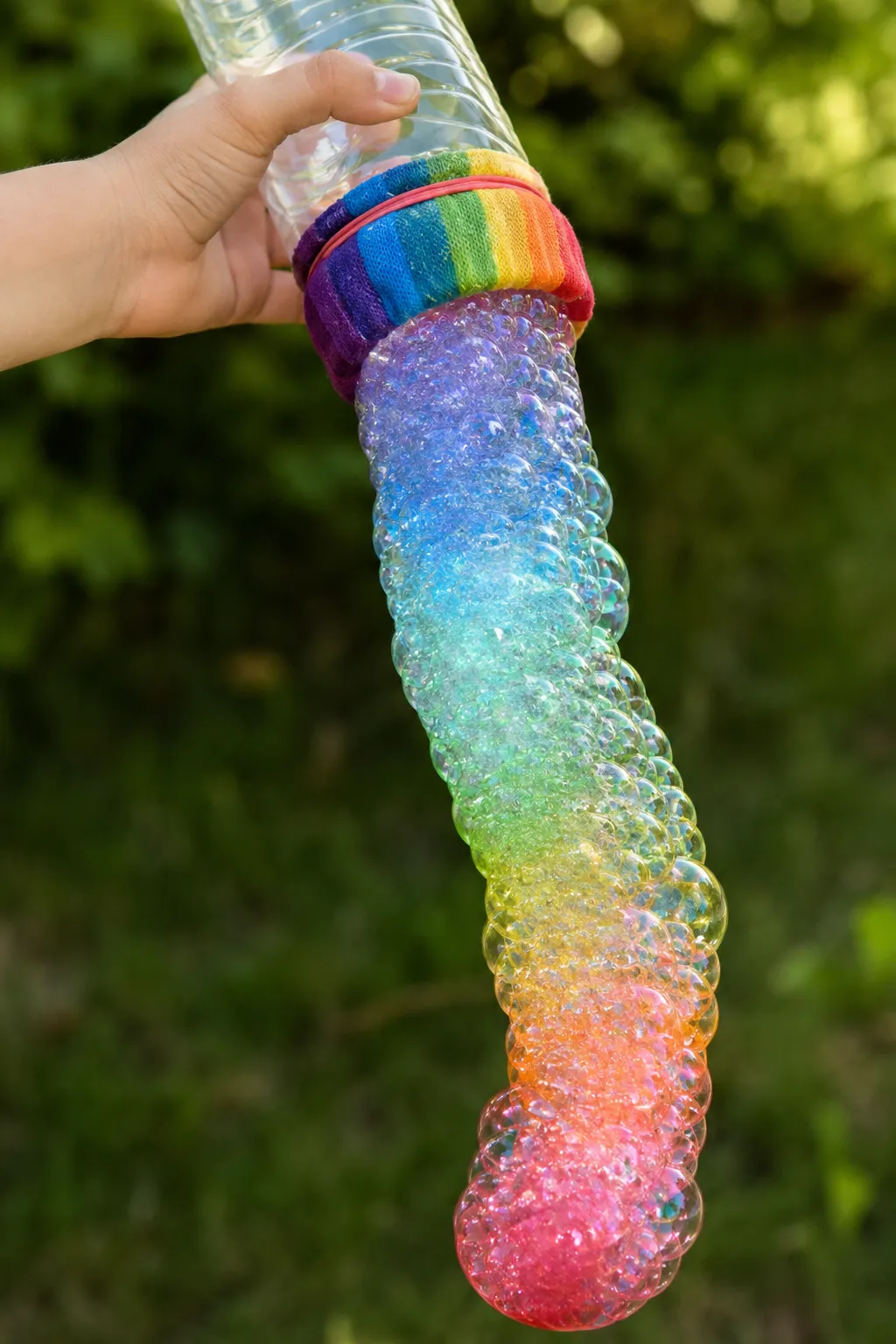
Rainbow bubble snakes are one of those activities where the result looks so impressive that it seems like it should be complicated—and then you find out it’s a plastic bottle, an old sock, and some dish soap, and you feel like you’ve been holding out on your kids for years.
The concept is simple: a homemade bubble blower with a fabric-covered opening creates a long, connected chain of bubbles rather than individual spheres. When the fabric is colored with marker or dye before play, the bubbles pick up the color as they form, creating a flowing snake of different colored bubble clusters that gets longer with every breath.
It takes about five minutes to make, uses almost nothing, and children from about two years old through primary school age find it genuinely, repeatedly entertaining. Here’s everything you need to know to make it work well.
What You Need
- A clean plastic bottle (a 500ml water bottle works perfectly)
- An old sock or a piece of thin fabric (a clean dish cloth, a cut-up t-shirt, or a cloth nappy insert all work)
- A rubber band or hair tie
- Dish soap
- Water
- Washable markers or food coloring
- Scissors
That’s it. Everything on this list is likely already in your house.
How to Make the Bubble Snake Blower
- Cut the bottom off the plastic bottle using scissors. Cut straight across the bottle roughly two to three centimeters from the base—you want to remove the closed bottom end and create an open circular end. The cut doesn’t need to be perfectly straight; slightly uneven is fine and won’t affect how the blower works.
- Stretch the sock over the cut end of the bottle, pulling it down so it covers the opening completely and extends an inch or two down the sides of the bottle. The sock fabric needs to be taut across the opening rather than loose and sagging—a tight, even surface across the opening produces much better bubble snakes than a loose, wrinkled one.
- Secure the sock firmly with a rubber band or hair tie wrapped around the bottle neck just above where the sock is stretched. Pull the rubber band tight enough that the sock can’t slip or shift during blowing. Give it a tug to confirm it’s secure before testing.
- Trim any excess sock hanging below the rubber band if it’s substantial—excess fabric can flap during blowing and disrupt the bubble formation. A centimeter or two of fabric beyond the rubber band is fine; more than that is worth trimming.
The blower is now complete. The drinking end of the bottle (the original bottle top) is where the child blows; the sock-covered cut end is where the bubble snake emerges.
Adding the Rainbow Colors
This is the step that transforms plain bubble snakes into rainbow bubble snakes, and it’s one of the most enjoyable parts of the preparation—children can do this step themselves.
Method A: Washable markers (easiest)
- Color the sock surface in sections using washable markers—one color per section. Divide the sock into four to six roughly equal sections and color each one a different color: red, orange, yellow, green, blue, purple.
- Cover each section thoroughly with marker color—the more saturated the color on the sock, the more vivid the color transfer to the bubbles. Don’t worry about staying within precise lines; the colors blending slightly at the boundaries creates a beautiful transition between colors.
- Dampen the sock slightly with a few drops of water before dipping in the bubble solution—this helps the color transfer to the bubbles more readily.
Method B: Food coloring drops (most vivid)
- Lay the assembled blower sock-end up on a surface.
- Drop food coloring directly onto the sock in sections—two to three drops of each color per section. The food coloring produces more vivid bubble colors than markers because it’s more concentrated and transfers more readily to the soap film of the bubbles.
- Allow the drops to spread slightly before using—30 seconds is enough.
Method C: Single color (for younger children)
For toddlers who find the rainbow concept less important than the activity itself, a single color applied to the whole sock produces colorful snakes without the multi-step coloring process. One or two drops of food coloring on the sock and you’re ready.
The Bubble Solution
The bubble solution for snake blowers works best slightly more concentrated than standard bubble solution:
- ½ cup dish soap
- 1 cup water
- 1 tablespoon glycerin or corn syrup (optional but makes a noticeable difference—glycerin or corn syrup strengthens the bubble film and produces longer, more connected snakes that don’t break apart as readily)
Stir gently to combine without creating foam—you want liquid bubble solution, not pre-made foam. Pour into a shallow dish or bowl wide enough to dip the sock end of the bottle into.
If you don’t have glycerin or corn syrup, plain dish soap and water still works well—the snakes just break apart slightly more easily.
How to Make the Bubble Snake
- Dip the sock end of the blower into the bubble solution until the sock is fully saturated. Lift out and allow the excess to drip off for a second before blowing.
- Blow gently and steadily through the drinking end of the bottle. A slow, even breath produces the best snake—blowing too hard pops the bubbles as they form rather than allowing them to chain together into a snake. The goal is a continuous, moderate exhalation rather than a sharp puff.
- Watch the snake emerge from the sock end with each breath. Each breath adds another cluster of bubbles to the end of the existing snake, making it progressively longer.
- Keep the sock end pointed slightly downward during blowing—gravity helps the snake hang together rather than collapsing back onto the sock surface. Pointing straight down or slightly angled down produces the longest, most dramatic snakes.
- Re-dip in the solution whenever the snake stops forming well or the sock feels dry—the sock needs to be consistently saturated with solution to keep producing bubbles.
- To release the snake, stop blowing and move the blower away—the snake detaches and drifts slowly to the ground, which is its own entertaining moment.
Tips for the Best Results
Dish soap matters more than you’d expect. Dawn, Fairy, and similar standard dish soaps produce significantly better bubble snakes than eco-friendly or plant-based formulas, which have lower surfactant concentrations. If the snakes are breaking apart immediately, switching dish soaps is often the fix.
Humid days produce better bubbles. Bubbles pop faster in dry conditions because the water in the soap film evaporates quickly. On dry days, add a little more glycerin or corn syrup to the solution and play in the shade rather than direct sun.
Thin fabric works better than thick. A thick, fluffy sock produces smaller, less defined bubble clusters than a thin cotton sock or a piece of t-shirt fabric. If you have the choice, use thin cotton—old t-shirt material stretched over the bottle end produces excellent results.
Let children re-color the sock during play. As the bubbles form, they pick up the marker or food coloring from the sock and the color gradually fades. Refreshing the color mid-session with a few more marker strokes or food coloring drops is quick and lets children participate in maintaining the rainbow effect.
Multiple blowers in different colors. For a group of children, making one blower per child in a single color rather than trying to share rainbow blowers gives everyone their own color—and the snakes from different blowers combine beautifully when they drift into each other.
Why the Bubbles Come Out in a Snake Shape
The snake shape comes from the fabric’s structure. When you blow through a single opening (like a wand), the soap film forms a single large sphere—a standard bubble. When you blow through a fabric surface with thousands of tiny holes, each hole produces a tiny bubble simultaneously, and the bubbles emerging next to each other fuse together as they form, creating a connected cluster. Each breath produces a new cluster that fuses to the previous one, building the chain that makes the snake. The color comes from the dye on the fabric transferring to the soap film of each bubble as it forms.
Variations to Try
Giant snake challenge: Use a larger bottle (1.5 or 2 liters) with a larger sock for a wider snake that produces more volume per breath. The larger surface area means more bubbles per breath and a more dramatic snake.
Double-layer sock: Stretch two differently colored socks over the same bottle opening—one laid on top of the other. The bubbles pick up both colors simultaneously, creating a more complex color mixing effect.
Scented bubble snakes: Add two or three drops of child-safe essential oil (lavender, orange) to the bubble solution. The snakes smell as interesting as they look—particularly good for sensory-focused play.
Bubble snake art: Hold the blower over a piece of paper as the snake drifts downward and catches on the paper surface. The popping bubbles leave circular rings of color on the paper—a spontaneous form of bubble printing that produces genuinely beautiful results with rainbow-colored snakes.
Cleanup
Bubble solution rinses off surfaces, skin, and clothing with water. Food coloring on the sock is permanent—use an old sock you don’t mind sacrificing. Washable marker on the sock will wash out in the laundry, though it may take two cycles to fully clear. The bubble solution on outdoor surfaces like patios and decking dries without leaving a mark.
FAQ
Why is my bubble snake breaking apart immediately? Usually one of three causes: the bubble solution isn’t concentrated enough (increase the dish soap ratio), the sock is too dry (re-dip more frequently), or blowing too hard (slower, steadier breath produces more connected snakes).
Can toddlers do this activity? With supervision, yes—from about two years old. The blowing action is within most two-year-olds’ capability, though younger toddlers may need some practice. The main supervision concern is the bubble solution—it’s non-toxic but not meant to be drunk. Keep the solution dish out of reach when not actively dipping.
Do I need glycerin? I don’t have any. Glycerin improves snake quality but isn’t essential. Corn syrup is the most accessible substitute—it’s in most kitchens and works nearly as well. Plain dish soap and water produces adequate snakes for most purposes without any additive.
The color isn’t transferring to the bubbles. What’s wrong? The sock may be too wet with bubble solution, which dilutes the color before it can transfer. Try applying the food coloring or marker after the first dip and allowing a few seconds for the color to distribute before blowing. Alternatively, use more concentrated food coloring—two to three drops per color section rather than one.
The Bottom Line
Rainbow bubble snakes require nothing you don’t already have, take five minutes to set up, and produce the kind of open-ended outdoor play that holds children’s attention long enough to finish a cup of tea. The rainbow effect is genuinely beautiful, the blowing action is satisfying and slightly challenging in exactly the right way, and the bubble art variation gives you something to frame if you’re feeling ambitious. Make two blowers so you’re not stuck watching—this one is just as fun for adults as it is for kids.
Enjoyed this project? Get even more DIY ideas that save (and make) you money.
Join our free newsletter for profitable DIY projects, clever cleaning hacks, home ideas, and creative crafts delivered straight to your inbox.
✓ Free forever • No spam • Unsubscribe anytime