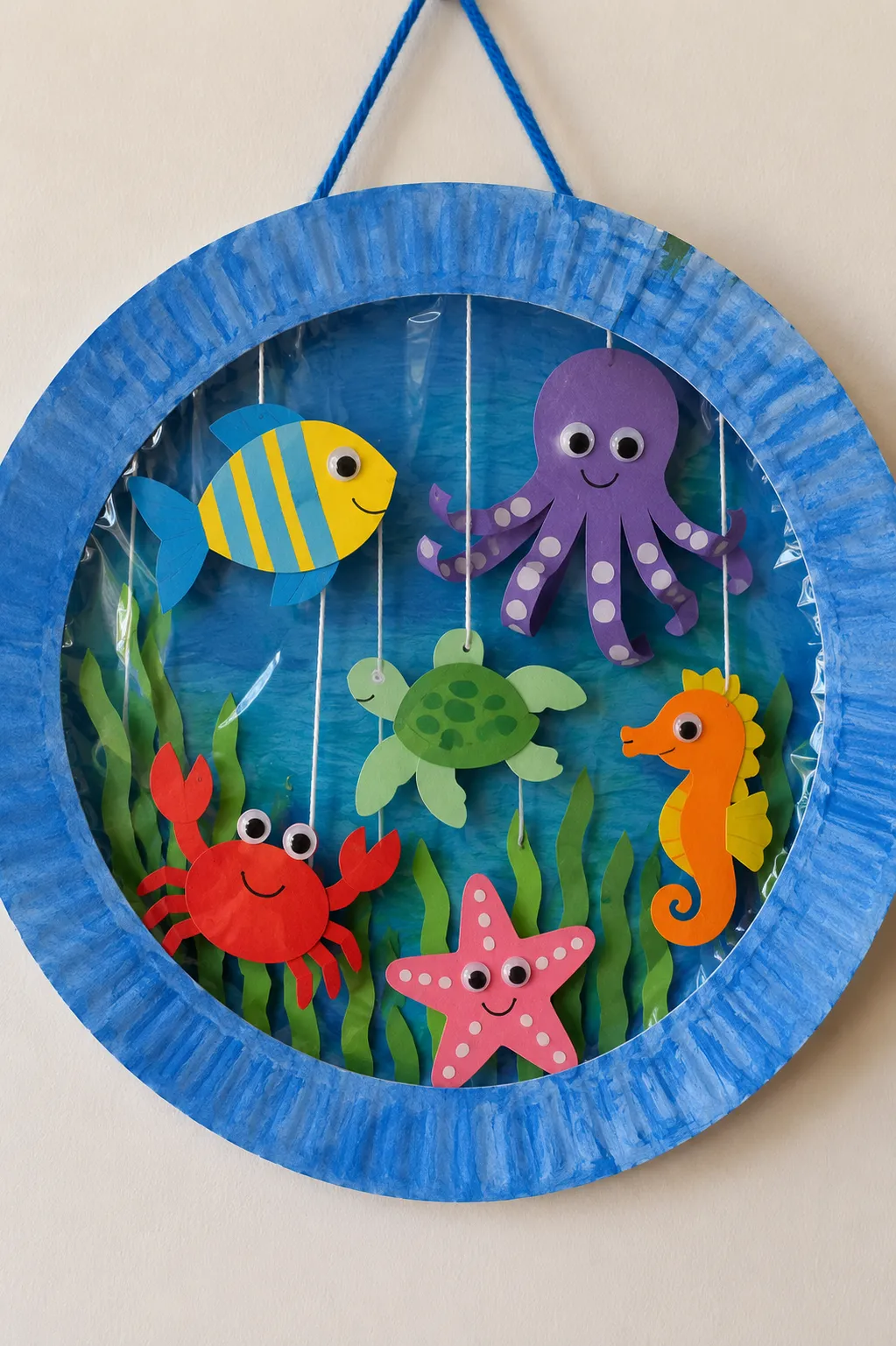
There’s a certain type of craft that looks like it took real effort but is actually completely manageable with a preschooler at the table. This is that craft. A paper plate aquarium checks every box—it’s colorful, it has moving parts, it ends up on the wall, and kids feel genuinely proud of the result because it actually looks like something.
The basic concept is simple: a paper plate becomes the aquarium tank, and paper sea creatures hang inside it on pieces of string so they dangle and move when touched. The magic is in the layering—blue cellophane or tissue paper for water, green paper strips for seaweed, and a handful of handmade sea creatures that kids cut, color, and assemble themselves.
What makes this craft worth coming back to is that you can make it completely different every time depending on which animals you include. Here are six of the most popular ones with step-by-step instructions for each, plus exactly how to build the aquarium around them.
What You’ll Need
For the aquarium base:
- 2 paper plates – one for the front frame, one for the back
- Blue paint or blue crayons – to color the inside of the plates
- Blue or green cellophane, tissue paper, or plastic wrap – for the water effect
- Green paper or crepe paper – cut into strips for seaweed
- String, yarn, or fishing line – to hang the sea creatures inside
- A hole punch – to thread string through the top plate
- Scissors and glue or a stapler – to assemble everything
- Googly eyes – genuinely worth buying for this craft; they make every creature more alive
For the sea creatures:
- Cardstock or thick paper – regular printer paper works but cardstock holds up better
- Crayons, markers, or watercolor paints – for coloring
- Scissors – child-safe for kids old enough to cut independently
- Templates – simple printed outlines or hand-drawn shapes work equally well
How to Build the Aquarium Base
Before making the creatures, build the tank so it’s ready to receive them once they’re finished.
Step 1: Cut the center out of one paper plate to create a frame—this is the front of the aquarium. Leave about 1.5 inches of border all the way around. An adult should do this step with scissors or a craft knife for younger children.
Step 2: Paint or color the second paper plate blue on the inside-facing surface. This is the back wall of the aquarium. Add darker blue or green patches for depth and variation if you want a more interesting background. Let it dry completely.
Step 3: Cut strips of green paper or crepe paper into long, thin pieces for seaweed and glue them along the bottom of the back plate so they stand upright. Wavy, uneven strips look more natural than straight ones—encourage kids to cut freehand rather than along a ruler.
Step 4: Cut a piece of blue cellophane or tissue paper slightly larger than the hole in the front frame plate. This layer goes between the two plates and creates the rippling water effect when the finished aquarium moves.
Step 5: Punch 3–5 holes along the top inner edge of the back plate using a hole punch. These are where the strings holding the sea creatures will be tied or threaded through.
Step 6: Attach the sea creatures to lengths of string or yarn before sandwiching the plates together—it’s much easier to tie them in now than to try feeding them through after assembly.
Step 7: Layer the cellophane over the back plate, then place the front frame plate on top, and staple or glue the edges together firmly all the way around. Add a string loop to the top for hanging.
Creature 1: Paper Plate Fish
The fish is the most essential aquarium resident and the easiest one to make—good starting point for younger kids before moving to more complex creatures.
Step 1: Trace or draw a simple fish body shape onto cardstock—an oval with a pointed front works perfectly. Cut it out.
Step 2: Cut a triangle from the offcut piece of cardstock for the tail fin. Cut two smaller triangles for the top and bottom fins.
Step 3: Glue the tail to the back of the fish body and the fins to the top and bottom. Let the glue set for a minute before handling.
Step 4: Color the fish with stripes, spots, or scales using markers or crayons. Bright tropical colors work beautifully—yellow and blue, orange and white like a clownfish, or all-over rainbow. Add a googly eye on each side.
Step 5: Draw a small curved smile with a black marker and add details like scales with a series of small curved lines across the body.
Step 6: Punch a small hole at the top of the fish body and thread string through for hanging inside the aquarium.
Creature 2: Paper Octopus
Kids love the octopus because of the legs—there’s something deeply satisfying about cutting and curling eight strips of paper.
Step 1: Cut a large circle from cardstock for the octopus head—about the size of a tennis ball works well. Color it in a solid color, purple or red being the most popular choices.
Step 2: Cut eight long, thin strips of paper from a contrasting or matching color. These are the tentacles and should be roughly the same length.
Step 3: Curl each tentacle by wrapping it tightly around a pencil and then releasing it. The natural curl makes the octopus look like it’s floating and moving in water.
Step 4: Glue the tentacles to the underside of the circular head, spacing them evenly so they hang down in all directions.
Step 5: Add two large googly eyes to the front of the head and draw a small circular mouth with a black marker.
Step 6: Add suction cup details to each tentacle using a white paint pen or white crayon—small dots along the underside of each strip. This detail takes an extra two minutes and makes the octopus look significantly more polished.
Step 7: Punch a hole at the top of the head and attach string for hanging.
Creature 3: Paper Crab
The crab is the most dimensional of the six creatures and gives kids great scissor practice with all the cutting involved.
Step 1: Cut an oval shape from red or orange cardstock for the crab’s body—slightly wider than it is tall, like a flattened circle.
Step 2: Cut six thin strips of cardstock in the same color for the legs—three on each side.
Step 3: Fold each leg strip in a zigzag accordion pattern so it looks jointed. Glue three to each side of the body, angling them slightly downward.
Step 4: Cut two larger strips for the front claws and fold them in the same accordion style. At the end of each claw strip, cut a small notch to create the pincer shape.
Step 5: Glue the claws to the front of the body, pointing slightly upward and outward for a classic crab pose.
Step 6: Add two googly eyes on short paper stalks—cut two small rectangles, fold them slightly, and glue an eye to the end of each one before attaching them to the top of the body.
Step 7: Draw a mouth and body details with a black marker, punch a hole at the top, and attach string.
Creature 4: Paper Jellyfish
The jellyfish is the most elegant creature in the aquarium and genuinely looks beautiful hanging—the trailing tentacles catch any air movement and create a floating effect.
Step 1: Use half a paper plate for the jellyfish bell—cut a standard paper plate in half and use the rounded dome half as the body. Color it in soft pink, purple, or translucent blue.
Step 2: Cut long strips of tissue paper, crepe paper, or curling ribbon in matching or complementary colors for the tentacles. These should be significantly longer than the body—about three times the height of the bell—for the best visual effect.
Step 3: Glue or tape the tentacle strips along the straight cut edge of the half-plate body, spacing them loosely so they have room to move independently.
Step 4: Add dots and spots to the bell using markers or paint to give it pattern and depth—real jellyfish have beautiful translucent spots and most kids find this detail the most fun part.
Step 5: Add two small googly eyes near the center bottom of the bell for a friendly face.
Step 6: Punch a hole at the center top of the bell and attach a long piece of string so it hangs lower in the aquarium than the other creatures—the trailing tentacles need vertical space to drape properly.
Creature 5: Paper Starfish
The starfish is the quickest creature to make and is perfect for younger kids or for filling out the aquarium with a floor-dwelling creature.
Step 1: Trace a five-pointed star shape onto orange or yellow cardstock—draw it freehand or use a cookie cutter as a template. The points should be rounded rather than sharp for a more organic starfish look.
Step 2: Cut out the shape and add texture detail using a black or brown marker—small dots and short lines across the surface mimic the bumpy texture of a real starfish.
Step 3: Color it deeply in orange, red, pink, or yellow. Real starfish come in surprisingly vivid colors and kids enjoy looking up what colors are possible before choosing.
Step 4: Add a small googly eye in the center of the body.
Step 5: Because starfish live on the ocean floor, position this one on a short string so it sits near the bottom of the aquarium close to the seaweed. Alternatively, glue it directly to the back plate of the aquarium rather than hanging it, which looks very natural.
Creature 6: Paper Seahorse
The seahorse is the most distinctive and recognizable of the six and always gets the most admiring comments when the finished aquarium goes on the wall.
Step 1: Draw or print a seahorse outline onto cardstock—the distinctive curved body with a coiled tail, small snout, and bumpy dorsal fin along the back. Cut it out carefully.
Step 2: Color the seahorse in yellow, orange, or green with darker spots or stripes along the body. The segmented look of a real seahorse can be suggested with a series of curved lines drawn across the body with a darker marker.
Step 3: Cut a small dorsal fin shape from a contrasting color and glue it along the back of the seahorse body for dimension.
Step 4: Add a googly eye positioned high on the head near the snout—seahorse eyes sit high and close to the front of their face.
Step 5: Add a tiny curved smile with a black marker. Seahorses have an expression that always looks slightly content and this detail makes them instantly recognizable.
Step 6: Punch a hole at the very top of the curved head and hang on a short string so the seahorse sits vertically in the aquarium, which is exactly how real seahorses orient themselves in water.
Quick Fixes for Common Problems
| Problem | Most Likely Fix | Alternative Approach |
|---|---|---|
| Creatures are too heavy and string pulls through the hole | Reinforce the hole with a small piece of tape before punching through it | Use a larger knot on the string so it can’t pull through |
| Paper plate warps after painting | Use thicker cardstock plates or let paint dry fully before assembling | Glue the two plates together while still slightly damp to flatten as they dry |
| Cellophane keeps slipping out from between plates | Add a thin line of glue around the inner edge of the frame before pressing cellophane down | Use a stapler every inch around the edge instead of glue |
| Creatures all tangle together inside the aquarium | Space the string attachment holes further apart along the top edge | Use different string lengths so creatures hang at different depths |
| Seaweed strips fall off the back plate | Use a stronger glue—PVA or hot glue rather than a glue stick | Tape the base of each seaweed strip to the plate for extra hold |
| Young kids struggle to cut creature shapes | Pre-cut the main body shapes and let kids focus on coloring and decorating | Print templates on cardstock so the outline is already there to follow |
Ways to Extend the Craft
Once the aquarium is finished, the play doesn’t have to stop. A few simple additions transform it from a finished craft into an ongoing project.
Make additional creatures over the following days and add them to the aquarium—a whale, a shark, a sea turtle, or a lobster. The aquarium becomes a growing world rather than a one-session project, and kids are more invested in something they keep returning to.
Add a sand layer to the bottom of the back plate using actual sand or brown and tan torn paper pieces. Shell stickers or small drawn pebbles complete the ocean floor and give the starfish and crab a surface to live on.
Use the finished aquarium as a storytelling prompt. Ask kids to name each creature and make up a story about what happened in the aquarium that day. This transitions the craft into language development and imaginative play with zero extra setup.
FAQ
What age is this craft best suited for? With adult help for the cutting and assembly, kids as young as 2.5 or 3 can participate meaningfully—mostly in the coloring and decorating stages. From about age 4 upward, kids can do most of the craft independently with supervision. The seahorse and crab are more complex and better suited to ages 5 and up.
How long does it take to make the full aquarium with all six creatures? Plan for 45–60 minutes for the full version with all six creatures. If you’re working with younger kids or want a quicker session, choose two or three creatures and build the rest of the aquarium simply. The jellyfish and fish together make a beautiful minimal aquarium in under 30 minutes.
Can I use watercolor paint instead of markers for the creatures? Yes, and it actually gives a more interesting, translucent effect that suits the underwater theme beautifully. Use cardstock rather than regular paper if painting with watercolors so the paper doesn’t buckle and tear.
What can I use instead of cellophane for the water effect? Blue tissue paper works equally well and is easier to find. Overlapping pieces of blue and green tissue paper together looks especially realistic. In a pinch, blue plastic wrap from the kitchen works fine and has a natural shimmer that looks like light on water.
Conclusion
The paper plate aquarium works as a craft because it has depth—literally and figuratively. There are enough steps and enough decisions (which creatures, what colors, how to decorate) that kids stay engaged through the whole process, and the finished result is something they’re genuinely proud to hang on the wall. Make all six creatures for a full aquarium or pick two or three for a quicker session. Either way, the aquarium goes up on the wall and stays there for weeks before anyone asks to take it down.
Enjoyed this project? Get even more DIY ideas that save (and make) you money.
Join our free newsletter for profitable DIY projects, clever cleaning hacks, home ideas, and creative crafts delivered straight to your inbox.
✓ Free forever • No spam • Unsubscribe anytime