Some science experiments produce a result you look at and then throw away. This one produces something you grow over several days, watch closely, and then eat. That combination of patience, observation, and edible payoff makes rock candy one of the most genuinely memorable science activities you can do with kids—and one of the few where they’ll actually ask to check on the experiment every single morning without being reminded.
The science behind it is real and worth understanding before you start, because knowing why it works transforms it from a cooking project into an actual experiment. Crystal formation, supersaturation, nucleation sites, evaporation—these are concepts kids absorb naturally when they’re watching them happen in a glass jar on the kitchen counter rather than reading about them in a textbook.
Here’s everything you need to know to grow beautiful rock candy crystals, troubleshoot when things go wrong, and get the most out of it as a learning experience.
The Science Behind Rock Candy
Before starting, take five minutes to explain the chemistry to kids at whatever level suits their age. This context is what makes it a science experiment rather than just a recipe.
Sugar dissolves in water, but only up to a point. At room temperature, water can hold a certain amount of dissolved sugar before it becomes saturated—meaning it can’t dissolve any more. When you heat water, the molecules move faster and spread further apart, which means hot water can hold significantly more dissolved sugar than cold water can.
When you make a rock candy solution, you dissolve far more sugar into hot water than the water could normally hold at room temperature. This is called a supersaturated solution—the water is holding more sugar than it really wants to.
As the solution slowly cools and water gradually evaporates over the following days, the water can hold less and less dissolved sugar. That excess sugar has to go somewhere—so it comes out of the solution and forms solid crystals. Given a surface to attach to (the string or stick in the jar), those crystals build up layer by layer into the chunky, sparkling formations that become rock candy.
This process is called crystallization, and the string or stick provides what scientists call a nucleation site—a surface where crystals can begin to form and grow.
What You’ll Need
- 3 cups of white granulated sugar plus extra for coating the stick
- 1 cup of water
- A medium saucepan
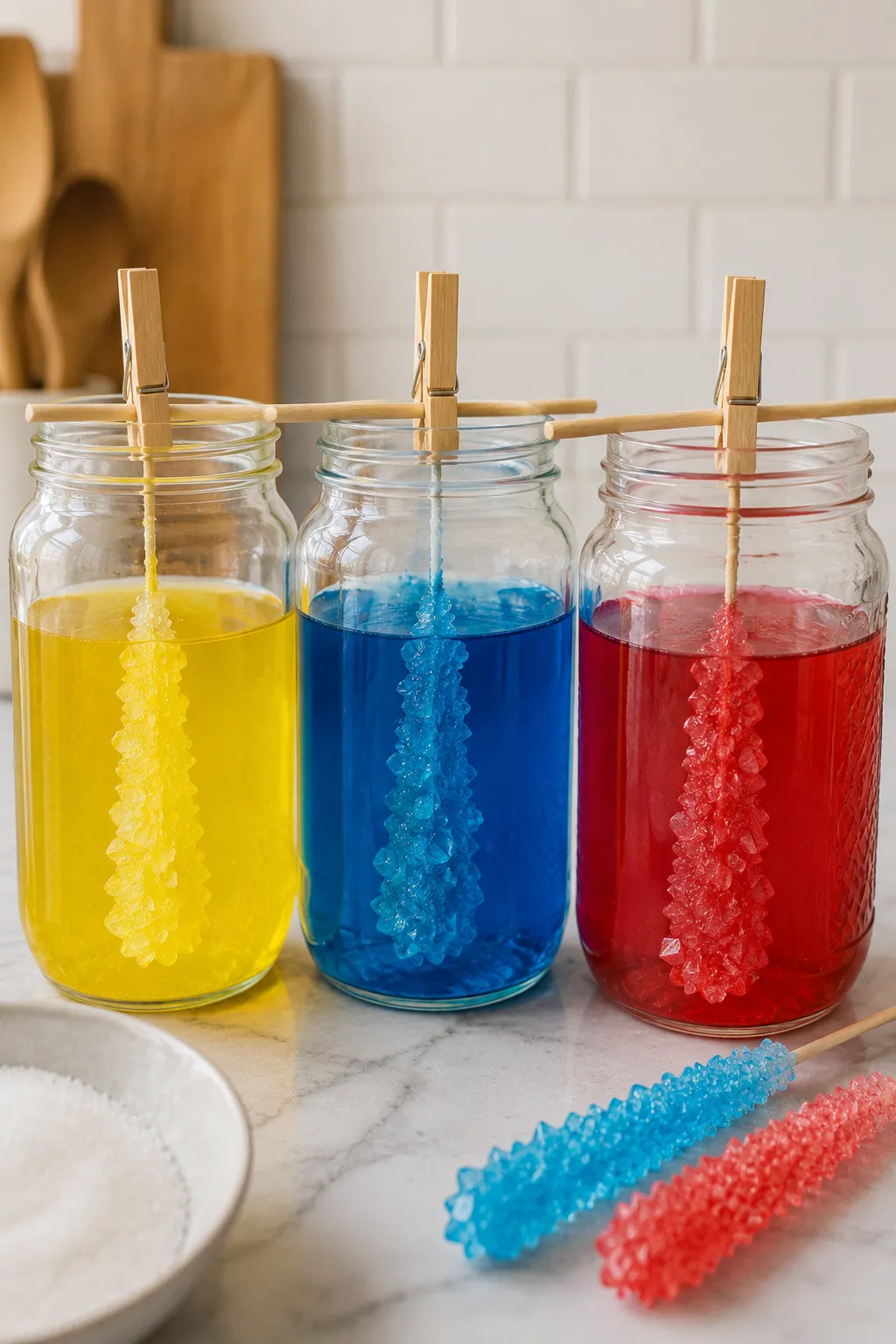
- A tall glass jar or mason jar – one per color or flavor
- Wooden skewers or cotton string – one per jar
- Clothespins or pencils – to suspend the stick across the top of the jar
- Food coloring – gel food coloring gives the most vibrant crystal color
- Flavoring extracts – optional but highly recommended (cherry, raspberry, grape, watermelon)
- A candy thermometer – not essential but helpful for consistent results
- Wax paper – for drying the prepared sticks
How to Prepare the Sticks or String
This step happens the day before you make the sugar solution and is more important than most instructions acknowledge. Skipping it is the most common reason rock candy experiments fail.
Step 1: Dampen the wooden skewer or length of cotton string with plain water so the sugar will stick to it.
Step 2: Roll or dip the damp stick or string in granulated sugar until it’s completely coated. Press the sugar in firmly so it adheres well.
Step 3: Lay the coated stick or string on a piece of wax paper and leave it to dry completely—this takes several hours or overnight. Do not rush this step.
Step 4: Once dry, check that the sugar coating is firmly attached. The sugar crystals on the stick act as seed crystals—they give the dissolved sugar in the solution something familiar to attach to when it starts crystallizing, which is why prepared sticks grow significantly more crystal than bare ones.
Step 5: Cut the string or skewer to the right length so it will hang or sit in the jar without touching the bottom or sides—crystals that touch the glass walls can fuse to them and become impossible to remove cleanly.
How to Make the Sugar Solution
Step 1: Pour 1 cup of water into a medium saucepan and bring it to a gentle boil over medium heat.
Step 2: Add the sugar one cup at a time, stirring between each addition until fully dissolved before adding the next cup. Don’t rush this—adding all the sugar at once makes it harder to dissolve fully and increases the chance of grainy, cloudy candy.
Step 3: Continue stirring over medium heat until all 3 cups of sugar are fully dissolved and the solution is completely clear with no visible sugar grains. If using a candy thermometer, you’re aiming for around 230–235°F (110–113°C)—the thread stage. This level of concentration is what creates a good supersaturated solution once cooled.
Step 4: Remove from heat and let the solution cool for 15–20 minutes. It should still be warm but not scorching hot—around 120°F or comfortable to hold the outside of the pan briefly. This is the point at which you add color and flavor.
Step 5: Add food coloring and flavoring extract and stir to distribute evenly. For gel food coloring, start with a small amount and add more for deeper color—gel is significantly more concentrated than liquid coloring and a little goes a long way.
Step 6: Pour the solution carefully into your jars, filling to about an inch from the top.
Setting Up the Experiment
Step 1: Place your prepared sugar-coated stick or string into the jar immediately while the solution is still warm. Suspend it using a clothespin balanced across the top of the jar, or tie the string around a pencil laid across the opening.
Step 2: Make sure the stick or string hangs centered in the jar without touching the walls or the bottom—at least half an inch clearance on all sides.
Step 3: Cover the top loosely with a paper towel or coffee filter secured with a rubber band. This allows water to evaporate (which is essential for crystal growth) while keeping dust and debris out of the solution.
Step 4: Move the jar somewhere it won’t be disturbed—a countertop away from foot traffic, a high shelf, or a windowsill. Vibration can disrupt crystal formation, so somewhere relatively still is better.
Step 5: Check on it every day but resist the urge to move or touch it. You should start seeing crystal formation within 24–48 hours. Crystals grow slowly and steadily over 5–7 days, becoming larger and more defined each day.
Step 6: Remove the rock candy after 7 days or when it has reached a size you’re happy with. Carefully lift the stick straight up, allow excess solution to drip off, and rest it on a piece of wax paper for 1–2 hours to dry before eating or displaying.
How to Make Multiple Flavors and Colors
Making several jars at once turns a single experiment into a proper science investigation—kids can compare crystal growth rates, crystal size, and whether color or flavoring affects the outcome.
Classic Red Cherry: Add red gel food coloring and ½ teaspoon cherry extract. Produces vivid red crystals with a bright cherry flavor.
Blue Raspberry: Blue gel food coloring plus ½ teaspoon raspberry extract. Blue crystals are always the most striking-looking and kids consistently choose this as their favorite color.
Grape Purple: A mix of red and blue food coloring to achieve deep purple, plus ½ teaspoon grape extract. Purple crystals have an almost jewel-like quality when held up to light.
Watermelon Pink: Pink food coloring (a small amount of red gel) plus watermelon extract. Pale pink crystals look delicate and pretty and the flavor is universally popular with kids.
Classic Clear: No coloring, no flavoring. Clear crystals actually show the crystal structure most clearly and work best for the science-focused observation element of the experiment—light refracts through them beautifully.
Cinnamon Gold: A tiny amount of yellow and orange food coloring mixed together, plus ½ teaspoon cinnamon extract. The warm amber color of the crystals matches the flavor and looks stunning against white paper.
Turning It Into a Proper Science Experiment
If you want to go beyond the basic recipe and turn this into a genuine structured experiment—great for school projects or older kids—here are some variables worth testing.
Does temperature affect crystal size? Make two identical solutions, set one jar in a warm spot and one in a cool spot, and compare results after 7 days.
Does the type of sugar matter? Compare white granulated sugar, raw cane sugar, and brown sugar solutions side by side. Brown sugar produces particularly interesting results—less visually striking but very educational.
Does the concentration of sugar affect growth rate? Make one jar at 3:1 sugar to water and another at 2:1 and compare how quickly crystals form and how large they grow.
Does a seed crystal coating make a difference? Prepare one stick with a sugar coating and one bare stick and place both in the same jar. The difference in crystal growth is dramatic and makes a compelling visual proof of why nucleation sites matter.
For each variable tested, help kids write a hypothesis before starting (“I think the warmer jar will grow bigger crystals because…”), record observations daily, and write a conclusion at the end. This structure is what transforms a fun kitchen activity into actual scientific method practice.
What to Do While You Wait
The 7-day waiting period is part of the experiment, not dead time. Build daily observation into the routine and it becomes one of the most valuable parts of the whole activity.
Keep a crystal growth journal next to the jars. Each day, kids draw what they see and note any changes—when the first crystals appeared, how they changed in size and shape from one day to the next, whether different colors or flavors seem to be growing at different rates.
Photograph the jars at the same time each day and compile the photos into a time-lapse sequence at the end. Even a simple slideshow of seven daily photos makes the growth process viscerally clear in a way that daily observation alone doesn’t.
Use the waiting time to read about crystal formation in other contexts—snowflakes, gemstones, salt flats, cave formations. Rock candy crystallization is the same fundamental process that creates amethysts and stalactites, just at kitchen speed.
Quick Fixes for Common Problems
| Problem | Most Likely Fix | Alternative Approach |
|---|---|---|
| No crystals forming after 48 hours | Solution may not be concentrated enough—remake with full 3:1 sugar to water ratio | Stick may not have been seed-coated—remove, re-coat with sugar, dry overnight, replace |
| Crystal crust forms on top of jar instead of on stick | Skim off the surface crust gently each day to keep the solution accessible | Move the jar somewhere slightly warmer to slow surface evaporation |
| Crystals fuse to the jar wall | Ensure stick is centered with at least ½ inch clearance from glass on all sides | Gently twist the stick once per day to prevent wall attachment |
| Crystals are very small after 7 days | Leave for up to 14 days—some batches just grow more slowly | Check that the jar is in a stable location with minimal vibration or disturbance |
| Solution looks cloudy or grainy | Sugar wasn’t fully dissolved before pouring—reheat and stir until completely clear | Strain through a fine mesh sieve before pouring into jars |
| Color is much paler than expected | Gel food coloring gives far more vivid results than liquid—switch for next batch | Add significantly more coloring—the solution looks darker than the finished crystals will |
Rock Candy Variations Worth Trying
Rock candy on a stick vs. string: Wooden skewers produce chunky, substantial candy that’s easy to hold and eat. Cotton string produces longer, thinner crystal formations that show the crystal structure more clearly—better for the science observation side. Both work; the choice depends on whether you’re prioritizing eating or studying.
Rock candy lollipops: Use lollipop sticks instead of skewers and pour the solution into small clear plastic cups rather than jars. The crystals form around the stick in a more compact formation and look exactly like a classic old-fashioned rock candy lollipop.
Geode rock candy: Pour the solution into a greased eggshell half or a small silicone hemisphere mold. As crystals form on the curved inside surface, they build into a dome shape that, once removed, looks remarkably like a crystal geode. This version is slower—plan for 10–14 days—but the result is genuinely stunning.
Rainbow rock candy set: Make six jars simultaneously in red, orange, yellow, green, blue, and purple. Display the finished sticks together in a glass as a centerpiece or give them as gifts. This version is especially popular for birthday parties and classroom demonstrations.
FAQ
Is rock candy safe for young children to eat? Rock candy is pure sugar, so it’s safe to eat but best treated as an occasional treat rather than a snack. The hard crystal surface can be sharp on edges—supervise young children while eating and consider letting them lick rather than bite the candy. The string version should have the string removed before eating.
Why didn’t my rock candy grow any crystals? The two most common reasons are an under-concentrated solution (the sugar-to-water ratio wasn’t high enough) and an unprepared stick (no seed crystal coating to give the crystals a surface to start forming on). Check both before restarting.
Can I use honey or another sweetener instead of sugar? White granulated sugar works best because its crystals are uniform and pure. Honey contains other compounds that interfere with crystallization and won’t produce the same results. Raw cane sugar works but produces smaller, rougher crystals. For the best and most visually impressive results, stick with standard white sugar.
How long does homemade rock candy last? Rock candy keeps almost indefinitely if stored in a dry place—moisture is the enemy and will cause the crystals to dissolve back into syrup. Store in an airtight container or wrapped individually in cellophane. Avoid the refrigerator as the humidity causes dissolving.
Can I speed up the process? Not without compromising crystal quality. The slow, gradual cooling and evaporation process is exactly what allows large, well-formed crystals to develop. Faster evaporation produces smaller, less defined crystals. The 7-day wait is genuinely necessary for good results and is part of what makes the patience element of the experiment valuable.
What age is this experiment best suited for? The cooking stage requires adult involvement due to the hot sugar solution—never leave kids unsupported around boiling sugar syrup, which reaches much higher temperatures than boiling water and causes serious burns. The setup, observation, and journal-keeping stages are suitable from age 4 upward. The full structured experiment with variables is most appropriate for ages 8 and up.
Conclusion
Rock candy earns its place as one of the best kids’ science experiments because it delivers on every level—real chemistry, visible daily results, a structured observation period that builds patience and scientific thinking, and a genuinely delicious payoff at the end. Prepare the sticks the night before, make the solution with plenty of sugar, set up the jars somewhere undisturbed, and check on them every morning. The moment kids spot those first tiny crystals forming on the stick after day one is one of those small science moments that genuinely sticks with them. Then they get to eat the evidence.
Enjoyed this project? Get even more DIY ideas that save (and make) you money.
Join our free newsletter for profitable DIY projects, clever cleaning hacks, home ideas, and creative crafts delivered straight to your inbox.
✓ Free forever • No spam • Unsubscribe anytime