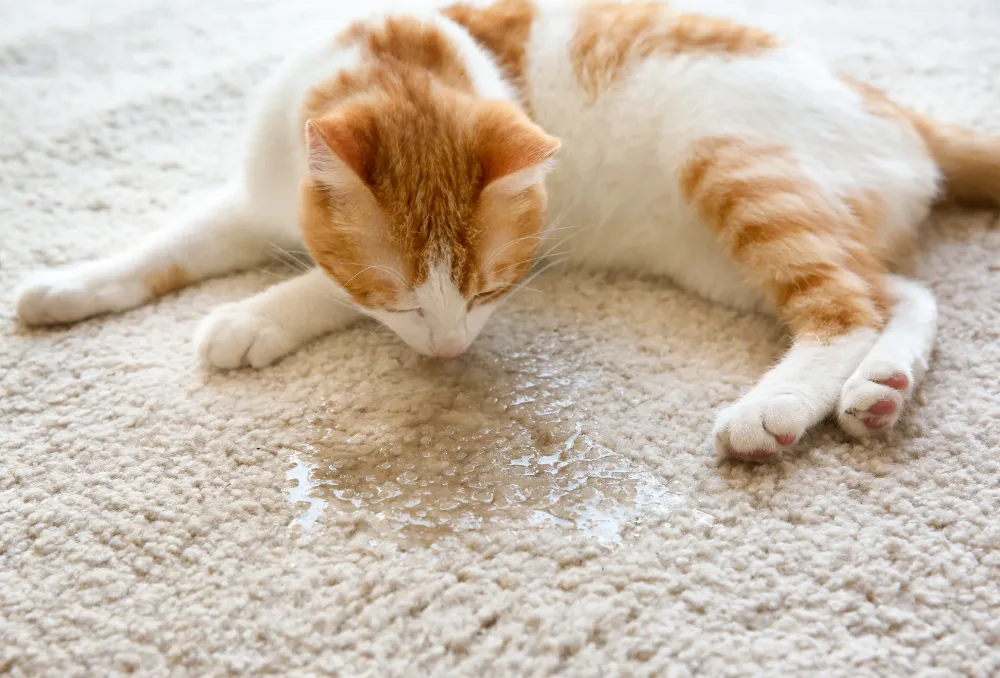
There’s a moment every cat owner knows—you walk into a room and catch that unmistakable smell before you’ve even spotted the spot. Cat urine has a way of announcing itself long before you find the source, and rugs are one of the worst places for it to land because the fibers, the backing, and sometimes a pad underneath all soak it up at once. By the time you find it, it’s often already further along than you’d like.
The reason cat pee is so much harder to deal with than most other stains comes down to uric acid. It’s the compound responsible for that sharp ammonia smell, and it doesn’t dissolve in water the way most things do. It crystallizes into the fibers and stays there, completely odorless and invisible, until humidity or warmth reactivates it and the smell comes back seemingly out of nowhere. This is why a rug that smelled fine all winter can suddenly reek again on the first humid day of summer.
The actual fix depends on a few things: how fresh the accident is, what the rug is made of, and whether it’s gone all the way through to a pad or the floor underneath. Here are six different methods, plus everything you need to know to figure out which one applies to your situation.
Why Regular Cleaning Methods Don’t Work on Cat Urine
Before getting into the methods themselves, it’s worth understanding why a quick scrub with carpet shampoo or a spray of fabric freshener never actually solves this. Most cleaning products are built to lift dirt, oils, and general grime, none of which behave anything like uric acid crystals. Spraying something that smells nice over the top just masks the smell temporarily, and the crystals are still sitting there waiting for the next humid day to reactivate.
This is also why heat is the enemy here. Steam cleaners, hot water, and hair dryers all feel like they should help, but heat actually bonds the proteins in the urine more permanently into the fibers, making the smell significantly harder to remove afterward. Every method below uses cold or lukewarm water for this exact reason.
What You’ll Need
- Paper towels or old white towels
- Rubber gloves
- An enzyme-based pet stain cleaner (this one is genuinely essential, more on why below)
- Baking soda
- White vinegar
- 3% hydrogen peroxide
- A small amount of dish soap
- Cold water
- A UV flashlight (optional, but extremely useful for finding spots you can’t see or smell directly)
- A wet vacuum or shop vac if you have access to one
Method 1: Blot First, No Matter What Method You Use Next
This isn’t really a standalone method, but it’s the step everyone skips and it makes every method below significantly more effective. If the urine is still fresh, this is where you start regardless of what you do afterward.
Press a thick stack of paper towels or an old towel directly onto the wet spot and stand on it gently, or press down with your hands, to pull as much liquid out as possible. Move to a fresh section of towel and repeat several times. Resist the urge to rub or scrub at this stage, since that just pushes the urine further into the fibers and backing rather than lifting it out.
Keep blotting until barely any moisture transfers to the towel anymore. The less urine left sitting in the rug before you apply any cleaning solution, the less work that solution has to do.
Method 2: Enzyme Cleaner (The One That Actually Works Long-Term)
If you only do one thing properly from this entire list, this is it. Enzyme cleaners work completely differently from regular cleaning products because they contain live bacterial cultures that produce enzymes specifically designed to break down uric acid, urea, and the other compounds in urine at a molecular level. Once those compounds are actually broken down rather than just diluted or masked, there’s nothing left to reactivate later, which is the whole point.
After blotting up as much fresh urine as possible, saturate the area generously with the enzyme cleaner. Don’t be shy with the amount here. The cleaner needs to reach as deep into the rug as the urine did, which means if the stain went all the way through to the backing, the cleaner needs to as well.
Cover the area loosely with a damp towel or plastic wrap and leave it for the time specified on the product label, often anywhere from 10 minutes to several hours for older or more deeply set stains. The bacteria need time and moisture to do their job, and letting it dry out too soon cuts that process short.
Blot up the excess cleaner with clean towels once the dwell time is up, but don’t rinse it out completely. Any small amount left behind in the fibers will keep working as the rug finishes drying.
Let the rug air dry fully, ideally with some airflow from an open window or a fan. If any smell remains once it’s completely dry, a second application is often needed for stains that had really set in.
Method 3: Baking Soda and Vinegar Combination
This is the classic home remedy, and it genuinely does help, particularly for relatively fresh stains or as a follow-up step after enzyme treatment for extra odor insurance. It works through neutralizing odor and mild disinfecting rather than the deep molecular breakdown enzyme cleaners offer, so think of it as a strong complement rather than a total replacement.
Mix equal parts white vinegar and cold water in a spray bottle and saturate the stained area thoroughly. Blot with clean towels, working from the outer edge of the stain toward the center so you’re not spreading it further outward. Repeat the spray and blot cycle two or three times.
Once the area is damp rather than soaking, sprinkle a generous layer of baking soda across the whole spot. In a separate small bowl, mix about half a cup of hydrogen peroxide with a teaspoon of dish soap, then drizzle this over the baking soda and gently work it in with a soft brush or gloved fingers.
Leave this mixture sitting for 15 to 20 minutes, then blot up as much as you can and let it dry completely. Vacuum up any leftover baking soda residue once it’s dry. Test the hydrogen peroxide on a hidden corner of the rug first, since it can lighten certain dyes, particularly on darker or more vibrant rugs.
Method 4: Dish Soap and Hydrogen Peroxide Spray
This method works particularly well on lighter colored rugs and tends to handle both the visible staining and a good portion of the odor in one pass, making it a solid choice when you want something effective but don’t have an enzyme cleaner on hand.
Combine one cup of hydrogen peroxide, a tablespoon of dish soap, and a tablespoon of baking soda in a bowl, stirring gently rather than shaking to avoid excessive foaming. Apply this directly to the stained area, making sure it gets down into the pile rather than just sitting on the surface.
Use a soft brush to work it gently into the fibers with a dabbing motion, again moving from the outside of the stain inward. Let it sit for 10 to 15 minutes before blotting thoroughly with clean towels.
Rinse the area with a light mist of cold water from a spray bottle and blot again, repeating this rinse step once or twice to remove any leftover soap, since soap residue left in a rug tends to attract dirt over time and creates its own ongoing problem. Sprinkle baking soda over the damp area once more and leave until fully dry before vacuuming it up.
Method 5: Wet Vacuum Extraction for Deep-Set Stains
If the urine has soaked all the way through to the rug pad or even the floor underneath, surface treatments alone often aren’t enough, and this is where a wet vacuum or shop vac becomes genuinely useful. This method works best paired with enzyme cleaner rather than on its own.
Apply enzyme cleaner generously to the affected area and let it sit for the full dwell time recommended on the product, allowing it to work its way down to wherever the urine has traveled.
Run the wet vacuum slowly over the area, making several passes to pull out as much moisture as possible from deep within the rug fibers and pad. Follow with a few dry passes, without dispensing any additional water, purely to extract whatever liquid remains.
If the smell is still noticeable once the area is dry, apply a second round of enzyme cleaner, since the extraction process may have diluted some of the first application before it had fully finished working. For rugs with a removable pad underneath, lifting the rug and treating the pad and the floor beneath separately is often necessary, since urine that’s reached that level won’t be addressed by treating the rug alone.
Method 6: Full Rug Soak (For Smaller Washable Rugs)
For smaller rugs that can be fully submerged, a complete soak often gets results that spot treatment can’t, especially for older stains where the exact source location isn’t entirely clear or the contamination has spread more broadly than a single visible spot.
Check the rug’s care label first to confirm it can handle being soaked, since not every rug material tolerates this well. Fill a bathtub or large basin with cold water and add a generous amount of enzyme cleaner according to the product’s dilution instructions.
Submerge the rug fully and let it soak for several hours, or overnight for older or more significant contamination. Periodically press down on the rug to help the solution work through all the layers.
Drain the tub and rinse the rug thoroughly with clean cold water, pressing out as much liquid as possible without wringing or twisting, which can damage certain rug fibers or backing.
Lay the rug flat to dry, ideally outdoors or somewhere with strong airflow, and avoid hanging it in a way that stretches it out of shape while wet. This can take a day or two depending on rug thickness, so plan for the room to be without the rug for a bit.
Quick Fixes for Common Problems
| Problem | Potential Solution | Alternative Suggestion |
|---|---|---|
| Smell comes back days after cleaning | Apply enzyme cleaner again with a longer dwell time to fully break down remaining uric acid | Use a UV flashlight in a dark room to check if there’s a wider spread than initially treated |
| Can’t find where the smell is coming from | Use a UV flashlight at night, since cat urine glows greenish under UV light | Get down low and follow the smell systematically across the room in sections |
| Stain reappears as the rug dries | Urine may have wicked back upward from the pad—place weighted paper towels on the spot right after treatment | Treat the rug pad and floor underneath separately, not just the rug surface |
| Hydrogen peroxide lightened part of the rug | Stop use immediately and stick to enzyme cleaner only going forward | Test any new product on a hidden corner before applying to a visible area next time |
| Rug pad underneath is soaked through | Replace the pad if the smell persists after multiple treatments, since pads are inexpensive compared to rugs | Treat both sides thoroughly with enzyme cleaner and allow extended drying time with airflow |
| Cat keeps returning to the same spot | Once fully clean and dry, use a pet deterrent spray on the area to disrupt the scent signal | Address the underlying cause, such as litter box cleanliness or a possible health issue |
When the Rug Pad or Floor Underneath Is Affected
Sometimes the rug itself can be cleaned thoroughly and the smell still lingers, which usually points to the pad beneath or the flooring itself holding onto contamination the rug treatment never reached. Lift the rug and check the pad for any dampness, discoloration, or smell of its own. A pad that’s been soaked repeatedly is often more practical to simply replace than to keep treating, since pads are far less expensive than most rugs.
If the floor underneath is hardwood, treat it with enzyme cleaner as well and allow it to dry fully before placing anything back on top, since sealing moisture and odor under a rug again just sets up the same problem to return. For tile or other hard flooring, a thorough clean with enzyme cleaner followed by a regular floor cleaner typically resolves it without further issue.
Why Cats Return to the Same Spot
A cat’s nose picks up on residual urine scent long after a human can detect anything at all, which is exactly why thorough cleaning matters beyond just making the room smell pleasant again. If any trace of the original scent signal remains, there’s a real chance the same spot gets used again.
Beyond making sure the cleaning was complete, it’s worth considering why the accident happened in the first place. A litter box that isn’t cleaned often enough, stress from a change in the household, a territorial issue with another pet, or an underlying medical condition like a urinary tract infection can all lead to inappropriate elimination outside the box. If accidents are becoming frequent or sudden, a vet visit is worth ruling out anything medical before assuming it’s purely behavioral.
FAQ
Why does cat urine smell so much stronger than other pet stains?
Cats are highly efficient at conserving water, which means their urine is significantly more concentrated than most other animals’. That concentration means more uric acid and other odor-producing compounds packed into a smaller amount of liquid, which is part of why the smell is so persistent compared to other common household stains.
Can I just use carpet shampoo instead of an enzyme cleaner?
Regular carpet shampoo is built to lift dirt and general grime, not to break down uric acid. It can make the stain look cleaner temporarily while doing very little to actually eliminate the compound causing the smell, which is why the odor so often returns later even after the rug looks completely clean.
Is it okay to put a cat-soiled rug in the washing machine?
For smaller, machine-washable rugs, yes, but only after pre-treating with enzyme cleaner and removing as much of the urine as possible first. Running a heavily soiled rug straight through the wash without pretreatment risks spreading contamination through the machine itself and often doesn’t fully resolve the smell on its own.
How many times do I need to apply enzyme cleaner before the smell is gone?
A fresh, relatively small stain often responds to a single thorough application. Older or larger stains, or ones that have soaked into a pad, sometimes need two or three treatments with full drying time in between each one before the smell is completely eliminated.
Will steam cleaning get rid of cat urine smell?
Steam cleaning is one of the few things actively recommended against here, since the heat can permanently set the proteins and uric acid into the fibers rather than removing them. Cold water extraction, whether by hand or with a wet vacuum, is the better approach for this specific type of stain.
Conclusion
Getting cat pee fully out of a rug comes down to actually breaking down the uric acid rather than just covering up the smell temporarily, and enzyme cleaner is genuinely the product that makes the biggest difference across every method here. Blot first, never use hot water or steam, give the cleaner enough time and saturation to reach as deep as the urine did, and check the pad underneath if the smell lingers after the rug itself seems clean. Done properly, the smell doesn’t come back, and neither does the cat.
Enjoyed this project? Get even more DIY ideas that save (and make) you money.
Join our free newsletter for profitable DIY projects, clever cleaning hacks, home ideas, and creative crafts delivered straight to your inbox.
✓ Free forever • No spam • Unsubscribe anytime