Carpet beetles have a way of doing serious damage before anyone notices they’re around. Unlike a lot of household pests that announce themselves immediately, carpet beetles work quietly, often in dark closets, under furniture, or inside storage boxes, chewing through wool sweaters, silk, fur, feathers, leather, and yes, carpet, for weeks or months before someone finally spots the damage or the beetles themselves. By the time you notice irregular holes in a favorite sweater or thinning patches in a rug, there’s a good chance the infestation has already been established for a while.
What makes carpet beetles particularly tricky compared to many other pests is that the adults you might spot crawling near a window are actually the least destructive stage of their lifecycle. It’s the larvae, small and fuzzy, that do almost all the actual damage by feeding on natural fibers and animal-based materials, and they’re also the stage that’s hardest to spot since they tend to avoid light and hide deep in fabric, carpet fibers, or storage containers.
Here are seven ways to actually deal with an infestation, starting with how to confirm what you’re dealing with.
How to Confirm It’s Carpet Beetles
Before treating for carpet beetles, it’s worth confirming the identification, since the damage pattern can sometimes be mistaken for other pests like moths, and the treatment approach differs somewhat between the two.
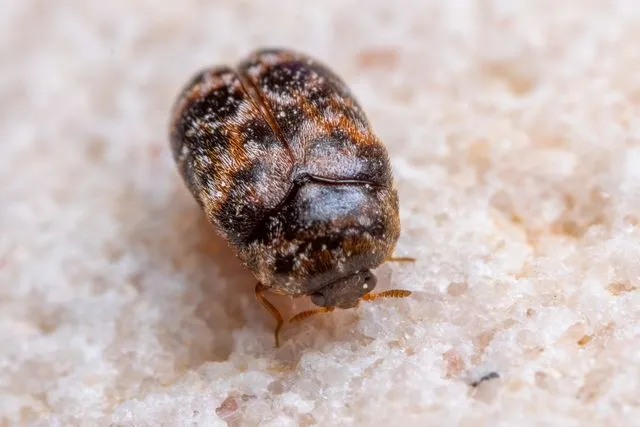
Adult carpet beetles are small, round, and often have a mottled pattern of white, brown, and orange or yellow scales, typically about an eighth of an inch long. They’re commonly found near windows, since adults are drawn to light and often end up there trying to get outside.
The larvae look completely different from the adults, appearing as small, fuzzy, carrot-shaped or oval creatures, usually brown or tan with visible bristly hairs, and they tend to be the more commonly spotted stage since they’re actively feeding within fabric, carpet, or stored items.
The damage itself tends to look like irregular holes or thinned, patchy areas in natural fiber materials, often concentrated in dark, undisturbed areas like the back of a closet, under furniture that’s rarely moved, or inside a storage box that hasn’t been opened in a while. You may also notice shed larval skins, which look like small, hollow, fuzzy casings left behind as the larvae grow and molt, and these are often one of the clearest signs of an active infestation even when you haven’t seen a live beetle or larva directly.
Why Carpet Beetles Are Hard to Get Rid of Quickly
Understanding the lifecycle here explains why a single treatment often isn’t enough and why patience matters with this particular pest. Carpet beetle eggs hatch within roughly one to two weeks, and the larval stage that follows can last anywhere from several months to over a year depending on temperature, humidity, and food availability, which is significantly longer than many other common household pests. This extended larval period is exactly why damage can be substantial by the time an infestation is discovered, and it’s also why treatment needs to be thorough and sometimes repeated, since a single pass might miss larvae that are deep within fabric or hidden in an undisturbed corner.
Adult carpet beetles also lay eggs in batches, often in secluded areas near a food source, which means a single female establishing herself in a closet or under a rug can produce dozens of larvae over her lifespan, all feeding simultaneously in slightly different stages of development.
Method 1: Thorough Vacuuming of All Affected Areas
This is the essential first step in any carpet beetle treatment and should be done regardless of which other methods you use afterward, since physical removal addresses eggs, larvae, shed skins, and adult beetles all at once without introducing any chemicals.
Vacuum every carpet and rug thoroughly, paying particular attention to edges, under furniture, along baseboards, and inside closets, since these less-disturbed areas are exactly where carpet beetles prefer to lay eggs and where larvae tend to concentrate.
Vacuum upholstered furniture completely, including cushions (lifting them to vacuum underneath and between), the underside of furniture where accessible, and any seams or crevices where larvae might be hiding.
Vacuum inside closets and drawers, including corners and along baseboards where lint and debris tend to accumulate, since carpet beetle larvae often feed on this kind of accumulated organic material in addition to actual clothing or fabric items.
Empty the vacuum canister or replace the bag immediately after vacuuming affected areas, disposing of the contents in a sealed bag outside the house, since simply emptying it back into the same room risks reintroducing any eggs or larvae that were captured.
Repeat this thorough vacuuming weekly for at least a month, since a single vacuuming session won’t capture every hidden larva, and the extended larval lifecycle means new larvae can still be developing even after an initial cleanup seems successful.
Method 2: Wash or Dry Clean All Affected and At-Risk Fabric Items
Since carpet beetle larvae feed specifically on natural fibers and animal-based materials, treating clothing, linens, and other fabric items directly is essential, particularly anything found in or near the area where damage or larvae were discovered.
Wash any affected or nearby clothing, linens, or fabric items in the hottest water the fabric can tolerate, since heat is effective at killing carpet beetle eggs and larvae in a way that cold water alone isn’t.
For items that can’t be washed in hot water, such as wool or silk, dry cleaning is an effective alternative, since the cleaning solvents used are also lethal to carpet beetles at all life stages.
For items that can’t be washed or dry cleaned at all, placing them in a sealed plastic bag and putting them in a freezer set to 0°F or below for at least 72 hours kills carpet beetles and their eggs effectively, since the sustained cold is lethal to all life stages given enough time.
Don’t just spot-treat damaged items, since carpet beetles often spread to multiple nearby items even if only one shows visible damage, so treat everything stored in the same closet, drawer, or general area rather than just the piece you initially noticed was affected.
Method 3: Steam Clean Carpets, Rugs, and Upholstery
Steam cleaning is particularly effective against carpet beetles because the high heat penetrates fabric and carpet fibers in a way that surface cleaning alone doesn’t, reaching larvae that might be hiding deeper within the material.
Use a steam cleaner on all affected carpets and rugs, working slowly enough that the steam has time to penetrate rather than just passing quickly over the surface, since the heat needs sustained contact to be effective against larvae embedded in the fibers.
Steam clean upholstered furniture as well, paying particular attention to seams, crevices, and the underside of cushions where larvae commonly hide and where surface vacuuming alone might not have reached.
Allow carpets and upholstery to dry completely after steam cleaning before resuming normal use, since trapped moisture creates conditions that could support other issues like mold, separate from the carpet beetle problem you’re addressing.
For area rugs that can be removed, consider taking them outside on a hot, sunny day in addition to steam cleaning, since direct sun and heat provide an additional layer of treatment that’s hard to achieve indoors.
Method 4: Apply Diatomaceous Earth to Affected Areas
Diatomaceous earth is a natural, non-toxic powder made from fossilized algae that works mechanically rather than chemically, damaging the exoskeleton of insects that come into contact with it and causing them to dehydrate. It’s a particularly good option for areas where you want to avoid chemical pesticides, such as around pet bedding or in rooms where children play.
Use food-grade diatomaceous earth specifically, rather than the pool-grade version, since food-grade is safe for use around pets and children when applied as directed.
Apply a thin, even layer to carpet edges, baseboards, inside closets, and any cracks or crevices where carpet beetles have been spotted or where larvae activity is suspected, using a duster or a piece of cardboard to spread it evenly rather than applying it too thickly in one spot.
Leave the diatomaceous earth in place for several days to a week, since it works gradually rather than killing on contact, giving beetles and larvae time to come into contact with the powder as they move through treated areas.
Vacuum up the diatomaceous earth thoroughly once the treatment period is complete, since while it’s non-toxic, leaving a visible powder residue around the house isn’t necessary once it’s done its job, and reapply periodically if activity continues.
Method 5: Use an Insecticide Spray Labeled for Carpet Beetles
For more significant infestations, a targeted insecticide treatment provides faster results than the methods above alone, particularly when combined with thorough vacuuming and fabric treatment rather than used as a standalone solution.
Choose a product specifically labeled for carpet beetles rather than a general all-purpose insecticide, since the formulation and application instructions are tailored to this specific pest’s behavior and hiding patterns.
Apply according to the product label directions, typically focusing on carpet edges, baseboards, closets, under furniture, and any cracks or crevices where beetles or larvae have been found, rather than treating the entire open floor area unnecessarily.
Ventilate the room well during and after application, and keep children and pets out of the treated area for the time period specified on the product label, since most insecticides require a waiting period before the area is safe for normal use again.
Reapply according to the product’s recommended schedule if activity continues, since a single application may not address larvae that are deep within carpet padding or that hatch from eggs laid before treatment.
For significant or persistent infestations that don’t respond to DIY insecticide treatment, a pest control professional can apply more targeted treatments and has access to products not available for consumer purchase, along with experience identifying hiding spots that might be missed during a DIY approach.
Method 6: Inspect and Treat Storage Areas, Closets, and Attics
Carpet beetles thrive in undisturbed storage areas, which means treating visible living spaces alone often misses a significant source of ongoing infestation if storage boxes, closets, or attic spaces aren’t addressed as well.
Go through stored items systematically, particularly anything containing natural fibers like wool blankets, fur, feathers, leather, or old clothing that’s been packed away for an extended period without being checked.
Inspect items for any visible damage, shed larval skins, or actual larvae before repacking anything, treating any affected items using the washing, dry cleaning, or freezing methods described in Method 2.
Switch to sealed plastic storage containers rather than cardboard boxes for long-term storage going forward, since cardboard provides hiding spots and can itself become a food source for carpet beetle larvae in some cases, while sealed plastic containers create a barrier that’s much harder for beetles to access.
Vacuum and clean storage areas themselves, including attic spaces, basement storage areas, and closet floors and corners, since accumulated dust, lint, and debris in these areas can harbor beetles even after the stored items themselves have been treated.
Method 7: Address the Source by Checking for Dead Insects or Animal Remains
Carpet beetles are sometimes drawn into a home not because of fabric or carpet specifically, but because of dead insects or small animal remains in less obvious areas like wall voids, chimneys, or attics, which serve as an initial food source that allows a population to establish before spreading to fabric items throughout the house.
Check chimneys, attics, and any areas where birds, rodents, or insects might have died or nested, since carcasses and nesting debris in these locations can support carpet beetle larvae feeding on the organic material before the population expands and starts looking for food sources elsewhere in the house.
Look specifically near light fixtures and windows for accumulated dead insects, since these collection points are a surprisingly common, overlooked food source that allows a small carpet beetle population to persist undetected for a while before becoming a more noticeable household infestation.
Clean out and address any of these sources you find, removing dead insects or animal remains and treating the area, since leaving an underlying food source in place means new generations of carpet beetles can continue developing there even after you’ve thoroughly treated the more obvious areas of the house.
For chimney or attic access issues, particularly involving dead animals or extensive nesting material, a pest control or wildlife removal professional may be the safer and more practical option rather than attempting this yourself.
Quick Fixes for Common Problems
| Problem | Potential Solution | Alternative Approach |
|---|---|---|
| Found damage but no visible beetles or larvae | Look for shed larval skins near the damage, which confirm an active or recent infestation | Check nearby dark, undisturbed areas like closet corners and under furniture for hiding larvae |
| Treated once but still seeing activity weeks later | The extended larval lifecycle means a single treatment often isn’t enough—repeat vacuuming and treatment weekly for a month | Check storage areas and less obvious spots like attics or chimneys for an ongoing source |
| Damage is appearing on multiple items in different rooms | Check for a shared source, such as a chimney or attic area with dead insects or animal remains | Treat all natural fiber items throughout the house, not just the ones with visible damage |
| Not sure if it’s carpet beetles or moths causing the damage | Look for the larvae specifically—carpet beetle larvae are fuzzy and oval, while moth larvae are more worm-like | Check for adult beetles near windows, since this is a distinguishing sign specific to carpet beetles |
| Diatomaceous earth doesn’t seem to be working | It works gradually over days, not instantly—give it a full week before reassessing | Combine with vacuuming and insecticide spray for faster results on an active infestation |
| Stored items keep getting reinfested after cleaning | Switch to sealed plastic containers rather than cardboard boxes going forward | Inspect and treat the storage area itself, not just the items being stored |
How to Prevent Carpet Beetles From Coming Back
Once an infestation has been addressed, a few ongoing habits significantly reduce the chance of it recurring, since carpet beetles are drawn to specific conditions that are largely within your control to manage.
Vacuum regularly, including under furniture and in closets, rather than only when you suspect a problem, since consistent vacuuming removes potential food sources like lint, hair, and skin cells before they can accumulate enough to support a developing population.
Store natural fiber clothing and items in sealed containers rather than open boxes or bags, particularly for seasonal items that sit untouched for months at a time, since this single change removes easy access to a major food source.
Check stored items periodically rather than packing them away and forgetting about them for years, since catching a small issue early is far easier to resolve than discovering significant damage after an extended period of neglect.
Address any dead insect accumulation near windows, light fixtures, or in attics and chimneys promptly, since removing this food source prevents the kind of underlying population that can eventually spread to fabric and carpet throughout the house.
FAQ
Do carpet beetles bite humans or pets?
No, carpet beetles don’t bite people or animals. Some people experience skin irritation from contact with the bristly hairs on the larvae, similar to a mild allergic reaction, but they aren’t parasitic and don’t feed on humans or pets the way some other household pests do.
How long does it take to fully get rid of a carpet beetle infestation?
Given the extended larval lifecycle, expect the full process to take several weeks to a few months for a well-established infestation, even with consistent treatment. A minor, early-caught infestation can often be resolved within a few weeks of thorough vacuuming and targeted treatment.
Can carpet beetles infest synthetic carpet or fabric?
Carpet beetle larvae feed specifically on natural fibers and animal-based materials like wool, silk, fur, feathers, and leather, so purely synthetic carpet and fabric aren’t a food source on their own. However, blended materials containing any natural fiber percentage, or synthetic carpet with accumulated organic debris like food particles, hair, and skin cells, can still support an infestation.
Will getting rid of the adult beetles solve the problem?
No, and this is one of the most important things to understand about this particular pest. Adult beetles you see near windows are the least damaging stage and are often just trying to find their way outside. The larvae causing the actual damage are usually hidden and require direct treatment of affected fabric, carpet, and storage areas rather than just addressing visible adults.
Is it necessary to throw away damaged clothing or can it be saved?
In most cases, damaged items can be saved if the infestation is treated promptly using hot water washing, dry cleaning, or freezing. Items with extensive damage covering a large area, or sentimental pieces where any visible repair would be impractical, may not be worth the cleaning effort, but the damage itself doesn’t necessarily mean the item is unsalvageable from an infestation standpoint.
Conclusion
Getting rid of carpet beetles for good requires treating every stage of their lifecycle and every location where they might be hiding, not just the spot where you first noticed damage. Vacuum thoroughly and repeatedly, treat all natural fiber items in the affected area rather than just the obviously damaged ones, and check less obvious sources like attics, chimneys, and storage boxes that might be sustaining the population without your knowledge. Be patient with the timeline, since the extended larval stage means this isn’t typically a one-treatment fix, but consistent, thorough effort over a few weeks genuinely resolves it.
Enjoyed this project? Get even more DIY ideas that save (and make) you money.
Join our free newsletter for profitable DIY projects, clever cleaning hacks, home ideas, and creative crafts delivered straight to your inbox.
✓ Free forever • No spam • Unsubscribe anytime