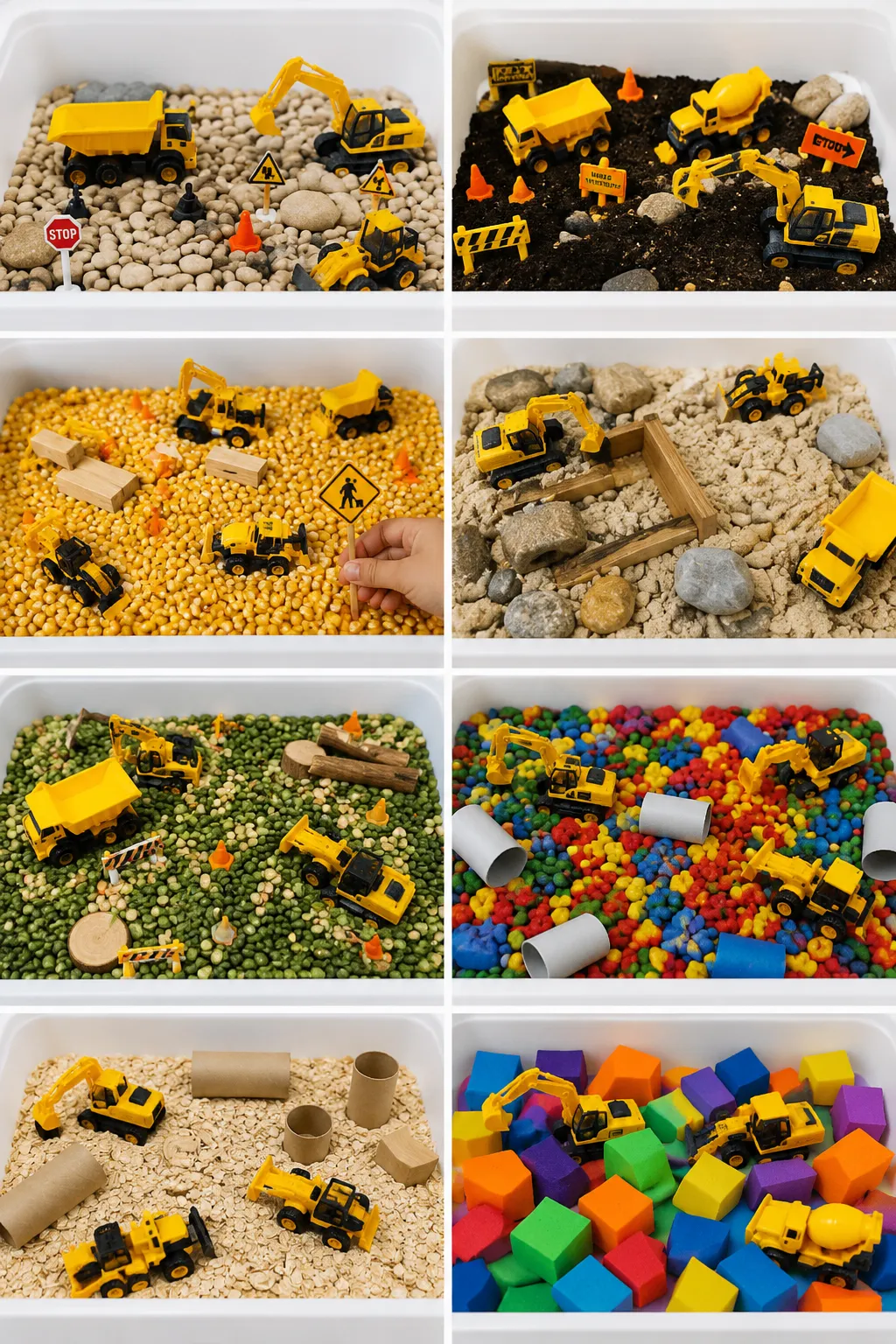
There’s a reason construction themes are endlessly popular with toddlers and preschoolers. Trucks, diggers, dumpers, and bulldozers tap into something fundamental about how kids this age want to interact with the world, moving things, filling things, dumping things out, and doing it all over again with absolute commitment. A construction sensory bin takes that natural interest and gives it a sensory-rich environment to play out in, which is why kids who might walk away from a regular toy bin after ten minutes will stay completely absorbed in a construction sensory setup for an hour or more.
The base concept is simple: fill a bin with a sensory material that mimics a construction site environment, add some trucks and tools, and let the imaginative play take over. What keeps it interesting across multiple setups is varying the sensory base material, the props, and the theme within the broader construction category, since each variation feels genuinely different to play in even though the core activity is the same.
Here are eight different construction sensory bin ideas, each with its own sensory base, suggested props, and play ideas to get the most out of each setup.
What You’ll Need for Any Construction Sensory Bin
Before getting into specific ideas, a few supplies apply across almost every version on this list.
For the bin itself, any large plastic storage container, under-bed storage box, or shallow plastic tray works well. Wider and shallower tends to work better than narrow and deep for this kind of play, since it gives kids more surface area to move trucks around on and makes it easier to access every part of the bin without tipping over.
For trucks and construction vehicles, a basic set of small plastic construction vehicles is the most used prop across every version below. Dump trucks, bulldozers, excavators, and cement mixers are all popular. Toy construction workers or small figurines add a narrative layer that extends play time.
For tools and accessories, small shovels, spoons, funnels, cups, and containers for scooping and pouring add a lot to the play without adding much cost, and most of these can come straight from a kitchen drawer.
A mat or tray underneath the bin catches overflow and makes cleanup significantly faster, particularly for the looser, messier base materials.
Idea 1: Dirt and Gravel Construction Site
This is the most straightforward construction sensory bin setup and often the one that produces the most immediate, enthusiastic response from kids who love anything that feels like real outdoor digging. The combination of actual soil and small pebbles looks and feels like a genuine construction site, which makes the imaginative play feel more convincing than any other base material.
Use potting mix or plain outdoor soil as the main base, filling the bin to about three to four inches deep. Add a layer of small gravel or decorative pebbles on top for texture variation and to mimic the look of a construction site surface.
Embed small rocks, sticks, or flat pieces of bark partially in the soil for trucks to excavate around, giving the play a purposeful element rather than just general digging.
Add a small amount of water to one corner of the bin to create a wet mud patch alongside dry soil, since the texture difference between wet and dry adds a significant sensory element that kids explore and compare.
Set up small construction vehicles throughout the bin, a bulldozer pushing gravel, a dump truck being loaded with scoops of soil, and an excavator digging near the rocks, with the basic narrative already implied by the placement.
This version is best done outside or with a very large mat underneath, since soil and gravel make the messiest overflow of any version on this list.
Idea 2: Sand Construction Site
Sand is one of the most classic and widely used sensory bin bases for good reason. It’s easy to find, easy to manage, and has a texture that’s satisfying to dig, scoop, pour, and smooth in a way that makes it almost self-perpetuating as an activity. A sand-based construction bin has an immediate, intuitive appeal that works across a wider age range than some of the more specific themes below.
Fill the bin with play sand to a depth of about four to five inches, deep enough for small trucks to drive through and leave visible tracks without hitting the bottom of the bin immediately.
Dampen a section of the sand before play, since moist sand holds shapes and can be packed and molded into hills, tunnels, and ramps in a way dry sand alone can’t, which adds a building and construction element on top of the basic digging.
Add small pebbles, flat rocks, and plastic road signs or cones for a full construction site environment, and lay a piece of cardboard painted gray as a road section partially embedded in the sand for trucks to drive on and off.
For an extra sensory dimension, add a small amount of kinetic sand to one corner of the regular play sand, since the different texture and behavior of kinetic sand compared to regular sand creates an interesting sensory comparison during play.
Idea 3: Black Bean and Gravel Road Construction
This version uses dried black beans as the sensory base, which has a surprisingly convincing visual similarity to freshly laid asphalt when viewed from the right angle. It’s also one of the tidiest construction bin setups since black beans are less messy than soil or sand and easier to sweep up if they escape the bin.
Fill the bin with dried black beans and mix in a handful of small gray or white pebbles throughout to give the “asphalt” a more varied, realistic texture.
Lay pieces of gray cardstock or construction paper on the surface of the beans to act as road sections being constructed, with trucks positioned at the edges of the “road” as if laying it down.
Add small orange traffic cones, made from orange model clay or small orange beads if toy versions aren’t available, and position them along the road edges for a convincing road construction scene.
Include a few white chalk-drawn road markings on the cardstock road sections before placing them in the bin, since the detail makes the whole setup look more complete without much extra effort.
The smell of dried black beans is noticeable and pleasant during play, which adds an unexpected olfactory sensory element alongside the visual and tactile ones.
Idea 4: Kinetic Sand Construction Zone
Kinetic sand deserves its own construction bin setup rather than just being used as an add-on to regular sand, since its unique moldable, slightly sticky properties that allow it to hold shapes while still flowing between fingers give it a completely different play quality from any other sensory base material.
Fill the bin with kinetic sand, which is available at most toy stores and online. The natural tan or brown color works perfectly as a construction base without any modification, though the black version is particularly convincing as an asphalt or soil base.
Because kinetic sand holds shapes so well, this version lends itself particularly well to building and construction play rather than just digging. Kids can use small molds to create building foundations, shape roads and ramps, and stack or sculpt the sand into structures that actually hold their form long enough to be played with.
Add small plastic building pieces, like Duplo or other large plastic blocks, partially embedded in the kinetic sand as building foundations that construction vehicles can work around.
The cleanup advantage of kinetic sand, that it sticks to itself rather than to surfaces and is easy to retrieve and return to the bin, makes this version particularly practical for indoor use compared to soil or regular sand.
Idea 5: Oatmeal and Rice Demolition Site
Using a mixture of oatmeal and rice as the sensory base creates a terrain that looks and behaves differently from sand or soil, with a lighter, airier texture that makes digging and moving material more effortless for small hands and smaller vehicles.
Mix equal parts dry oatmeal and dry white rice in the bin, filling to about four inches deep. The combination of the two textures, the rough grainy texture of the oatmeal against the smooth slippery texture of the rice, makes this particularly interesting from a sensory standpoint.
Frame this version as a demolition site rather than a general construction site by partially burying small cardboard structures, cardboard tubes, small boxes, and flat pieces of cardboard stacked to look like walls, for vehicles and hands to knock down, excavate, and clear away.
Add a fine layer of cornmeal or flour on top of some sections to create a dusty demolition site atmosphere, since the visual of a dusty, powdery surface over the buried structures looks convincingly like a real demolition scene.
This is one of the most taste-safe versions on the list for very young toddlers, since all of the base materials are genuine food products, though the flour or cornmeal topping would need to be omitted for a baby version where mouthing materials is a concern.
Idea 6: Moon Sand Tunnel Construction
Moon sand, made from a simple mixture of eight parts flour to one part baby oil, has a unique dry-but-moldable texture that’s unlike any other sensory base material. It holds impressions and shapes almost like playdough but crumbles when you squeeze it, which makes it particularly satisfying for construction play where building and destroying happens in rapid cycles.
Make a large batch of moon sand by mixing eight cups of flour with one cup of baby oil, working the oil through the flour thoroughly until the texture is uniform and the mixture holds its shape when squeezed but crumbles cleanly when released.
This version works particularly well as a tunnel construction theme, since moon sand holds its shape well enough to form tunnels and bridges that small vehicles can actually drive through rather than immediately collapsing.
Pack the moon sand firmly into the bin to create a landscape with hills and valleys rather than a flat surface, since the moldable quality of the material makes this kind of terrain building quick and easy before the main play even starts.
Add a small supply of craft sticks or popsicle sticks as bridge-building materials and a few cotton balls or pieces of foam as rocks to be moved and relocated during play.
Idea 7: Colored Rice and Pebble Excavation Site
Colored rice adds an extra visual dimension to the construction sensory bin that regular white rice doesn’t have, turning the base material itself into something visually interesting that draws kids in even before any vehicles are added. The process of making colored rice is also a quick activity in its own right that older kids can participate in ahead of the main play.
To make colored rice, place dry white rice in a zip-lock bag with a few drops of food coloring and a small splash of white vinegar, seal the bag, and shake it until the color coats all the rice evenly. Spread on a baking sheet to dry for a couple of hours before using. Make several different colors and layer or mix them in the bin for a more visually striking base.
Frame this version as an excavation and mineral mining construction site, embedding small plastic gems, glass beads, or painted pebbles throughout the rice for vehicles and hands to excavate and discover.
Add small sieves or slotted spoons so kids can sift the rice to find the buried gems, which adds a discovery element that keeps the play going longer than basic digging alone would sustain.
Label the “minerals” by color and create a simple sorting chart next to the bin, so kids can sort found gems by color or type as they excavate them, adding a math and classification component alongside the sensory play.
Idea 8: Cloud Dough Road Building Site
Cloud dough, made from flour and baby oil in roughly the same ratio as moon sand but with a slightly softer, more powder-like quality, creates a construction sensory base that looks exactly like soft white sand or plaster while feeling completely different from either one under the hands.
Mix four cups of flour with half a cup of baby oil, working the oil through thoroughly until the mixture has a fine, silky texture that crumbles loosely when dropped but packs together when squeezed. Add a small amount of cornstarch for extra softness if desired.
This version works particularly well as a road building theme, since cloud dough can be packed and smoothed into flat road surfaces that hold their shape long enough for vehicles to drive on before crumbling away and needing to be rebuilt.
Color sections of the cloud dough with food coloring before adding to the bin, kneading the color in before placing each section, to create different zones of the construction site in different colors, such as gray for roads, brown for earth, and green for grass areas being built around.
Add small street signs, traffic cones, and miniature figurines of construction workers to the bin alongside the vehicles to build out a full narrative construction scene that kids can direct and rearrange throughout their play.
Quick Fixes for Common Problems
| Problem | Potential Solution | Alternative Approach |
|---|---|---|
| Sensory material escaping the bin constantly | Use a bin with higher sides or place a fitted shower curtain liner under and around the bin to extend the catch zone | Set the bin inside a larger plastic storage lid which acts as a wide tray for overflow |
| Kids lose interest after 15 minutes | Add a new element mid-play, such as burying small gems to find or introducing water to one corner | Introduce a new vehicle or figure they haven’t seen before to restart the narrative |
| Younger siblings grabbing everything unsafely | Set up a baby-safe parallel bin nearby with only large smooth items and a safe sensory base like water beads or plain rice | Involve the younger child in the setup process so they feel included from the start |
| Dry sensory bases making too much dust | Lightly mist with water from a spray bottle to dampen slightly without making it wet | Switch to a damper base material like kinetic sand or moon sand for indoor use |
| Trucks getting clogged with sensory material | Use slightly larger toy vehicles with bigger wheel clearances, since smaller detailed vehicles clog more easily | Keep a small brush nearby to clear vehicle wheels periodically during play |
| Setup feels the same every time | Rotate the base material rather than using the same one repeatedly, since each material feels completely different to play in | Change the narrative theme even with the same base material, from general construction to tunnel building or demolition |
Tips for Getting the Most Out of Construction Sensory Bins
Set up the bin before calling kids over, since arriving to a fully arranged, visually interesting setup produces a stronger initial reaction and engagement than watching the setup happen.
Follow the child’s lead rather than directing the play, since open-ended construction bin play is most valuable when kids are inventing their own scenarios rather than following a set activity.
Rotate the base material every few sessions rather than using the same one every time, since each material feels genuinely different under the hands and wheels, making the activity feel fresh even with the same vehicles and props.
Introduce new props gradually rather than all at once, since adding one new element to an existing setup often re-engages a child who was starting to wind down more effectively than replacing the whole setup.
Take photos of the constructions kids create during play, since kids who see their own creations photographed feel their work has been recognized and valued, which increases investment in the activity over time.
FAQ
What age is a construction sensory bin best suited for?
The basic digging and truck play works from about 18 months upward, with the base material chosen based on age and safety considerations. Taste-safe versions like oatmeal and rice work for younger toddlers still prone to mouthing everything, while older preschoolers and school-age kids can handle all the versions including soil, gravel, and kinetic sand.
How do I store leftover sensory bin material between uses?
Most dry base materials, including sand, rice, oatmeal, and moon sand, store well in airtight containers or large zip-lock bags between sessions. Soil should be kept outdoors between uses. Kinetic sand can be stored in its original container or any sealed plastic container and stays usable indefinitely.
How long does a construction sensory bin typically keep kids engaged?
This varies enormously by age and setup, but a well-set-up construction bin with an interesting base material and a good selection of vehicles and props typically holds toddler attention for 30 to 45 minutes and preschooler attention for 45 to 90 minutes. The more varied and interesting the props, the longer the engagement tends to last.
Can I set this up indoors or does it need to be outside?
Most versions can be done indoors with a good mat underneath and reasonable expectations about some overflow. Soil and gravel versions are best kept outside, and sand is easiest to manage outdoors as well. Kinetic sand, moon sand, cloud dough, rice, oatmeal, and black beans are all practical indoor options.
Do I need to buy a special bin or does any container work?
Any large plastic container works. Under-bed storage boxes are popular because they’re wide, shallow, and have a lid for storage between uses. Large plastic storage totes, concrete mixing trays from hardware stores, and baby bathtubs all make excellent sensory bin containers.
Conclusion
Construction sensory bins work as well as they do because they combine two things toddlers and preschoolers are deeply drawn to, trucks and digging, with the kind of open-ended sensory environment that sustains attention far longer than either element alone would. Choose a base material that suits your space and cleanup tolerance, set out a selection of vehicles and tools, and let the play find its own direction from there. Rotate through the different ideas on this list and the activity stays fresh across weeks and months of play rather than becoming something kids have exhausted after a session or two.
Enjoyed this project? Get even more DIY ideas that save (and make) you money.
Join our free newsletter for profitable DIY projects, clever cleaning hacks, home ideas, and creative crafts delivered straight to your inbox.
✓ Free forever • No spam • Unsubscribe anytime