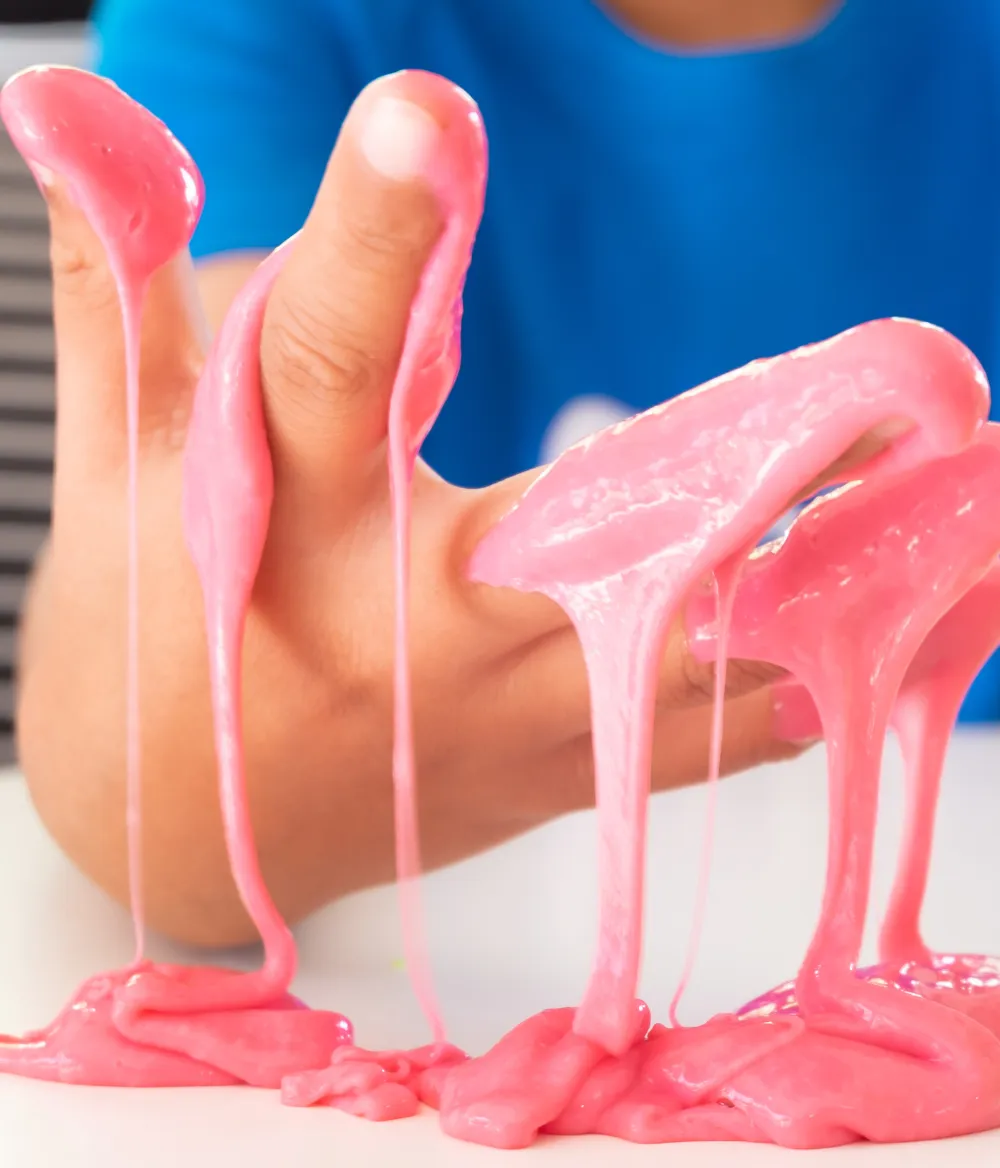
Sticky slime is the most frustrating outcome in slime-making, and it’s also the most common one. You follow the recipe, the slime looks right in the bowl, and then the moment you pick it up it coats your hands and refuses to let go. Or it was fine yesterday and today it’s inexplicably sticky again. Or you’ve been kneading for five minutes and it’s getting stickier rather than less so.
All of these situations have specific causes and specific fixes, and most of them take less than two minutes to resolve once you know what’s actually happening. The key is diagnosing the right cause before reaching for more activator, because adding more activator is the instinctive response but it’s also how slime ends up tough, rubbery, and overworked.
Why Slime Gets Sticky: The Main Causes
Understanding the cause is what makes the fix work rather than just guessing.
Under-activation is the most common reason for sticky slime in a freshly made batch. Not enough activator means the polymer network hasn’t cross-linked sufficiently to produce a cohesive, non-sticky gel. The fix is more activator, but added carefully and gradually rather than in large amounts.
Warm hands make already-made slime stickier during play even when the slime itself is perfectly activated. Body heat softens and loosens the polymer network slightly, which is why slime that felt fine at the start of a play session sometimes feels sticky fifteen minutes in. This isn’t a recipe problem and doesn’t need more activator.
Humidity causes slime to absorb moisture from the air, which loosens the polymer network and increases stickiness. This is especially noticeable on humid or rainy days and in bathrooms or kitchens where ambient moisture is higher.
Too much colorant or add-ins can interfere with the activator ratio. Liquid food coloring adds extra water to the slime base, which effectively dilutes the activator and makes the slime stickier than it would be without the added liquid.
Incorrect storage that exposes the slime to humidity or that doesn’t fully seal the container allows moisture from the environment to be absorbed into the slime, progressively making it stickier over hours or days.
The slime type itself has different baseline stickiness levels. Fluffy slime is naturally sticker than standard slime. Butter slime has a different sticky quality from clay content. Jiggly slime is supposed to feel somewhat wet and loose. Knowing what the target texture for each type actually feels like prevents fixing something that isn’t broken.
What Not to Do
Before getting into the fixes, a few responses that feel right but consistently make things worse.
Don’t dump in a large amount of activator at once. More activator feels like the obvious answer to sticky slime, but adding too much too fast crosses the line from sticky slime to over-activated slime, which is tough, rubbery, and breaks rather than stretches. Once slime is over-activated it’s very difficult to fix, whereas under-activated slime is straightforward to correct.
Don’t add water to try to smooth it out. Water makes slime stickier, not less sticky, since it dilutes whatever activator is already present and loosens the polymer network further.
Don’t knead aggressively for long periods hoping it will fix itself. Kneading does help activate slime, but kneading alone doesn’t add activator, and slime that’s under-activated doesn’t become non-sticky from kneading alone without some additional activator.
Don’t give up immediately. Most sticky slime is fixable quickly and doesn’t need to be thrown away.
Fix 1: Add More Activator (For Under-Activated Slime)
This is the right fix when the slime is a fresh batch that hasn’t reached the correct consistency yet, or when the slime was stored correctly but has been sitting long enough that the activator concentration shifted.
- Add one drop of contact lens solution directly to the slime.
- Knead thoroughly for at least sixty seconds before assessing the stickiness level.
- If still sticky, add one more drop and knead again for another sixty seconds.
- Continue this one-drop-at-a-time process, assessing after each addition, until the slime is no longer sticky.
- Stop immediately when stickiness resolves, since the next drop after that is often what tips the slime into over-activation.
The patience required here is genuinely important. The instinct is to add several drops at once to speed things up, but the difference between correctly activated and over-activated slime in a small batch can be as little as one or two drops of contact lens solution.
Fix 2: Knead With a Small Amount of Lotion (For Warm Hands and Play Session Stickiness)
When slime was non-sticky earlier in the same play session but has become sticky from handling, more activator is usually not the answer. The slime itself hasn’t changed, body heat and friction have temporarily loosened the surface slightly.
- Apply a small amount of fragrance-free lotion to your hands, roughly the size of a pea.
- Work it into your hands briefly before picking up the slime.
- Knead the slime with the lotion-coated hands for thirty to sixty seconds.
- The lotion acts as a lubricant between the slime and the skin surface, reducing the stickiness sensation without changing the activator ratio.
This fix is particularly effective for fluffy slime and butter slime, where stickiness from warm hands is a common experience during longer play sessions.
Fix 3: Dust With a Small Amount of Cornstarch or Baby Powder (For Surface Stickiness)
When slime feels sticky only on the outside surface but the interior is the right consistency, a light dusting of cornstarch or baby powder addresses the surface tack without affecting the overall slime chemistry.
- Dust a very small amount of cornstarch onto the surface of the slime ball.
- Knead it in gently.
- Continue adding tiny amounts and kneading until the surface stickiness resolves.
- Use sparingly, since too much cornstarch changes the texture and color of the slime noticeably over time.
This works particularly well for clear slime where adding more contact lens solution risks overcrowding the activator and losing the translucency, and for slimes with add-ins where you want to fix surface stickiness without disturbing the internal bead or glitter distribution.
Fix 4: Refrigerate the Slime (For Humidity-Related Stickiness)
When slime has become sticky due to humidity absorption from the environment, the fix is removing that excess moisture rather than adding more activator.
- Place the sticky slime in an airtight container.
- Refrigerate for thirty to sixty minutes.
- Remove from the refrigerator and knead briefly with dry hands.
- The cooler temperature removes some of the excess absorbed moisture and firms up the polymer network temporarily.
This is a short-term fix rather than a permanent one since the slime will return to ambient temperature and conditions after a while, but it makes the slime playable for a session and buys time to address the storage conditions causing the humidity absorption.
Fix 5: Baking Soda Addition (For Slime That’s Very Sticky and Not Responding to Contact Lens Solution)
When slime is very sticky and repeated small additions of contact lens solution aren’t making a noticeable difference, the issue is sometimes that there isn’t enough baking soda in the batch to allow the boric acid in the contact lens solution to work effectively.
- Add a tiny pinch of baking soda, significantly less than a quarter teaspoon, to the slime.
- Knead thoroughly for one to two minutes.
- If the texture improves, add one to two drops of contact lens solution and knead again.
- Continue this baking soda plus contact lens solution approach in very small amounts if the slime is still sticky.
This fix works because baking soda and boric acid react together to create the cross-linking that makes slime non-sticky, and a batch with too little baking soda relative to the glue amount may not respond well to contact lens solution alone.
Fix 6: The Glycerin Method (For Slime That’s Slightly Sticky but Has Good Stretch)
Glycerin is a skin-safe, colorless liquid available at most pharmacies that acts as a lubricant and plasticizer in slime without adding water or changing the activator ratio. It’s particularly useful when slime is just barely sticky, has good stretch already, and you don’t want to risk over-activating.
- Add one to two drops of glycerin to the slime.
- Knead thoroughly for sixty seconds.
- Assess the stickiness.
- Add one more drop if still slightly sticky and knead again.
Glycerin also adds a nice smoothness to the slime texture and a slight sheen that many people find improves the look and feel of the finished slime as a bonus effect alongside fixing the stickiness.
Fix 7: Rebuild the Batch (When Slime Is Too Far Gone)
Sometimes slime has been over-handled, contaminated, or has absorbed enough environmental moisture that no surface fix produces a lasting result. At this point, using the sticky slime as part of a new batch rather than trying to fix it in isolation is the most effective approach.
- Make a fresh, correctly activated slime batch.
- Knead the sticky slime together with the fresh batch, combining them thoroughly.
- The fresh batch’s activator helps pull the sticky slime into the correct consistency range.
- If the combined batch is still sticky, add one drop of contact lens solution at a time and knead until resolved.
This method works particularly well when you have leftover sticky slime from a previous session and want to save it rather than throw it away.
How to Prevent Slime From Getting Sticky in the First Place
Most stickiness problems are easier to prevent than to fix after the fact.
- Add activator slowly from the start. The slow addition approach during making prevents both under-activation and over-activation by giving the polymer network time to form between additions.
- Always wash and dry hands completely before handling slime. Moisture and oils from hands are the biggest contributors to stickiness developing during play.
- Store in a fully airtight container immediately after play. Humidity absorption is the most common reason for correctly made slime to become sticky during storage.
- Keep play sessions in low-humidity environments when possible. High-humidity days produce sticky slime regardless of how well it was made, since moisture absorption is ongoing during play.
- Avoid adding too much liquid coloring. Liquid food coloring adds extra water to the slime base. Use gel food coloring instead, which adds concentrated color with minimal added liquid.
- Let the slime rest for five minutes after making before deciding it needs more activator. Some batches firm up slightly during a short rest as the cross-linking continues on its own.
Slime Type-Specific Stickiness Notes
Different slime types have different baseline textures, and what counts as correctly fixed stickiness varies between them.
Fluffy slime is naturally softer and slightly tackier than standard slime because of the shaving cream incorporated into the base. If fluffy slime sticks slightly to hands during early play but not aggressively, that’s within the normal range for this type rather than a problem requiring a fix.
Butter slime has a unique soft, spreadable stickiness from the clay content that’s part of the correct texture rather than a flaw. Over-activating butter slime to eliminate all stickiness produces a tough, unspreadable texture. A light tackiness is correct for this type.
Clear slime often feels slightly sticky compared to white glue slime even when correctly activated because clear glue’s polymer behaves differently from white glue. If clear slime is slightly tacky but doesn’t coat the hands or leave residue, it’s likely within the correct range.
Jiggly slime is inherently soft and somewhat wet feeling compared to standard slime because of the high water content in the recipe. Trying to fix jiggly slime to a non-sticky standard slime consistency will ruin the texture entirely.
Edible slimes made from peanut butter, marshmallow, or similar bases have their own stickiness dynamics that respond to food-grade adjustments like powdered sugar rather than activator-based fixes.
Quick Fixes for Common Problems
| Problem | Potential Solution | Alternative Approach |
|---|---|---|
| Fresh slime is sticky from the start | Add contact lens solution one drop at a time, kneading fully between each addition | Check that the contact lens solution contains boric acid, since solutions without it don’t activate slime |
| Slime was fine yesterday but sticky today | Humidity absorption during storage is the likely cause—refrigerate briefly and knead with dry hands | Check that the storage container was fully airtight, since even a small gap allows humidity in |
| Slime gets stickier the more it’s kneaded | Warm hands are softening the polymer—apply a small amount of lotion to hands and take a break | Refrigerate the slime for 20 minutes to firm it back up before continuing |
| Added too much activator trying to fix stickiness and now it’s rubbery | Knead in a small amount of lotion or clear hair gel to soften the over-activated slime | Add a small amount of fresh unactivated glue and knead through to dilute the activator concentration |
| Sticky slime that won’t respond to contact lens solution | Add a tiny pinch of baking soda before the next drop of contact lens solution | The glue may be old or partially dried out—this sometimes reduces its ability to activate properly |
| Slime sticks in specific spots but not others | Uneven activator distribution during making—knead more thoroughly to distribute activator evenly | Add one drop of contact lens solution and focus kneading on the sticky sections |
| Fluffy slime immediately sticky after making | Shaving cream adds moisture that competes with the activator—add slightly more contact lens solution in very small increments | Add a small amount of baking soda before the next contact lens solution addition |
FAQ
How do I know if my slime needs more activator or just a rest?
Rest the slime for five minutes in a sealed container before adding anything. Slime that firms up during the rest period didn’t need more activator. Slime that remains just as sticky after resting probably does need a small additional amount.
Can I use hand sanitizer instead of contact lens solution to fix sticky slime?
Hand sanitizer contains alcohol rather than boric acid, so it doesn’t activate slime the same way. It may temporarily reduce surface stickiness by drying the slime surface slightly but doesn’t fix the underlying under-activation and can damage the slime texture over time.
Is there such a thing as slime that can’t be fixed?
Some batches are genuinely beyond fixing, particularly very old slime that’s been repeatedly exposed to humidity, slime that’s been contaminated with food or other materials, and slime where the glue has partially dried or degraded in the container before use. If a batch doesn’t respond to two to three careful fixing attempts, starting fresh is usually the more practical option.
Why does my slime only get sticky in summer?
Higher temperatures and higher outdoor humidity in summer affect slime in two ways. Heat softens the polymer network, making slime feel stickier to the touch even without any chemical change. Higher humidity means more moisture available to be absorbed into the slime. Both effects are real and seasonal, and making slime indoors with air conditioning running during humid summer months produces consistently better results than making it in a warm, humid environment.
Does the brand of contact lens solution matter for fixing sticky slime?
Yes. Contact lens solutions vary in their boric acid concentration between brands, which means a drop of one brand has a different activating effect from a drop of another. If one contact lens solution isn’t making a noticeable difference to sticky slime, check the ingredient list for boric acid and consider trying a different brand with a higher concentration.
Closing Thoughts
Sticky slime is fixable in the vast majority of cases, and the fix is almost always one of the methods above applied with patience and small additions rather than large corrections. Diagnose the cause first, whether that’s under-activation, warm hands, humidity, or incorrect storage, since the right fix is different for each cause. Add activator one drop at a time and stop the moment stickiness resolves. Store properly in a completely airtight container after every play session. Most sticky slime problems, once addressed correctly, don’t come back with the same batch if those storage habits are followed consistently afterward.
Enjoyed this project? Get even more DIY ideas that save (and make) you money.
Join our free newsletter for profitable DIY projects, clever cleaning hacks, home ideas, and creative crafts delivered straight to your inbox.
✓ Free forever • No spam • Unsubscribe anytime