Coffee filter butterflies are one of those crafts that belong in a permanent rotation. The materials cost almost nothing, the technique is simple enough for toddlers but produces results impressive enough that adults want to make them too, and the color-bleeding effect—where marker colors bleed and blend into each other when the filter gets wet—creates something that looks genuinely beautiful rather than like a craft project gone slightly wrong.
The basic concept is simple: color a coffee filter with markers, spray or dip it with water to activate the color bleeding effect, let it dry, then pinch and twist it into a butterfly shape with a pipe cleaner. The whole process takes about 20 minutes of active time plus drying time, and every single butterfly turns out differently—which makes it one of the most satisfying crafts for children who want a result that feels uniquely theirs.
This guide covers the basic method in full detail, plus variations for different ages, materials, and effects so you can adapt the craft to whatever you have on hand.
Why Coffee Filter Butterflies Work So Well as a Kids’ Craft
A few things make this craft particularly successful compared to most paper crafts:
The color bleeding is forgiving. Unlike painting where precision matters and staying in the lines is expected, the water-bleeding effect on coffee filters is entirely random—every application produces something beautiful. There’s no way to do it wrong.
The result looks impressive. The translucent, jewel-colored wings that result from the bleeding effect look genuinely lovely—not craft-project lovely but actually lovely. Children are proud of them and adults are surprised by them.
It’s sensory-rich. Coloring on the rippled texture of a coffee filter feels different from coloring on paper. The water spray is a tactile element toddlers love. The transformation from colored filter to wet bleeding colors is visually fascinating.
It scales across ages. A two-year-old can do the water spray step and make something beautiful. A seven-year-old can execute intricate color patterns with deliberate color placement. The same activity works for a wide age range simultaneously.
Materials
Basic materials:
- Round coffee filters (basket-style, not cone—the round flat-bottom filters produce the best butterfly wing shape)
- Washable markers in bright colors (Crayola washable markers produce the most vibrant bleeding effect—non-washable markers bleed less predictably)
- Pipe cleaners (chenille stems) in any color
- A spray bottle filled with water
- A piece of newspaper or waterproof mat to work on
- Paper towels or a drying rack
Optional additions:
- Glitter glue or sequins for decoration after drying
- Googly eyes
- Additional pipe cleaners for antennae
- Clothespins for a different body style
- String or fishing line for hanging
On marker choice: This is the one place where the specific product matters. Washable Crayola markers produce the most vibrant, clean color bleeding. Permanent markers (like Sharpies) also work and produce slightly different effects—the colors bleed but stay more distinct rather than fully blending. Non-washable Crayola or similar basic markers work but produce less saturated results. If you have a choice, washable markers in the brightest colors you can find produce the most impressive butterflies.
The Basic Method: Step by Step
Step 1: Prepare Your Workspace
- Lay newspaper, a silicone mat, or a stack of paper towels on the work surface. The water-bleeding step is slightly messy—water and marker color will soak through the filter and onto the surface beneath. A protected surface makes cleanup easy.
- Set up the spray bottle filled with plain water. Adjust the nozzle to a fine mist rather than a stream—a gentle mist distributes water evenly across the filter without disrupting the colors before they’ve had time to settle.
- Set out the markers and a coffee filter for each child.
Step 2: Color the Coffee Filter
- Place the coffee filter flat on the protected work surface. Don’t unfold or flatten it aggressively—the natural rippled shape of the filter is part of what makes the finished butterfly look dimensional and interesting.
- Color the filter with markers, pressing firmly enough to deposit color into the filter paper. Coffee filter paper is more porous and absorbent than regular paper—markers need slightly more pressure than on standard craft paper to produce vibrant color.
- Cover as much of the filter as possible with color. Uncolored white sections will show in the finished butterfly—some white can be beautiful as contrast, but large uncolored areas can look unfinished. Encourage children to fill most of the filter surface.
- Use multiple colors and place them adjacent to each other rather than trying to stay in distinct sections—the bleeding effect blends adjacent colors into each other, and placing different colors next to each other is what creates the beautiful gradient transitions that make coffee filter butterflies so striking.
- Color with intention or randomly—both work. Older children often want to create deliberate color patterns (a rainbow sequence, complementary colors, their favorite colors in specific areas). Younger children typically scribble freely, and the bleeding effect makes both approaches look beautiful.
Color placement tips:
- Complementary colors placed adjacent (red next to blue, yellow next to purple) create vibrant bleeding effects where they meet
- Too many colors in too small an area can blend into muddy brown—three to five colors per filter usually produces the best results
- Darker, more saturated colors at the center and lighter colors toward the edges creates a natural-looking wing gradient
- Leaving a small white center section works well since this area becomes the “body” section when the butterfly is pinched together
Step 3: Apply the Water
This is the transformation step—the most exciting moment in the whole craft.
- Hold the spray bottle about 20–30cm from the colored filter.
- Apply a fine mist of water evenly across the entire filter surface. Watch the colors immediately start to bleed and bloom outward from where the marker was applied.
- Don’t oversaturate. The filter should be damp—not soaking wet. Too much water causes all colors to bleed together into a grey-brown muddy result. The goal is enough water to activate bleeding while keeping distinct color areas.
- For young children who are delighted by the spray bottle, let them spray themselves and then guide them to aim at the filter—the control required to spray lightly is a fine motor challenge that many toddlers enjoy.
- Allow the colors to bleed for 30–60 seconds without touching. The bleeding effect is active while the paper is wet—watch the colors travel outward and blend at the edges.
- For additional blending, add a few more mist sprays after the initial bleeding has occurred.
- Carefully lift the wet filter and place it on a paper towel or drying rack to dry completely. Wet filters tear easily—lift from underneath rather than pinching the edges.
Alternative to spray bottle: For very young toddlers or if a spray bottle isn’t available, dip a paintbrush in water and dab across the colored filter, or dip the edge of the filter briefly in a shallow dish of water. These methods produce slightly different effects—brush application creates more controlled streaks; edge-dipping creates a gradient that travels from the edge inward.
Step 4: Allow to Dry Completely
- Leave the filter flat on paper towels or on a drying rack. The colors continue to bleed slightly while the filter is still wet—this is normal and part of the process.
- Drying takes approximately 30–60 minutes at room temperature. On a warm, sunny day near an open window, filters can dry in 15–20 minutes.
- Don’t rush the drying with a hairdryer unless using the lowest cool setting—heat can cause some marker colors to shift and can warp the filter paper.
- The filter is dry when it returns to its natural light, slightly stiff texture and the color no longer looks wet or glossy.
- Assess the colors once dry. Colors often look more vivid once fully dry than they did while wet—the transformation from wet to dry is another moment of revelation that children enjoy.
Step 5: Shape the Butterfly
This is the assembly step—quick, satisfying, and adaptable depending on what look you want.
- Pinch the center of the dried filter between your fingers, gathering the paper together at the midpoint. The two halves of the filter become the two wings of the butterfly.
- Twist a pipe cleaner around the pinched center, wrapping it two to three times to secure the wing shape firmly. The pipe cleaner becomes the butterfly’s body.
- Leave equal lengths of pipe cleaner extending above and below the body wrapping. The upper extensions become antennae; the lower extension can be curled into a loop for hanging or bent into feet for standing.
- Adjust the wings by gently spreading and shaping the filter paper. The wings can be spread wide and flat, angled forward to look like a flying butterfly, or curved to create a three-dimensional wing shape.
- Curl the antenna ends by wrapping each upper pipe cleaner end around a pencil or finger and then removing—this creates the characteristic curled antenna of a butterfly.
- Shape the body by bending the pipe cleaner slightly in the middle to create a gentle curve.
Wing adjustment: The way you pinch and twist the filter significantly affects the finished butterfly’s appearance. Pinching at the exact center produces symmetrical wings. Pinching slightly off-center creates wings that are wider on one side, which looks more naturalistic. Pinching in a slight gathering fold rather than a sharp pinch creates more dimensional, layered wings.
Variations and Extensions
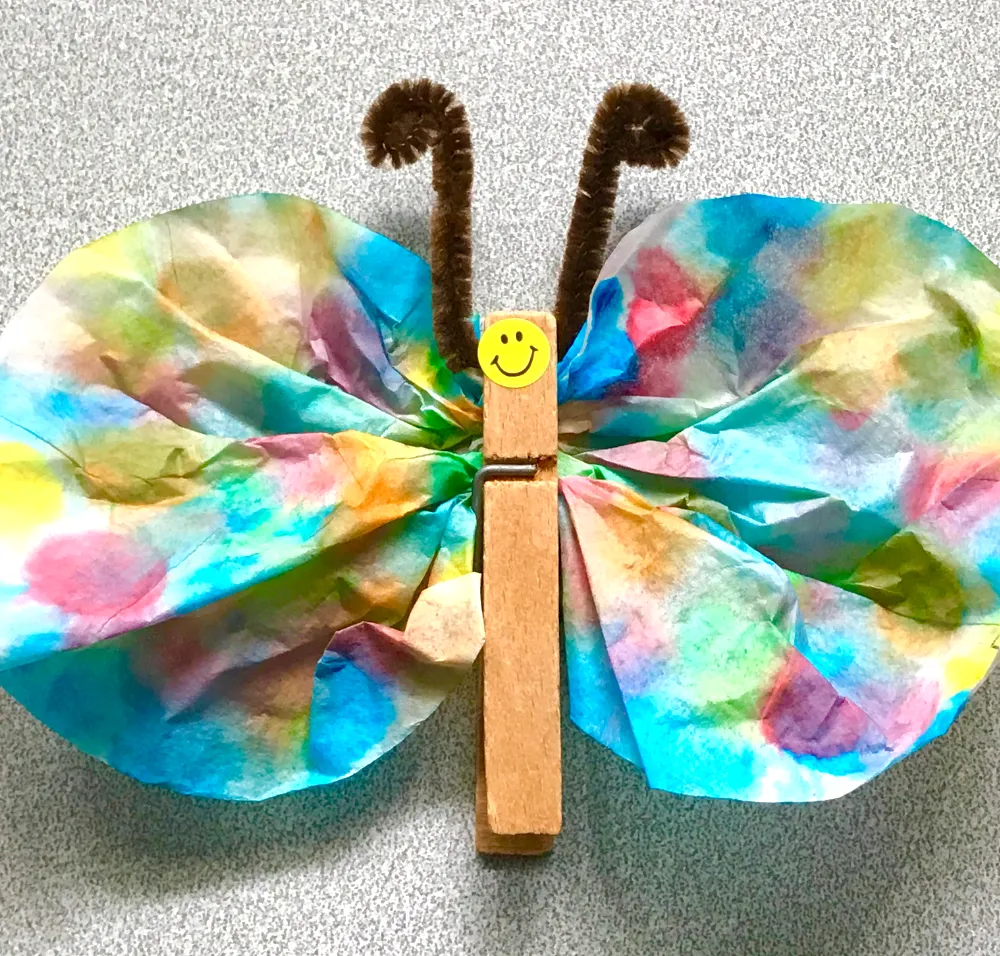
Variation 1: Clothespin Body Butterfly
Instead of a pipe cleaner body, use a wooden clothespin as the body—more substantial, can be painted or decorated, and stands on its own.
- Complete the filter coloring and drying as in the basic method.
- Paint or color the clothespin if desired—a black or brown clothespin looks most realistic; brightly painted clothespins look more festive.
- Apply a line of hot glue or craft glue along the inside of the clothespin.
- Pinch the filter as in the basic method and insert the pinched section into the clothespin, pressing the jaws closed over the filter center.
- Glue googly eyes onto the head end of the clothespin and attach two short pipe cleaner antennae with glue.
- Stand the finished butterfly on any flat surface—the clothespin feet allow it to stand independently.
Variation 2: Two-Filter Butterfly (More Realistic Wing Shape)
Using two coffee filters instead of one creates a butterfly with four distinct wing sections—two upper wings and two lower wings—that more closely resembles a real butterfly’s wing structure.
- Color and wet two filters simultaneously in complementary or matching colors.
- Dry both filters completely.
- Pinch each filter separately to create individual wing pairs.
- Stack the two pinched filters with one angled slightly above the other, then wrap both with a single pipe cleaner body.
- Adjust the four wing sections to create the characteristic shape of a real butterfly with larger upper wings and smaller lower wings.
Variation 3: Sharpie and Rubbing Alcohol Method
Permanent markers (Sharpies) and isopropyl rubbing alcohol instead of water produce a dramatically different effect—the alcohol spreads the permanent marker ink in sharp, crystalline patterns rather than the soft, watercolor-like bleeding of washable markers and water. More suitable for older children (alcohol should be handled by adults or older children under supervision).
- Color the filter with Sharpie markers, applying heavily.
- Drip rubbing alcohol from an eyedropper or pipette onto the colored filter—use sparingly, as alcohol bleeds much further than water.
- Watch the ink spread in sharp, distinct rings and rays from each drop point.
- Allow to dry completely before shaping.
The Sharpie-and-alcohol method produces a more graphic, geometric effect compared to the soft watercolor look of the basic method—beautiful in a different way.
Variation 4: Tissue Paper Overlay
After the basic coffee filter butterfly is assembled, layering small pieces of colored tissue paper between the filter layers adds depth and complexity to the wing appearance.
- Cut or tear small irregular pieces of colored tissue paper.
- Brush the tissue paper pieces with a thin layer of watered-down PVA glue and press onto sections of the dried filter.
- Allow to dry and assemble the butterfly as usual.
Variation 5: Coffee Filter Monarch Butterfly
The monarch butterfly’s distinctive orange, black, and white pattern can be replicated with careful marker work.
- Color the filter in orange covering approximately 70% of the surface.
- Add black marker in thick lines along the edges and in veining patterns across the orange sections.
- Leave small irregular white sections near the outer edges, or use a white gel pen to add the small white dots characteristic of monarch wing margins.
- Apply water sparingly—a light mist only. Too much water will blend the black into the orange and muddy the distinct pattern. The monarch pattern benefits from minimal bleeding compared to the free-color approach.
- Assemble with a black pipe cleaner body.
Display Ideas
Coffee filter butterflies are too pretty to put in a craft drawer:
Butterfly mobile: Thread multiple butterflies on fishing line at different heights and attach to a wooden dowel or branch. The translucency of the dyed filters catches light beautifully when hung near a window.
Butterfly garden display: Attach butterflies to wooden skewers pushed into a small pot of moss, pebbles, or a piece of floral foam. A cluster of different-colored butterflies at different heights creates an indoor butterfly garden.
Wall display: Arrange butterflies on a wall with small pins through the pipe cleaner bodies. A cluster of twenty to thirty butterflies in a loose flock pattern makes a genuinely impressive wall installation.
Window hanging: The translucent, dyed coffee filter paper is stunning when hung against a window—the light passes through and the colors glow like stained glass.
Greeting card decoration: A small coffee filter butterfly attached to the front of a handmade card transforms a plain folded paper card into something memorable.
Wreath decoration: Attach coffee filter butterflies to a plain wreath form using the pipe cleaner bodies to wire them to the wreath.
Troubleshooting
Colors turned muddy brown: Too much water was applied, causing all the colors to blend together past the point where individual colors are distinguishable. Use less water next time—the filter should be damp, not saturated. For a current muddy filter, let it dry and assess—sometimes what looks muddy when wet produces acceptable results once dry.
Colors didn’t bleed at all: The markers used may be non-washable or the water may have been applied too sparingly. Try dipping a paintbrush in water and applying directly to the marker lines—more direct contact with the marker pigment activates bleeding more reliably than a fine mist on thick marker lines.
Filter tore when wet: Coffee filters are very fragile when saturated. Let the filter dry completely before handling. If tearing is a consistent problem, try using two filters stacked together for more structural integrity, or use a slightly thicker basket filter.
Pipe cleaner won’t stay in place: The pipe cleaner may not be wrapped tightly enough, or the filter pinch point may be slipping. Add a small drop of craft glue at the pipe cleaner wrap before shaping the wings. Allow glue to dry before releasing.
Wings won’t stay spread: Very wet filters that dried while folded may have set in a folded position. Gently re-dampen the center fold and reshape, holding in position until dry. Adding a small piece of tape across the back of the center helps maintain the spread wing position.
Age Adaptations
For babies and toddlers (under 2): An adult colors and assembles the butterfly while the baby watches and participates in the water spray step—the transformation of wet and dry is visually engaging for very young children even without direct participation.
For toddlers (2–3 years): Child colors freely (outcome doesn’t matter), adult assists with water spray direction, adult assembles the pipe cleaner butterfly. Focus is entirely on the coloring and water spray experience rather than the finished product.
For preschoolers (3–5 years): Child handles all steps with light guidance. Help with the pipe cleaner wrapping step if fine motor skills aren’t quite there yet—holding the pinched filter while wrapping requires two-handed coordination that some preschoolers find challenging.
For school age (5+): Full independent execution of all steps. Can attempt the monarch variation, the two-filter version, or deliberate color planning for specific effects. Good age for the Sharpie-and-alcohol variation with appropriate supervision.
FAQ
What type of coffee filter works best? Round, flat-bottom basket filters (the kind for drip coffee makers) produce the best butterfly wing shape. Cone filters work but the wing shape is less symmetrical. White filters show colors the most vividly—natural brown filters produce more muted, earthy results, which can be beautiful in a different way.
Can I use food coloring instead of markers? Yes—diluted food coloring dropped onto a plain white filter and allowed to spread produces a beautiful tie-dye-like effect. The wings look different from the marker-and-water method—softer and more diffuse—but equally attractive. Apply drops of different colors to different sections of the filter and let them bleed into each other naturally.
How do I make them permanent so the colors don’t run if they get wet later? Once dried, coffee filter butterflies are relatively stable—the marker pigment has been distributed through the filter and doesn’t run significantly from casual contact with moisture. For maximum permanence, spray with a light coat of clear acrylic sealer once fully dry and assembled.
Can I make these with paper towels instead of coffee filters? Paper towels work as a substitute but produce noticeably inferior results—the texture is less interesting, the color bleeding is less even, and the finished butterfly has less of the translucent, delicate quality that makes coffee filter butterflies particularly beautiful. Coffee filters are inexpensive enough that buying a pack specifically for this craft is worthwhile.
The Bottom Line
Coffee filter butterflies are one of those rare crafts that require almost nothing, take very little time, and produce something genuinely beautiful. The color-bleeding step is the magic—it transforms what would be a mediocre coloring-page result into something that looks like watercolor painting. Make more than you think you need because they disappear quickly into gifts, wall displays, and mobile decorations. And keep a pack of coffee filters and some washable markers in the craft supplies permanently—this is the activity you’ll reach for on a rainy afternoon for years.
Enjoyed this project? Get even more DIY ideas that save (and make) you money.
Join our free newsletter for profitable DIY projects, clever cleaning hacks, home ideas, and creative crafts delivered straight to your inbox.
✓ Free forever • No spam • Unsubscribe anytime