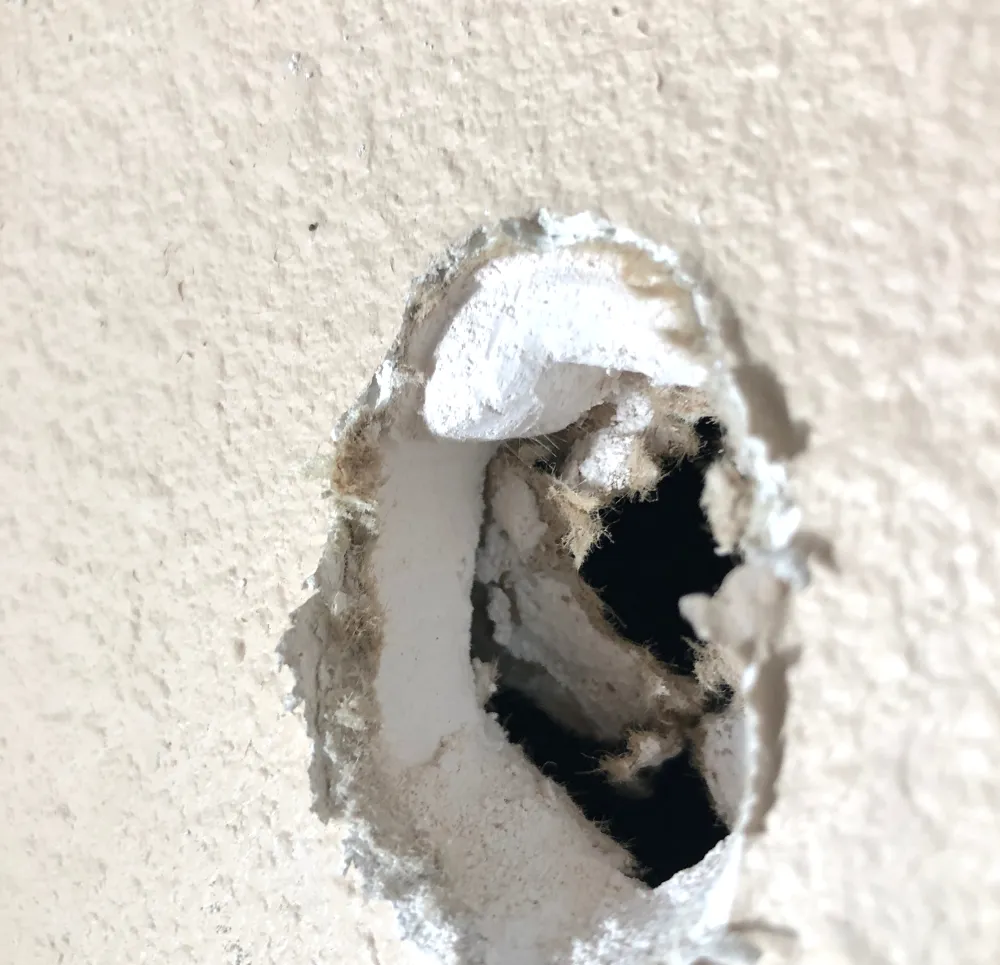
Drywall holes happen. A doorknob swings too hard, a picture anchor pulls out, someone trips and puts an elbow through the wall, or you cut an access hole for plumbing and need to close it back up. The range of damage runs from tiny nail holes you can barely see to fist-sized holes to full panel damage that needs structural repair.
The good news is that drywall repair is one of the most learnable DIY skills there is. The materials are inexpensive, the techniques are straightforward, and a well-done repair is completely invisible under paint. The bad news is that a poorly done repair—one that isn’t properly feathered, isn’t sanded adequately, or isn’t primed before painting—is obvious from across the room when light hits the wall at the wrong angle.
This guide covers eight methods matched to different hole sizes and damage types, from a nail hole you can fix in 60 seconds to a large structural repair that takes a full weekend. Each method includes the specific technique details that make the difference between a repair that disappears and one that telegraphs itself every time the light changes.
Assessing the Damage Before Choosing a Method
The right repair method depends entirely on the size and type of damage:
- Nail and screw holes (under 5mm): Spackle or topping compound pressed in with a finger. Two-minute fix.
- Small holes (5mm–2.5cm/1 inch): Spackle or lightweight joint compound with a putty knife.
- Medium holes (2.5cm–10cm/1–4 inches): Self-adhesive mesh patch or California patch method.
- Large holes (10cm–20cm/4–8 inches): Wood backer method or clip repair kit.
- Very large holes (over 20cm/8 inches): Full panel replacement or furring strip method.
- Corner damage: Corner bead repair—different from flat wall repair.
- Water-damaged drywall: Needs assessment before repair—active moisture must be resolved first.
Materials Overview
Different compounds are used at different repair stages:
- Spackle: Fast-drying, easy to sand, good for small holes. Shrinks with size—not appropriate for holes larger than a few centimeters.
- Lightweight joint compound (all-purpose or topping): The standard material for larger repairs. Applied in multiple thin coats. Dries slower than spackle but produces a smoother, more feathered finish.
- Setting-type joint compound (hot mud): Powder mixed with water that sets chemically rather than drying by evaporation. Sets hard in 20–90 minutes depending on formulation. Better for deep fills and structural repairs—less prone to shrinkage.
- Fiberglass mesh tape: For reinforcing larger repairs. Self-adhesive. Requires joint compound over it.
- Paper tape: Stronger than mesh for taped seams. Requires embedding in wet joint compound.
- Pre-mixed joint compound: Ready to use from the tub. Convenient for small repairs.
What You’ll Need (Depending on the Method)
- Spackle or lightweight joint compound
- Setting-type joint compound (hot mud) for larger repairs
- Self-adhesive mesh patch kit
- Drywall screws
- Drywall (for panel replacement)
- Furring strips or 2×4 lumber for backing
- Fiberglass mesh tape or paper tape
- A putty knife (3-inch and 6-inch)
- A drywall knife or utility knife
- A sanding block and sandpaper (120 and 220 grit)
- Drywall primer
- Paint to match existing wall
- A drill or screwdriver
- A drywall saw or jab saw
- Corner bead (for corner repairs)
- Rubber gloves and dust mask for sanding
Method 1: Spackle for Nail Holes and Very Small Damage (Under 5mm)
Nail holes, small screw holes, dents from picture hooks, and minor surface dings all fall into the category of damage that genuinely takes under two minutes to fix correctly. The mistake most people make is using too much spackle—for a nail hole, you need barely any.
- Clean the hole of any loose debris or torn paper facing. Run a fingernail around the edge of the hole to check for any drywall paper lifting—trim any loose paper with scissors or a utility knife. Lifted paper creates ridges that show through the spackle.
- Apply a tiny amount of spackle directly to the hole using a finger, a putty knife, or even the edge of a credit card. Press it firmly into the hole, ensuring the spackle fully fills the void.
- Wipe the surrounding area flat with a slightly damp cloth or the edge of the putty knife. The spackle should sit flush with or very slightly proud of the wall surface—slightly proud accounts for the inevitable small shrinkage as it dries.
- Allow to dry completely. Most lightweight spackles dry in 30–60 minutes for a nail hole. Pink spackle that turns white when dry is useful here—it makes it easy to see when drying is complete.
- Sand smooth with 220-grit sandpaper on a small sanding block. Sand flush with the wall surface, then run your fingertip across the area—it should feel completely smooth and level.
- Prime the spackled area before painting. Spackle is highly absorbent and will pull paint into it differently from the surrounding wall surface, creating a dull spot called “flashing” that’s visible when light hits the wall. Even a small dab of drywall primer on the repair eliminates this.
- Touch up with matching paint. For small repairs, a small brush application of wall paint over the primed spot usually matches well enough to be invisible.
Why primer matters: Skipping primer on spackle repairs is the most common cause of visible repairs after painting. The repair looks fine with fresh paint but as paint dries and cures, the different absorption rates of the spackle and the surrounding wall cause the repaired spot to look slightly different in texture and sheen. Prime first, always.
Best for: Nail holes, screw holes, small picture hook holes, minor surface dents.
Method 2: Lightweight Joint Compound for Small Holes (5mm–2.5cm)
For holes slightly larger than a nail hole but still small—thumbtack holes, small anchor holes, minor gouges—lightweight joint compound applied in thin coats produces a smoother, more feathered repair than spackle. The multiple thin coat approach is what makes larger repairs invisible: a single thick coat shrinks, cracks, and shows its edges clearly when painted.
- Prepare the hole by removing any loose debris and trimming any lifted paper facing with a utility knife. For holes with jagged edges, use the utility knife to clean up the perimeter of the hole into a relatively smooth circle or square shape—clean edges hold compound better than ragged ones.
- Apply the first coat of lightweight joint compound with a 3-inch putty knife. Press the compound firmly into the hole, filling it completely.
- Feather the edges. This is the most important technique in all drywall repair. “Feathering” means extending the compound significantly beyond the hole in all directions with progressively thinning application—the repair area is much larger than the hole itself, with a smooth gradient from the filled center to nothing at the edges. A feathered edge disappears under paint; an abrupt edge creates a visible ridge.
- Wipe smooth with the putty knife held at a low angle, pulling across the repair to remove ridges and tool marks.
- Allow to dry completely—usually two to four hours for a thin coat. Don’t rush this—partially dried compound looks dry on the surface but is still wet in the center, and applying the next coat over wet compound causes shrinkage problems.
- Sand lightly with 120-grit sandpaper on a sanding block. Sand the entire feathered area, not just the center. The goal is to knock down any ridges and tool marks without creating deep scratches that need to be filled.
- Apply the second coat, extending it slightly further than the first with even thinner feathering at the edges.
- Repeat drying and sanding, then apply a third thin finish coat if needed—the finish coat should be very thin and feathered over a wider area than the previous coats.
- Final sand with 220-grit until the repaired area feels completely smooth and the edges are imperceptible to the touch.
- Prime with drywall primer and paint to match.
The three-coat rule: Drywall professionals apply three coats of compound on nearly every repair—not because each coat is thick, but because each thin coat fills the imperfections left by the previous one. Trying to do a one-coat repair on anything larger than a nail hole almost always results in visible shrinkage cracks and edge ridges.
Best for: Small holes up to 2.5cm, anchor holes from wall anchors, minor gouges from moving furniture.
Method 3: Self-Adhesive Mesh Patch Kit (Best for Medium Holes, 2.5cm–10cm)
Self-adhesive mesh patch kits—available at every hardware store—are the simplest method for medium-sized holes and require no carpentry skills. The mesh provides a stable surface for joint compound to adhere to, bridging the hole and giving the compound something to grab rather than falling through.
- Clean the area around the hole. Remove any loose paper, debris, or crumbling drywall. If the edges of the hole are soft or crumbling, carefully trim with a utility knife until you have solid drywall around the perimeter.
- Choose the right patch size. The mesh patch should be larger than the hole—ideally with at least 2.5cm of mesh overlapping solid drywall on all sides. Most kits come in several sizes.
- Peel and apply the self-adhesive mesh patch directly over the hole, pressing firmly from the center outward to eliminate air bubbles and ensure full adhesion to the surrounding drywall surface.
- Apply the first coat of joint compound over the mesh with a 6-inch putty knife. Press firmly to push compound through the mesh openings—compound that sits only on top of the mesh rather than through it creates a weak repair. Cover the entire mesh and feather several centimeters beyond the patch edges.
- Allow to dry completely. Mesh patches hold more compound than a flat surface and take longer to dry than surface repairs—allow four to six hours minimum or overnight.
- Sand lightly with 120-grit to knock down ridges.
- Apply a second coat, extending the feathering beyond the first coat’s edges. The second coat should be noticeably thinner and wider than the first.
- Dry, sand, and apply a third finish coat feathered even further. The finish coat should cover an area significantly larger than the mesh patch itself—the gradual tapering of compound away from the repair center is what makes it invisible.
- Final sand with 220-grit over the entire feathered area until smooth.
- Prime thoroughly before painting—mesh patch repairs have multiple layers of compound that absorb primer at different rates, making priming especially important.
Important limitation of mesh patches: Mesh patches are weaker than wood-backed repairs because they have no solid backing—the repair is held together by the dried joint compound bridging the hole. For holes in high-traffic areas, next to doorframes, or in locations that receive physical contact, the wood backer method (Method 5) is more durable.
Best for: Medium holes in low-to-moderate traffic wall locations, holes from doorknob impacts, cable access holes.
Method 4: The California Patch Method (Best Seamless Repair for Medium Holes)
The California patch method uses a piece of drywall cut to size with the paper backing intact as a self-reinforcing patch. The paper backing extends beyond the drywall core on all sides, providing a tapered transition surface for joint compound that produces an extremely clean, professional repair. It’s more technique-intensive than a mesh patch but produces better results with less compound buildup.
- Cut a piece of drywall slightly larger than the hole—typically 2–3cm larger on each side.
- Score the back of the patch piece (the grey paper side) around the perimeter leaving a 2–3cm border of paper on all sides. Score through the gypsum core but not through the face paper (the white side).
- Snap the gypsum core along the scored lines and remove the gypsum from the border area, leaving only the paper flap around the perimeter of the patch. You now have a piece of drywall with a gypsum center and a paper border extending beyond the edges.
- Hold the patch over the hole and trace around the gypsum center portion (not the paper flap) with a pencil.
- Cut out the traced shape from the wall using a drywall saw or jab saw. The hole in the wall should be the same size as the gypsum center of the patch—the paper flap will overlap onto the existing wall.
- Test the fit—the gypsum insert should sit flush in the hole with the paper flap lying flat against the surrounding wall surface. Trim if needed for a clean fit.
- Apply a thin coat of joint compound around the perimeter of the hole on the wall surface.
- Press the patch into place, pressing the paper flap firmly into the wet compound. The gypsum insert fills the hole; the paper flap embeds in the compound around the perimeter.
- Apply joint compound over the paper flap and feather outward, blending the patch seamlessly with the surrounding wall.
- Allow to dry, sand, apply additional coats as in Method 2, feathering wider with each coat.
- Prime and paint.
Why this method produces excellent results: The paper flap creates a tapered transition between the patch and the surrounding wall that’s thinner and more gradual than any compound buildup over a mesh patch. With good feathering, California patch repairs are among the least visible of any medium hole repair method.
Best for: Medium holes where a very clean, professional result is the goal, visible wall areas where patch visibility is a significant concern.
Method 5: Wood Backer Method (Best for Large Holes, 10cm–20cm)
For holes too large for a mesh patch or California patch—where there’s nothing structural to anchor to—wood backing provides the solid support the repair needs. The wood backer is inserted through the hole and screwed to the existing drywall on either side, creating a rigid surface for the drywall patch to attach to.
- Square up the hole with a drywall saw or jab saw. Cut the irregular hole into a clean rectangle or square—a clean geometric shape is significantly easier to patch than a ragged irregular hole. Use a carpenter’s square to mark clean lines.
- Cut the hole to size along your marked lines. The squared hole should have clean, straight edges.
- Cut a piece of 1×3 or 1×4 lumber approximately 15cm (6 inches) longer than the hole height for each side of the hole.
- Insert one backer piece into the hole and position it vertically behind one edge of the hole, with approximately half the backer covering the back of the existing drywall on each side of the hole edge.
- Hold the backer in position (or have a helper hold it) and drive drywall screws through the existing drywall into the backer on each side of the hole edge. Use two screws per side to secure each backer piece firmly.
- Repeat with a second backer piece on the opposite side of the hole.
- For wider holes, add backer pieces top and bottom as well.
- Cut a drywall patch to exactly fit the squared hole. Use drywall of the same thickness as the existing wall—typically 12mm (1/2 inch) for most walls.
- Insert the patch and secure it to the backer pieces with drywall screws every 15–20cm around the perimeter.
- Tape the seams between the patch and existing drywall with self-adhesive mesh tape or paper tape embedded in joint compound.
- Apply joint compound in multiple thin feathered coats, extending well beyond the patch edges with each coat. Large repairs require more coats and wider feathering than small ones—plan for four to five coats over several days.
- Sand progressively with 120-grit then 220-grit between coats.
- Prime thoroughly and paint.
Best for: Large holes from doorknob impact, electrical or plumbing access holes, damage from furniture collision.
Method 6: Furring Strip Method (Best Large Hole Method Without a Helper)
The furring strip method is a variation of the wood backer method that holds itself in place during installation—ideal for solo repair work where holding a backer piece in position while driving screws isn’t practical.
- Square up the hole as in Method 5.
- Cut two pieces of 1×3 or 1×4 furring strip approximately 10cm longer than the hole height.
- Drill a pilot hole through the center of each furring strip.
- Thread a long screw through the pilot hole and into a small block of wood on the back—this becomes a handle that holds the strip while you position it.
- Insert the furring strip through the hole and position it behind the edge of the existing drywall.
- Drive screws through the existing drywall into the furring strip to secure it, then remove the temporary handle screw.
- Repeat on the opposite side of the hole.
- Continue with drywall patch, taping, and compounding as in Method 5.
Alternative self-securing method: Commercial drywall repair clips (also called drywall anchors or dog-eared clips) thread through the hole and clamp against the back of the existing drywall, providing a securing point for the patch without needing wood backer. These are available at hardware stores and are particularly useful for medium-to-large hole repairs where inserting wood backer is awkward.
Best for: Large hole repairs done solo, holes in awkward locations where positioning a backer piece is difficult.
Method 7: Corner Damage Repair (For Damaged Drywall Corners)
Damaged drywall corners—the outside corner where two walls meet—are a specific repair type that requires a different approach from flat wall repairs. The corner bead (the metal or vinyl strip that protects and defines the corner) often needs replacement as part of the repair.
- Assess the damage. Minor corner dents that haven’t bent the corner bead can be repaired with joint compound alone. Bent, crushed, or severely damaged corner bead needs to be replaced.
- For compound-only repair (minor dents):
- Apply joint compound to the damaged area and feather outward along both wall faces.
- Build up in thin coats until the corner profile is restored.
- Sand carefully to maintain a straight corner edge—use a sanding block rather than sandpaper alone to prevent rounding the corner.
- For corner bead replacement:
- Score the existing paint along the corner bead edges with a utility knife to prevent tearing the surrounding paper face.
- Remove the damaged section of corner bead using a pry bar or hammer and chisel—metal corner bead is either crimped or screwed into the drywall underneath.
- Cut a replacement piece of corner bead to the required length using metal snips.
- Secure the new corner bead—crimped metal bead requires a corner crimper tool; screw-on or nail-on bead is more DIY-friendly. Vinyl bead can be embedded in compound.
- Apply joint compound over the new bead in thin coats, feathering outward on both wall faces.
- Use a corner tool (a specialized knife designed for inside and outside corners) for the smoothest result, or carefully feather by hand with a standard putty knife working from each face.
- Sand, prime, and paint.
Best for: Impact damage to outside wall corners, damage from furniture bumping the corner repeatedly.
Method 8: Full Panel Replacement (For Extensively Damaged Drywall)
When damage is very large, water-damaged, or affects a significant portion of a wall panel, replacing the entire drywall panel—or a half-panel from stud to stud—produces better results than trying to patch within the existing panel. Full panel replacement also addresses any underlying issues (mold, moisture damage, insulation problems) that extensive drywall damage often indicates.
- Locate the studs on either side of the damaged area using a stud finder. Mark stud locations clearly with a pencil.
- Cut along the center of the nearest stud on each side of the damage using a drywall saw or circular saw with a drywall blade. Cutting along the stud center leaves half the stud face exposed for the new panel to attach to.
- Cut horizontally at the top and bottom of the damaged section if replacing a partial panel rather than a full floor-to-ceiling panel. Cut between studs at a height that corresponds to a convenient break point—typically at the midpoint of the wall or at chair rail height.
- Remove the damaged drywall section. Score any tape or paint at the seams first to prevent tearing the paper facing of adjacent panels.
- Inspect the wall cavity before installing new drywall—damaged panels often indicate moisture infiltration or other issues that need addressing before closing the wall.
- Cut the new drywall panel to size. New drywall should be the same thickness as the existing wall panels.
- Install the new panel by driving drywall screws into the studs every 30cm along each stud. Screws should be driven just below the paper surface without breaking through it—a slight dimple rather than a torn crater.
- Tape all seams with paper tape embedded in joint compound. Paper tape is stronger than mesh for long seams and produces flatter seam repairs.
- Apply joint compound in three coats, feathering wide on each coat. Full panel replacement produces long seams that require wide feathering—a 30cm (12-inch) knife is useful for the finish coats on long seams.
- Sand progressively, prime thoroughly, and paint.
- Texture matching: If the existing wall has texture (knockdown, orange peel, skip trowel), matching the texture on the new panel requires additional technique. See the texture matching section below.
Best for: Extensive damage covering a large wall section, water-damaged drywall, damage to multiple adjacent areas that would require overlapping patches, walls being opened for plumbing or electrical work.
Method Comparison at a Glance
| Method | Hole Size | Skill Level | Time to Complete |
|---|---|---|---|
| Spackle | Under 5mm | Beginner | 1–2 hours |
| Joint compound, multiple coats | 5mm–2.5cm | Beginner | 1–2 days |
| Self-adhesive mesh patch | 2.5cm–10cm | Beginner | 1–2 days |
| California patch | 2.5cm–10cm | Intermediate | 1–2 days |
| Wood backer method | 10cm–20cm | Intermediate | 2–3 days |
| Furring strip method | 10cm–20cm | Intermediate | 2–3 days |
| Corner repair | Any size | Intermediate | 1–3 days |
| Full panel replacement | Large/extensive | Advanced | 3–5 days |
The Most Important Technique: Feathering
Feathering is the single most important skill in drywall repair and the one that separates invisible repairs from obvious ones. It means extending joint compound well beyond the repair area with progressively decreasing thickness—a gradient from full compound at the center to nothing at the outer edges.
Why it matters: Joint compound adds thickness to the wall surface wherever it’s applied. If you apply compound only over the repair area, you’ve created a raised patch that catches light differently from the surrounding wall. Feathering spreads this thickness over such a large area that the gradient from thickest to thinnest is imperceptible—the eye reads it as a flat surface.
How wide to feather:
- For a 2.5cm hole: feather to approximately 20–25cm (8–10 inches) total width by the final coat
- For a 10cm hole: feather to 40–50cm (16–20 inches) total width by the final coat
- For large patches: feather even further—up to 60–90cm on each side
The rule: Each successive coat should extend further than the previous one. Coat one fills and provides structure. Coat two feathers further. Coat three is very thin and very wide—it blends the repair into the surrounding wall surface so gradually that no edge is detectable.
Matching Texture After Repair
Smooth walls: sand the repair flush and it’s done. Textured walls require matching the existing texture before painting—a perfectly repaired, smooth patch on a textured wall is as obvious as the hole was.
Common texture types and how to match them:
Orange peel: A light, random spatter texture that looks like the surface of an orange peel. Replicated with a hopper gun or a rattle-can orange peel texture spray. Practice on cardboard first—spray distance and pressure determine the pattern size.
Knockdown: Compound applied in random splatter patterns and then partially flattened (“knocked down”) with a drywall knife while still wet. Practice the splatter-then-flatten technique on a piece of scrap drywall before applying to the wall.
Skip trowel: Irregular, slightly overlapping arcs applied with a curved trowel. One of the harder textures to match—the randomness of the original application is difficult to replicate convincingly. A professional texture match is worth considering for large areas.
Popcorn ceiling: A specific product applied as a spray. Popcorn texture repair products are available in aerosol cans and buckets. Test the can product on a hidden section first—the particle size varies between products and may not match the existing texture.
Priming: The Step That Makes or Breaks the Finish
Every drywall repair—regardless of size—must be primed before painting. Skipping primer produces “flashing”—areas of different sheen and color that appear after the paint dries and are very difficult to correct without stripping back to bare compound.
Use drywall primer (PVA primer or high-build drywall primer) rather than paint-and-primer-in-one products. Paint-and-primer products don’t adequately seal the absorbent surface of fresh joint compound.
For large repairs, apply two coats of primer—the first coat will soak into the compound heavily. The second coat seals the surface more uniformly and ensures even paint absorption.
Don’t skip primer because the paint color is the same as the existing wall. The issue isn’t color matching—it’s absorption rate matching. Primed surfaces and unprimed compound absorb paint at different rates, producing visible sheen differences that are obvious when light hits the wall obliquely.
FAQ
How long does joint compound take to dry? Thin coats of pre-mixed joint compound typically dry in two to four hours under normal conditions. Thick coats, humid environments, and poor ventilation extend drying time significantly—sometimes to overnight or longer. Setting-type compound (hot mud) dries by chemical reaction rather than evaporation and reaches a workable hardness in 20–90 minutes depending on the formulation.
Can I use spackle for large holes? Not effectively. Spackle shrinks significantly as it dries—the larger the application, the more shrinkage and cracking. For holes larger than about 2cm, joint compound applied in multiple thin coats produces significantly better results than spackle.
Why does my repair show through the paint? The most common reasons: insufficient feathering (the edge of the compound is creating a ridge), skipping primer (causing flashing from different absorption rates), or not applying enough coats (the repair is slightly recessed). If the repair shows after painting, sand back thoroughly, apply additional feathered coats, re-prime, and repaint.
How do I know when joint compound is ready to sand? Joint compound is ready to sand when it has changed from a darker, slightly translucent appearance to a uniform light white and feels completely hard—not cool or damp—to the touch. Sanding compound that isn’t completely dry creates a gummy, unworkable surface that tears rather than sands.
My wall has multiple layers of paint over old repairs. How do I match the surface? Old walls with built-up paint layers sometimes have an uneven surface that makes new repairs obvious. After the final compound coat is dry, apply a skim coat—a very thin layer of joint compound over a wider area than the repair—to blend the repaired section with the surrounding surface. Skim coating requires some practice but is the most effective technique for making repairs invisible in walls with significant surface history.
The Bottom Line
Drywall repair is fundamentally about patience—thin coats, adequate drying time, and enough feathering to make the transition from repaired to unrepaired wall imperceptible. The most common mistake is rushing: too much compound at once, not enough dry time between coats, insufficient feathering, skipping primer. Do those four things correctly and any of the eight repair methods in this guide produces a result that’s genuinely invisible under paint. The method matters less than the technique—a well-feathered, properly primed mesh patch repair is less visible than a poorly feathered California patch. Master the feathering and the priming, and the specific method becomes almost secondary.
Enjoyed this project? Get even more DIY ideas that save (and make) you money.
Join our free newsletter for profitable DIY projects, clever cleaning hacks, home ideas, and creative crafts delivered straight to your inbox.
✓ Free forever • No spam • Unsubscribe anytime