You start pulling at a corner, hoping the whole sheet peels off in one satisfying strip. Instead, you get a fist-sized chunk, a cloud of dust, and a wall that now looks worse than when you started. Sound familiar?
Removing stubborn wallpaper is one of those home improvement tasks that looks simple on paper but quickly turns into a weekend-consuming project if you go in unprepared. The good news is that with the right tools, the right technique, and a little patience, even the most aggressively glued, multi-layered wallpaper can be removed cleanly — without destroying the drywall underneath.
This guide covers everything from understanding why wallpaper sticks so stubbornly, to tackling the trickiest walls, to finishing up so your wall is ready for whatever comes next.
Why Stubborn Wallpaper Is So Hard to Remove
Before you reach for a scraper, it helps to understand what you’re actually fighting. Wallpaper doesn’t just sit on a wall — it bonds to it, sometimes over decades.
The adhesive is the main villain. Older wallpaper pastes were wheat or starch-based and tend to harden into a cement-like layer over time. Newer wallpapers often use synthetic adhesives that are water-resistant, making them far less responsive to simple soaking.
Layers compound the problem. Many walls have been papered two, three, or even four times over the years — each layer glued over the last. When you try to remove the top layer, you’re often pulling against all of them at once.
Drywall vs. plaster makes a big difference. Older homes typically have plaster walls, which are dense and moisture-tolerant, making removal easier. Most homes built after the 1950s have drywall (also called gypsum board or plasterboard), which absorbs water quickly and can be badly damaged if you oversoak it.
The paper facing is a barrier. Most wallpaper has a decorative outer layer that is water-resistant by design. Until you break through or remove that facing, any water or solution you apply simply runs off without reaching the adhesive underneath.
What You’ll Need Before You Start
Getting your supplies together before you begin saves enormous time and prevents the project from stalling mid-wall.
- Scoring tool: A wallpaper scorer or perforating tool creates small holes that let water penetrate the facing layer
- Garden sprayer or large sponge: For applying removal solution evenly and generously
- Wallpaper removal solution: Either a commercial product or a DIY mix of equal parts white vinegar and hot water, or a few drops of dish soap in hot water
- Wide plastic scraper (6–10 inches): For lifting large sections of paper
- Narrow putty knife: For getting into corners and edges
- Drop cloths and plastic sheeting: Wallpaper removal is messy — protect your floors and furniture
- Painter’s tape: To secure sheeting and protect trim
- Bucket and sponge: For cleanup and rinsing adhesive residue
- Safety glasses and rubber gloves: Scraping sends debris flying and removal solutions can irritate skin
- Step ladder: For reaching upper sections near the ceiling
Pro tip: Before you do anything, turn off the electricity to the room at the circuit breaker. Water and electrical outlets are a dangerous combination, and you’ll be applying a lot of moisture to the walls.
Step-by-Step: How to Remove Stubborn Wallpaper
Step 1 — Prepare the room properly
- Move all furniture to the center of the room or out entirely, and cover everything that remains with plastic sheeting secured with painter’s tape. Wallpaper removal produces wet, sticky debris that clings to surfaces.
- Lay drop cloths across the entire floor, paying extra attention to the area directly against the walls where strips will fall.
- Remove all switch plates, outlet covers, and vent covers from the walls. Place them in a labeled bag so you can reinstall them easily later.
- Turn off the electricity to the room at the breaker and cover outlets and switches with painter’s tape to prevent any moisture from getting inside.
Step 2 — Identify your wall type and wallpaper type
- Gently press on the wall in a few spots. Plaster walls feel very hard and solid; drywall feels slightly hollow when you tap it with a knuckle. This matters because drywall needs to be kept as dry as possible throughout the process to avoid damage.
- Try peeling back a small corner of the wallpaper near a seam. Some modern “strippable” wallpaper will peel away in full, dry sheets with minimal effort. If that’s what you have, you may be able to skip soaking entirely for the top layer.
- Check whether there are multiple layers by looking at a corner or seam where the paper has already lifted slightly. If you can see different patterns or colors underneath, plan for a longer removal process.
Step 3 — Score the wallpaper surface
- Run a wallpaper scoring tool across the entire surface in overlapping circular patterns. The scorer creates thousands of tiny perforations in the outer layer, allowing your removal solution to penetrate through to the adhesive beneath.
- Apply steady, even pressure — enough to puncture the facing but not so hard that you gouge the wall behind it. On drywall especially, excessive pressure can damage the paper facing of the board itself, which creates expensive repair work later.
- Don’t skip this step even if the wallpaper feels thin or old. Scoring dramatically reduces the time and effort required in every subsequent step.
Step 4 — Apply your removal solution
- Mix your removal solution — either a commercial wallpaper remover diluted according to the product instructions, or a homemade solution of equal parts white vinegar and hot water. Hot water alone can work on some older paste-based papers, but adding vinegar or a few drops of dish soap improves penetration significantly.
- Load your garden sprayer or soak a large sponge and apply the solution generously to a manageable section of wall — roughly a 3-foot by 3-foot area at a time. Don’t try to soak the entire wall at once, as the solution will dry out on the first section before you get to it.
- Allow the solution to soak in for at least 5–10 minutes. You should see the wallpaper start to darken and blister slightly as the moisture works through the perforations and begins loosening the adhesive. On stubborn papers, a second application followed by another wait of 5 minutes makes a significant difference.
Step 5 — Scrape the wallpaper away
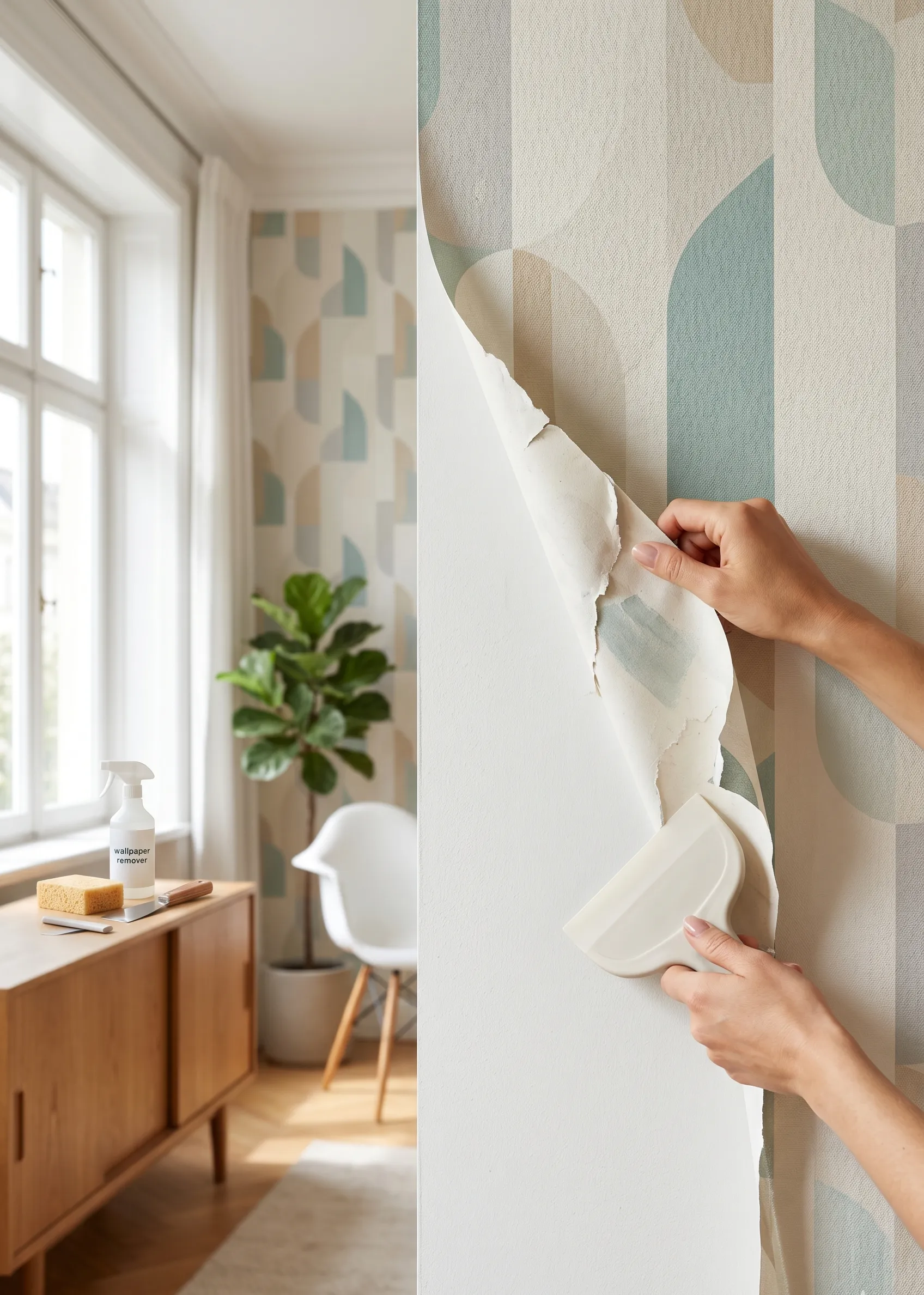
- Starting at a seam or a corner, slide your wide plastic scraper under the edge of the wallpaper at a low angle — roughly 30 degrees to the wall. Push forward with steady, even pressure rather than jabbing or prying, which can gouge drywall.
- Work in the direction of least resistance. If a section is lifting easily in one direction, follow it. If you’re tearing small pieces, the paper likely needs more soaking time — stop, reapply solution, and wait before continuing.
- Use the narrow putty knife to tackle corners, edges, and areas around outlet boxes where the wider scraper can’t reach.
- As sections come off, drop them immediately into a bucket or garbage bag rather than letting them pile up on the floor, where they become a slipping hazard.
Step 6 — Remove the adhesive residue
- Once the paper is off, you’ll almost certainly be left with a sticky, rough layer of old adhesive on the wall. This must be fully removed before you can paint or re-paper — painting over it will cause paint to peel, and the texture will show through new wallpaper.
- Apply your removal solution to the wall again, let it soften the adhesive for a few minutes, then scrub it away with a coarse sponge or nylon scrubbing pad. Rinse the wall with clean water using a fresh sponge, and repeat until the wall feels smooth and no longer tacky when you press your hand against it.
- Work in sections as before — keeping the process manageable prevents the solution from drying back onto the wall.
Step 7 — Allow the wall to dry completely and inspect
- Give the wall a full 24–48 hours to dry before doing anything else. Drywall in particular needs this drying time, as moisture trapped inside the board can cause bubbling, mold, or poor paint adhesion later.
- Once dry, inspect the surface carefully under a bright light or with a flashlight held at an angle to the wall. Look for gouges, torn drywall paper, remaining patches of adhesive, or any soft or bubbling areas.
- Sand down any rough spots lightly with medium-grit sandpaper, then fill deeper gouges or damage with lightweight joint compound. Allow repairs to dry fully before priming.
How to Remove Stubborn Wallpaper Glue from Walls
Many people successfully remove the paper itself only to find that the glue left behind is almost harder to deal with. Old adhesive dries hard, turns yellow, and creates a surface that paint will not bond to properly.
The most effective approach is a dedicated enzymatic wallpaper remover solution — these products are specifically formulated to break down the chemical bonds in both starch-based and synthetic adhesives. Apply it to the wall, allow 10 minutes of contact time, then scrub firmly with a coarse sponge and rinse thoroughly.
For smaller patches of residual glue, undiluted white vinegar applied with a cloth and allowed to sit for 5 minutes will soften most adhesive enough to wipe or scrape away. For very old, rock-hard paste, a heat gun held at a safe distance can warm and re-activate the adhesive, making it pliable enough to scrape off cleanly.
Never skip the rinsing step. Even after all visible glue is gone, a residual film can remain on the wall. Wipe down the entire surface with clean water and a fresh sponge, then let it dry before priming.
Removing Wallpaper from Different Wall Types
| Wall Type | Key Consideration | Best Approach |
|---|---|---|
| Drywall | Very moisture sensitive — oversaturation causes damage | Work in small sections; don’t oversoak; use minimal water |
| Plaster | Durable and moisture tolerant | Can handle more liberal soaking; less risk of damage |
| Previously painted wallpaper | Paint seals the surface against water | Score aggressively; may need a stronger commercial solution |
| Skim-coated walls | Thin plaster layer can be scraped off with the paper | Use very low scraper angle; avoid excess pressure |
| Paneling or wood | Rarely seen but possible in older homes | Avoid water-based solutions; use dry steam method |
Tips to Make the Job Easier and Faster
Work from the top down. Always start at the ceiling line and work toward the floor. Solution and loosened adhesive will drip downward, so working top-to-bottom means you’re always applying solution to a clean, dry surface rather than over already-loosened, drippy sections.
Keep the surface wet. The most common mistake people make is letting the removal solution dry out on the wall before they get back to it. If you’re working alone, keep your sections small. If you have a helper, one person can soak while the other scrapes.
Use a steamer for the toughest sections. A wallpaper steamer, available from most tool rental shops, delivers pressurized steam directly into the wallpaper, loosening even the most stubborn adhesive in seconds. It’s particularly effective on plaster walls and multi-layered situations. On drywall, use it carefully and sparingly to avoid moisture damage.
Don’t rush the drying phase. It’s tempting to start painting as soon as the wall looks dry on the surface. Resist this. Moisture trapped inside drywall leads to bubbling paint, poor adhesion, and in humid conditions, mold growth behind the finish coat.
FAQ
Can I paint directly over old wallpaper instead of removing it? It’s generally not recommended. Paint adds moisture, which can cause the wallpaper to bubble and peel. Seams and texture telegraph through even multiple coats of paint. Removal, while more labor intensive upfront, produces a far better and longer-lasting result.
How do I know if my drywall has been damaged during removal? Look for areas where the gray or brown inner layer of the drywall is exposed — this means the paper facing has been torn away. These spots must be primed with a shellac-based or oil-based primer before painting, or the wall will absorb paint unevenly and the damaged areas will remain visible.
Is a wallpaper steamer worth renting? Absolutely, especially for rooms with multiple layers or with wallpaper that has been painted over. A steamer cuts removal time significantly and reduces the amount of liquid applied to the wall, which is better for drywall. Most tool rental shops offer them for a reasonable daily rate.
What if small bits of paper are still stuck all over the wall after scraping? Re-wet the area with your removal solution, wait 5 minutes, and try again with your scraper. For very small stubborn patches, a damp cloth left against the spot for a few minutes will usually loosen it enough to wipe away cleanly.
Do I need to prime the wall before painting after wallpaper removal? Yes — always. Even on walls that look clean and smooth, residual adhesive and moisture can interfere with paint adhesion. A coat of oil-based or shellac-based primer seals the surface, ensures even paint absorption, and prevents any remaining adhesive from bleeding through the finish coat.
Conclusion
Removing stubborn wallpaper is undeniably a labor-intensive job, but it is absolutely a DIY-friendly one when you go in with the right tools and the right expectations. The process comes down to three things: getting moisture through the paper facing and into the adhesive, giving that moisture enough time to work, and scraping with steady, controlled pressure rather than brute force. Take it one section at a time, keep the wall from drying out mid-process, and resist the urge to paint before the wall has fully dried and been properly primed. Do those things, and you’ll end up with a clean, smooth surface ready for whatever you have planned next.
Enjoyed this project? Get even more DIY ideas that save (and make) you money.
Join our free newsletter for profitable DIY projects, clever cleaning hacks, home ideas, and creative crafts delivered straight to your inbox.
✓ Free forever • No spam • Unsubscribe anytime