This post contains affiliate links. We may earn a small commission if you buy through them.
There’s something deeply satisfying about making playdough from scratch. It takes about five minutes, costs almost nothing, and the moment you hand it to a kid, you’ve bought yourself a solid hour of quiet, focused, creative play. No screens, no batteries, no assembly required.
What surprises most people the first time they make it is how good the texture is. Homemade no cook playdough is soft, smooth, pliable, and remarkably similar to the store-bought stuff — except you know exactly what’s in it, you can customize the colors, and it costs a fraction of the price.
Watch this video to learn how to make No Cook Playdough:
What You’ll Need
These are pantry staples you almost certainly already have at home.
- 2 cups all-purpose flour — the base of the dough; plain white flour works best
- ½ cup salt — acts as a preservative and gives the dough its texture
- 2 tablespoons cream of tartar — this is the ingredient most people skip, but don’t; it makes the dough dramatically smoother and helps it last longer
- 2 tablespoons vegetable oil — keeps the dough soft and pliable; any neutral cooking oil works
- 1 to 1½ cups boiling water — the hot water is what activates everything and brings the dough together; this is the only “heat” involved, and you’re just pouring it, not cooking
- Gel Food coloring — gel food coloring gives the most vivid, rich colors; liquid food coloring works too but produces softer shades
- A few drops of essential oil or vanilla extract — completely optional, but scented playdough is a genuinely lovely sensory experience for kids
Recommended Product: Playdough Tools Set for Kids
How to Make No Cook Playdough Step-by-Step
Mixing the Dough
- Combine all the dry ingredients in a large mixing bowl. Add the flour, salt, and cream of tartar to the bowl and whisk them together briefly so everything is evenly distributed before you add any liquids. This prevents clumps of salt or cream of tartar from concentrating in one spot in the finished dough.
- Add the oil to the dry mixture. Pour the vegetable oil directly into the bowl with the dry ingredients and stir to combine. The mixture will look crumbly and a little sandy at this stage — that’s completely normal and exactly what you want before adding the water.
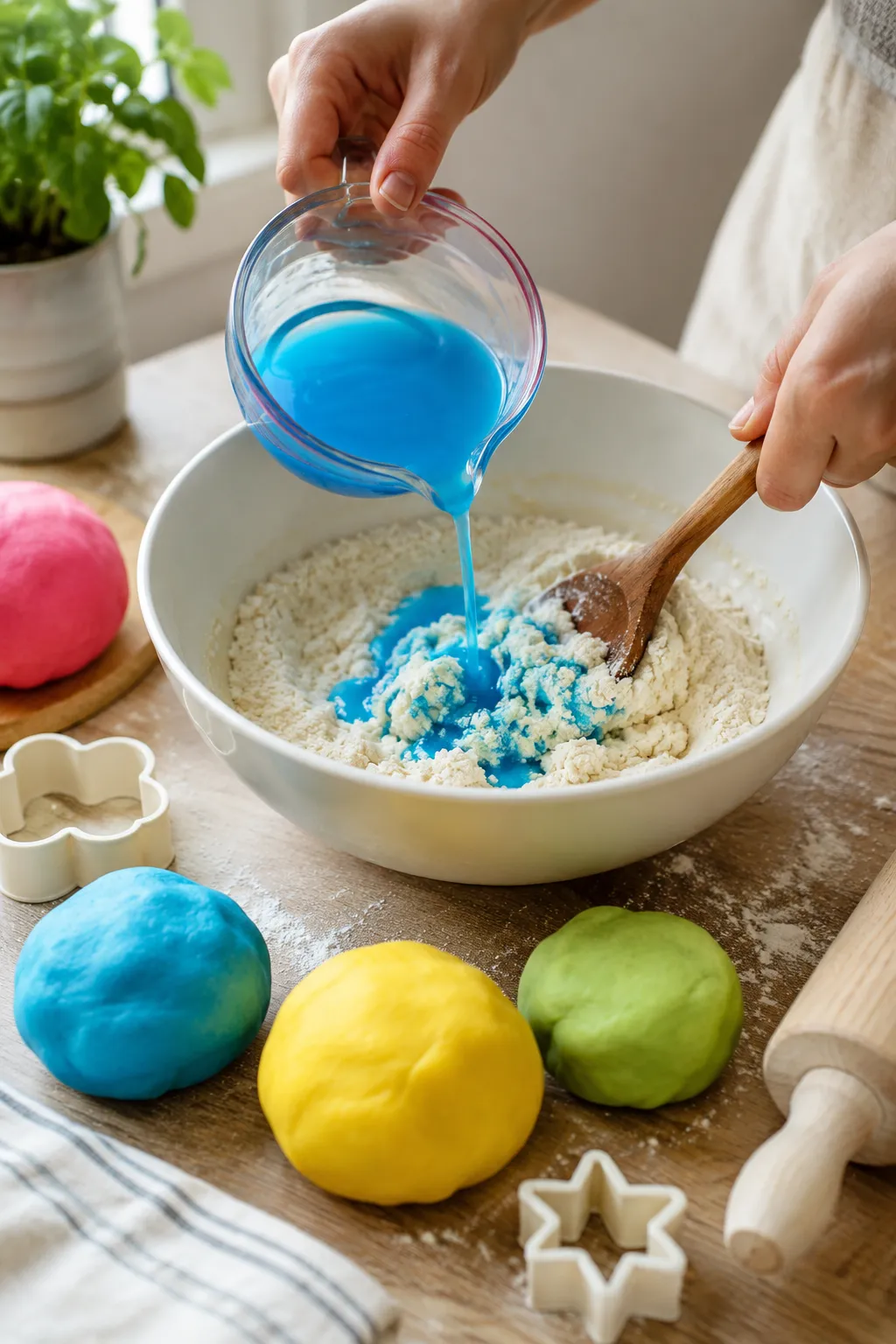
- Add your food coloring to the boiling water. Before pouring the water into the dough, stir your food coloring into it. This is the easiest way to get even, consistent color throughout the entire batch without having to knead color into already-formed dough. Add more drops for a deeper, more saturated color and fewer for a pastel shade.
- Pour the colored boiling water into the bowl gradually. Start with one cup and stir as you pour. The dough will come together quickly. Add more water a little at a time — a tablespoon or two — until the dough pulls away from the sides of the bowl and forms a single, cohesive ball. Be careful not to add too much water at once; a sticky dough is harder to fix than a dry one.
- Let it cool for one to two minutes before touching. The boiling water makes the dough hot immediately after mixing. Give it just a minute or two until it’s comfortable to handle — it doesn’t need to fully cool, just drop to a safe handling temperature.
Kneading the Dough
- Turn the dough out onto a clean surface and knead it. Use your hands to fold, press, and turn the dough for about one to two minutes. Kneading is what transforms it from a rough, slightly uneven ball into the smooth, soft playdough texture kids love. If the dough feels sticky, dust your hands and the surface with a small amount of flour and keep going. If it feels too dry or crumbly, wet your hands slightly and knead the moisture in.
- Add scent if desired. If you want scented playdough, now is the time to add a few drops of essential oil — lavender, peppermint, and lemon are all popular choices — or a half teaspoon of vanilla extract. Knead it in until fully incorporated.
- Divide and color if making multiple colors. If you want to make several colors from one batch, divide the plain dough before adding color, then knead food coloring into each portion separately. Wear gloves for this step if you don’t want colorful hands for the rest of the day.
The Finished Dough
- Test the texture. Good playdough should feel soft and smooth, hold its shape when pressed, and not stick to your hands or the table. It should roll into a ball easily and flatten without cracking at the edges. If the edges crack when you flatten it, knead in a tiny bit more water. If it sticks to everything, knead in a small dusting of flour.
- Hand it over and let the fun begin. The playdough is ready to use immediately. Set kids up with rolling pins, cookie cutters, plastic knives, or just their hands and imaginations.
How to Store Homemade Playdough
Storage is simple but important. Homemade playdough dries out if left exposed to air, so always store it in an airtight container or a tightly sealed zip-lock bag as soon as playtime is over. Press out as much air as possible before sealing.
Stored properly, no cook playdough will last anywhere from two to six weeks at room temperature. Some batches last even longer. If the dough starts to feel slightly dry after a few sessions, knead a few drops of water into it to restore the softness. If it develops an off smell or visible mold (usually from kids playing with wet hands or leaving food residue in it), it’s time to make a fresh batch.
Keep it at room temperature — refrigerating it can introduce condensation that makes it sticky and unpleasant.
Fun Variations to Try
Once you’ve nailed the basic recipe, there are so many directions you can take it.
Glitter playdough: Add a tablespoon of fine glitter to the dry ingredients before mixing. The glitter distributes evenly throughout the dough and catches the light beautifully. Kids find this completely irresistible.
Scented playdough: Match scents to colors for an extra sensory layer — lavender for purple, lemon extract for yellow, peppermint for green, strawberry extract for red or pink. This is particularly wonderful for sensory play with younger toddlers.
Glow-in-the-dark playdough: Add glow-in-the-dark powder (available at craft stores) to the dry ingredients. Charge it under a lamp and take it somewhere dim for an impressive effect.
Cloud dough texture: Replace half the flour with cornstarch for a softer, slightly more crumbly texture that many kids prefer. It’s less elastic but incredibly smooth.
Gluten-free playdough: Substitute the all-purpose flour with rice flour or a gluten-free flour blend at a 1:1 ratio. The texture is slightly different but still very playable — a great option for children with gluten sensitivities who tend to put things in their mouths.
Seasonal colors: Make themed batches for holidays — orange and black for Halloween, red and green for Christmas, pastels for spring. It makes the activity feel special and tied to what’s happening in the world around them.
Playdough Activities for Different Ages
The playdough itself is just the beginning. Here are some ways to extend the play depending on how old your kids are.
For toddlers (ages 1–3), the sensory experience is the whole point. Give them the dough and let them squish, poke, flatten, and tear it freely. Rolling it into snakes and balls is a fantastic fine motor activity at this age.
For preschoolers (ages 3–5), introduce simple tools — rolling pins, plastic cookie cutters, and blunt plastic knives. Making “food” for a pretend kitchen is a favorite theme, and pressing textured objects like forks, leaves, or coins into the dough to make prints is always a hit.
For school-age kids (ages 6–10), playdough becomes a sculpting medium. Challenge them to build animals, letters, miniature scenes, or replicas of things they’ve learned about in school. Mixing two colors together and predicting the result is also a satisfying mini science lesson.
Troubleshooting Common Problems
| Problem | Likely Cause | Fix |
|---|---|---|
| Dough is too sticky | Too much water added | Knead in flour a little at a time until it no longer sticks |
| Dough is dry and crumbly | Not enough water, or water cooled too much | Wet hands and knead slowly; add water a few drops at a time |
| Color is uneven or streaky | Color added to dough instead of water | Knead longer; next time, mix color into the water first |
| Dough feels grainy | Salt not fully dissolved | Use finer table salt; ensure water was hot enough |
| Dough dried out in storage | Stored in a loosely sealed container | Press out all air before sealing; switch to a zip-lock bag |
| Dough smells bad after a week | Moisture or food residue introduced during play | Discard and make a fresh batch; remind kids to wash hands first |
FAQ
Is no cook playdough safe for toddlers? The ingredients — flour, salt, oil, and water — are all non-toxic. However, with the high salt content, it’s not meant to be eaten in any quantity, so always supervise very young children who are still putting things in their mouths.
Why is cream of tartar in playdough? Cream of tartar is a mild acid that reacts with the other ingredients to create a smoother, more elastic dough and acts as a natural preservative to extend shelf life. You can make playdough without it, but the texture won’t be quite as good and it won’t keep as long.
Can I use whole wheat flour instead of white flour? Yes, but the texture will be slightly coarser and the color will be a warm tan regardless of what food coloring you add. For vibrant colors, white all-purpose flour is the better choice.
Why does my playdough dry out so fast? The most common reason is storage — any exposure to air will dry it out quickly. Make sure it’s in a properly sealed bag or airtight container every single time, even between short play sessions.
Can I make a big batch and divide it for a class? Absolutely. Simply multiply the recipe by however many batches you need. Mix large quantities in a stand mixer if available — the dough hook makes kneading large amounts much easier than doing it by hand.
Conclusion
No cook playdough is one of those rare things that’s genuinely as simple as it sounds. Five minutes, a handful of pantry ingredients, and you have something kids can play with for weeks. It’s soft, customizable, endlessly versatile, and far more satisfying to make and use than anything from a plastic tub at the store.
Get the basic recipe right first — pay attention to the water amount and don’t skip the cream of tartar — and then let the variations take you wherever your kids’ interests lead. Glitter, scents, seasonal colors, special tools — there are so many ways to make it feel new every time.
And when a batch finally runs its course? You’re ten minutes and a few cups of flour away from a brand new one.
Enjoyed this project? Get even more DIY ideas that save (and make) you money.
Join our free newsletter for profitable DIY projects, clever cleaning hacks, home ideas, and creative crafts delivered straight to your inbox.
✓ Free forever • No spam • Unsubscribe anytime