There it is. Maybe it was a doorknob that swung too hard, a shelf bracket that pulled free, or a moving day accident you’ve been ignoring for six months. Whatever caused it, a hole in the wall has a way of drawing every eye in the room straight to it.
The good news is that fixing a wall hole is one of the most approachable home repair jobs there is. You don’t need professional experience, an expensive toolkit, or a full weekend blocked out. What you do need is the right method for the right size hole — because a nail pop and a fist-sized gap require completely different approaches, and using the wrong technique on either one wastes time and produces poor results.
This guide walks you through every scenario, from the tiniest pin hole to large structural damage, across drywall, plaster, and even shower walls.
Why the Size and Wall Type Matter Before You Start
The single biggest mistake people make when fixing wall holes is reaching for the first filler they find without considering what they’re actually working with. Using a heavy patching compound on a tiny nail hole leaves a bumpy mess. Trying to fill a large hole with lightweight spackling causes it to crack and sink as it dries.
Hole size determines your method: Small holes (under ¼ inch) from nails or screws need nothing more than a dab of lightweight spackling compound. Medium holes (¼ inch to about 4 inches) need a backing support and a patching compound. Large holes (over 4 inches) require a proper drywall patch cut and installed before any finishing work begins.
Wall material determines your products: Drywall is the standard in most modern homes — it’s a gypsum core sandwiched between paper facing, and it responds well to most patching compounds. Plaster walls, common in homes built before the 1950s, are denser and require a different filler and technique. Shower walls introduce moisture and require waterproof materials throughout.
Getting these two factors right before you buy a single product saves you money, time, and the frustration of a repair that fails within weeks.
What You’ll Need
Gathering supplies before you start means the repair goes smoothly rather than stalling every five minutes.
- Lightweight spackling compound: For small holes and nail pops
- All-purpose joint compound (mud): For medium holes and skim coating
- Setting-type joint compound: For large holes — hardens chemically rather than by drying, so it won’t shrink or crack
- Drywall patch kit or mesh patch: For medium holes; provides backing support
- Drywall panel and drywall screws: For large hole repairs
- Drywall tape (paper or fiberglass mesh): For taping seams on larger patches
- Putty knife (3-inch and 6-inch): For applying and smoothing compound
- Drywall saw or utility knife: For cutting clean edges around large holes
- Sanding sponge or sandpaper (120 and 220 grit): For smoothing between coats
- Primer: Essential before painting — skipping this causes uneven sheen
- Paint and brush or roller: For the final finish
- Safety glasses and dust mask: Sanding joint compound produces very fine dust
Step-by-Step: How to Fix a Hole in the Wall
Step 1 — Clean up the damaged area
- Before applying any filler or patch, prepare the surface properly. Use a utility knife to trim away any loose paper facing, crumbling gypsum, or jagged edges around the hole. Loose material under a patch will cause it to fail — the filler needs a clean, solid surface to bond to.
- Wipe the area with a dry cloth to remove dust and debris. If there is any grease or residue near the hole (common in kitchens), wipe it with a damp cloth and allow it to dry completely before proceeding.
- Check inside the hole for any electrical wiring or plumbing before cutting or probing. If you see wires, stop and consult a licensed electrician before continuing.
Step 2 — Choose the right repair method for your hole size
- Take a moment to measure or estimate the hole size, as this determines every product and technique choice that follows. A hole under a quarter inch is a small fill job. Anything from a quarter inch to roughly four inches needs a backing patch. Anything larger needs a proper drywall replacement section.
- If the wall has been damaged repeatedly in the same area — such as a doorknob impact zone — consider installing a door stop after the repair to prevent the same damage from recurring.
Step 3 — Apply filler, patch, or replacement panel
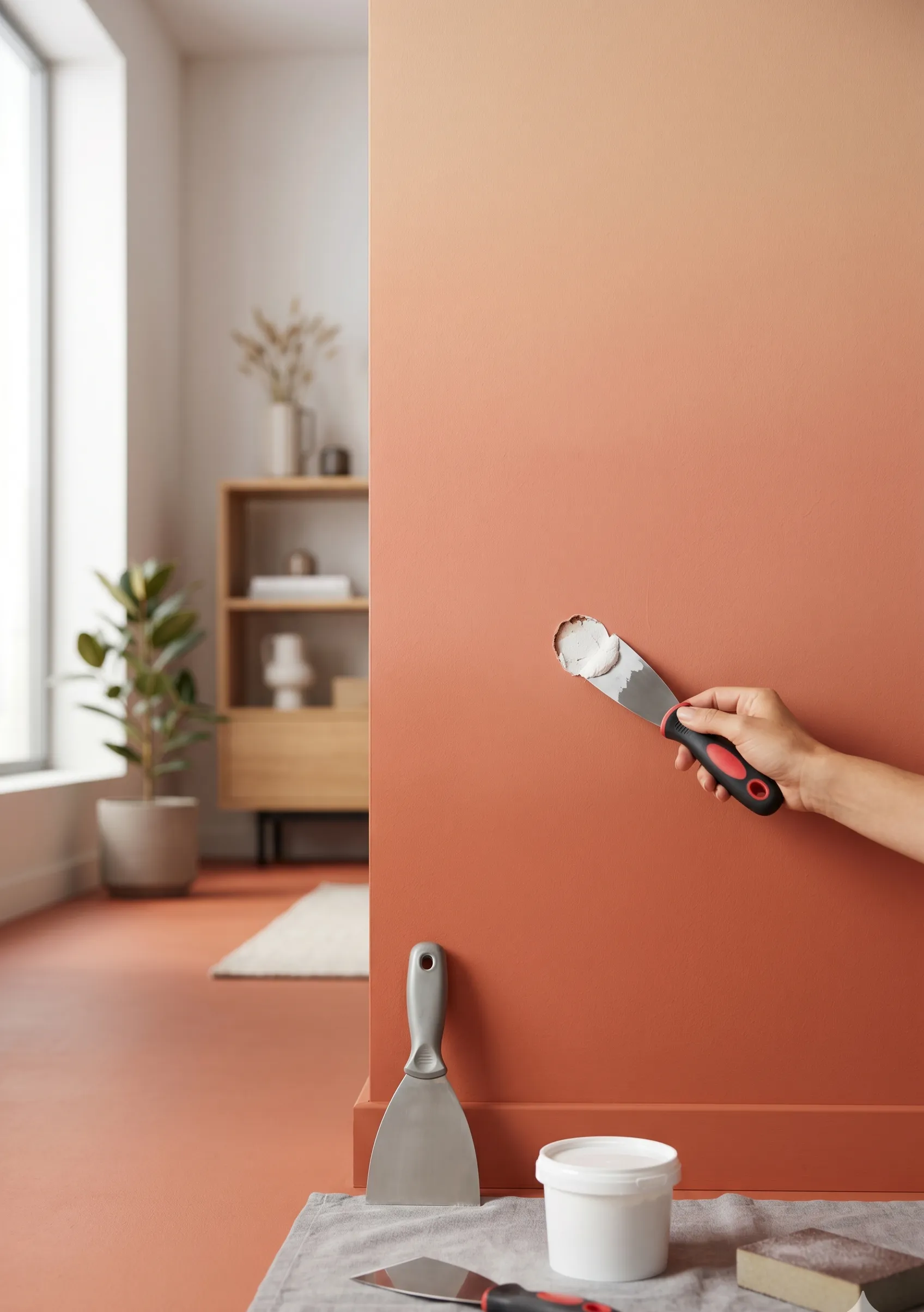
- For small holes, load a small amount of lightweight spackling compound onto a putty knife and press it firmly into the hole, drawing the knife across the surface at a slight angle to leave the filler flush with the wall. Allow it to dry fully — it will turn from pink or gray to bright white when ready — then sand lightly and repeat with a second thin coat if needed.
- For medium holes, press a self-adhesive mesh patch over the hole, ensuring it overlaps the edges by at least an inch on all sides. Apply joint compound over the mesh with a 6-inch putty knife, feathering the edges outward well beyond the patch boundary so the repair blends smoothly into the surrounding wall. Allow to dry, sand lightly, and apply a second coat.
- For large holes, cut the damaged area into a clean rectangle using a drywall saw, install horizontal wooden backing boards inside the wall cavity to support the new piece, cut a matching piece of drywall to fill the opening, screw it into the backing boards, tape all seams with drywall tape, and apply two to three coats of joint compound — sanding between each coat.
Step 4 — Sand smooth between coats
- Allow each coat of compound to dry completely before sanding. Sanding wet or damp compound tears the surface and creates more work. Drying time varies by product and humidity but is typically 4–8 hours per coat for standard joint compound.
- Use 120-grit sandpaper for the first pass to knock down ridges and high spots, then finish with 220-grit for a smooth, paint-ready surface. Always sand in circular motions and work gradually — removing too much compound means applying another coat.
- Wipe the sanded area with a dry or barely damp cloth to remove all dust before applying the next coat or primer. Dust left on the surface prevents proper adhesion.
Step 5 — Prime before painting
- This step is skipped more often than any other, and it is the most common reason a wall repair remains visible after painting. Joint compound and spackling are highly porous and absorb paint differently than the surrounding wall surface, causing a dull, flat patch to show through even after multiple paint coats.
- Apply a coat of drywall primer or a PVA-based primer to the repaired area and allow it to dry fully. On larger repairs, priming the entire wall rather than just the patch area produces a more even finish.
- Once primed, apply your topcoat paint, blending it outward from the repair into the surrounding wall. In most cases, painting the entire wall rather than spot-painting gives the most seamless result, especially if the existing paint has faded or aged.
How to Fix a Hole in the Wall Drywall
Drywall is the most common wall material in modern homes and the most frequently patched. The process described above applies directly to drywall, but there are a few drywall-specific details worth noting.
Always use setting-type compound (also called “hot mud”) rather than standard all-purpose compound for filling the first layer of large repairs. Setting compound hardens chemically and doesn’t shrink as it cures, which prevents cracking and sinking. Follow up with all-purpose compound for the finish coats, which sands more easily.
When cutting drywall for a large repair, cut back to the nearest stud if possible — this gives you a solid anchor point without needing to install backing boards. Use a stud finder to locate studs before cutting, and make your patch cuts along the center of a stud so both the existing drywall and the new patch piece can be screwed into it.
How to Fix a Big Hole in the Wall
Large holes — typically anything over four to six inches — require the most work but follow a logical process that produces genuinely invisible results when done carefully.
The “California patch” method is popular for medium-to-large holes because it uses the paper backing of a drywall offcut as a built-in tape layer, eliminating the need for separate backing boards in some situations. Cut a drywall piece larger than the hole, score the back to expose a border of paper facing, snap the gypsum away from the paper border, insert the gypsum core into the hole, and use the paper border as a built-in tape flange to feather compound over.
For very large holes or extensive wall damage, cutting back to studs and installing a proper replacement section is the most durable repair. Take your time with the taping and mudding process — apply thin coats, sand thoroughly between each one, and don’t rush to paint. The quality of the finish depends almost entirely on the patience applied in these final steps.
How to Fix a Hole in Plaster Wall
Plaster walls behave differently from drywall and require a slightly different approach. Plaster is applied in layers — a scratch coat, a brown coat, and a finish coat — over a lath backing, and repairs need to respect that layered structure to hold properly.
For small holes in plaster, use a pre-mixed plaster patching compound rather than standard drywall joint compound. Joint compound can be used for finish coats but shrinks too much to reliably fill deep plaster voids in a single application.
For larger holes, remove any crumbling plaster back to a solid edge and check that the lath behind it is intact. If the lath is broken or missing, it needs to be repaired or replaced before filling. Apply plaster bonding agent to the exposed lath and the edges of the existing plaster — this dramatically improves adhesion and prevents the repair from popping out later. Fill in layers, allowing each to partially set before applying the next, and finish with a skim coat of finish plaster or joint compound.
Never use expanding foam to fill plaster holes. It doesn’t bond properly, doesn’t accept paint evenly, and can put pressure on surrounding plaster, causing further cracking.
How to Fix a Nail Hole in the Wall
Nail holes are the simplest repair in home maintenance, but doing them properly — rather than just dabbing on filler and walking away — makes a real difference in the final appearance.
Use a lightweight spackling compound rather than all-purpose joint compound for nail holes. It dries faster, shrinks less, and sands more easily. Load a tiny amount onto your fingertip or a small putty knife, press it firmly into the hole, and draw it flat across the surface. The key is to slightly overfill rather than underfill — spackling shrinks slightly as it dries, and a depression is more visible than a slight bump that you can sand flat.
Once dry, sand with fine-grit sandpaper using a small circular motion, prime the spot, and paint. For walls with a textured surface, apply a light texture spray or stipple the wet compound with a sponge before it dries to match the surrounding texture.
How to Fix a Small Hole in the Wall
Small holes — up to roughly an inch in diameter — don’t need a patch kit or backing material. Spackling compound alone handles them easily, but the technique matters.
If the hole has ragged or torn edges, trim them neatly with a utility knife first. Torn paper facing around a hole creates ridges under the filler that show through paint. A clean edge gives the compound a smooth surface to bond to.
Apply compound in two thin coats rather than one thick one. A thick single application shrinks and cracks as it dries, while two thin coats dry flat and solid. Sand lightly between coats and prime before painting — even on small repairs, skipping primer will leave a visible dull spot on the finished wall.
How to Fix a Hole in Shower Wall
Shower wall repairs are in a category of their own because of the constant moisture exposure. Any repair that isn’t fully waterproofed will fail quickly — water will work its way behind the patch, cause mold growth, and eventually damage the surrounding wall structure.
Identify the wall material first. Shower walls are typically ceramic or porcelain tile over cement board, fiberglass or acrylic shower panels, or solid surface materials. Each requires a different repair product.
For tile over cement board, chip away any cracked tiles and damaged cement board, cut a replacement cement board patch, secure it with cement board screws, apply waterproof tile membrane over the seams, set replacement tiles using tile adhesive appropriate for wet areas, and grout with a mold-resistant, sanded grout. Seal all grout lines once fully cured.
For fiberglass or acrylic shower panels, use a fiberglass repair kit specifically designed for wet areas. These kits include a resin filler and hardener that cure into a waterproof, solid surface. Sand smooth, apply gelcoat to match the panel color if possible, and buff to blend with the surrounding surface.
Under no circumstances should standard joint compound, spackling, or drywall materials be used in a shower — they will absorb moisture, crumble, and create a mold problem far worse than the original hole.
Common Mistakes to Avoid
| Mistake | Why It’s a Problem | What to Do Instead |
|---|---|---|
| Skipping primer before paint | Patch absorbs paint unevenly, stays visible | Always prime repaired areas before painting |
| Applying compound too thick | Shrinks, cracks, and sinks as it dries | Apply multiple thin coats instead |
| Not letting coats dry fully | Sanding wet compound tears the surface | Wait until fully dry — white throughout, not just on surface |
| Using the wrong filler for the hole size | Small fillers crack in large holes; overkill for nail holes | Match product to hole size |
| Skipping surface prep | Loose edges and debris cause patch failure | Clean and trim the hole before any filling |
| Painting over unfixed texture | Smooth patch looks different from textured surroundings | Match texture before painting |
FAQ
How many coats of joint compound do I need? For most medium to large repairs, three coats is the standard: a fill coat, a tape coat, and a finish coat. Each coat should be thinner and wider than the last, feathering outward to blend the repair invisibly into the surrounding wall.
Can I use spackle instead of joint compound? Spackling is ideal for small holes and nail pops. For anything larger, all-purpose joint compound gives better results — it feathers more easily, covers larger areas smoothly, and produces a more professional finish.
How long does joint compound take to dry? Standard all-purpose joint compound typically takes 24 hours per coat in normal conditions. Humidity slows drying significantly. Setting-type compounds harden in 20–90 minutes depending on the product, which is useful for the base coat on large repairs.
Will the repair be visible after painting? If primed and painted correctly, a well-executed repair should be completely invisible. The most common cause of visible repairs is skipping primer, rushing between coats, or failing to feather the compound edges far enough beyond the repair area.
Do I need to match the wall texture? Yes, if your walls have any texture at all. A smooth patch on a textured wall will catch light differently and remain obvious no matter how many paint coats you apply. Texture spray cans, stippling with a sponge, or a slap brush technique can replicate most common wall textures convincingly.
Conclusion
Fixing a hole in the wall is one of those repairs that feels intimidating until you’ve done it once — and then it feels almost satisfying. The key is matching your method to the hole: a dab of spackling for a nail pop, a mesh patch for a medium hole, a proper drywall section for a large one. Take your time between coats, don’t skip the primer, and blend the paint into the surrounding wall rather than spot-painting the patch alone. Do those things carefully, and the finished result will be genuinely invisible — even to you.
Enjoyed this project? Get even more DIY ideas that save (and make) you money.
Join our free newsletter for profitable DIY projects, clever cleaning hacks, home ideas, and creative crafts delivered straight to your inbox.
✓ Free forever • No spam • Unsubscribe anytime