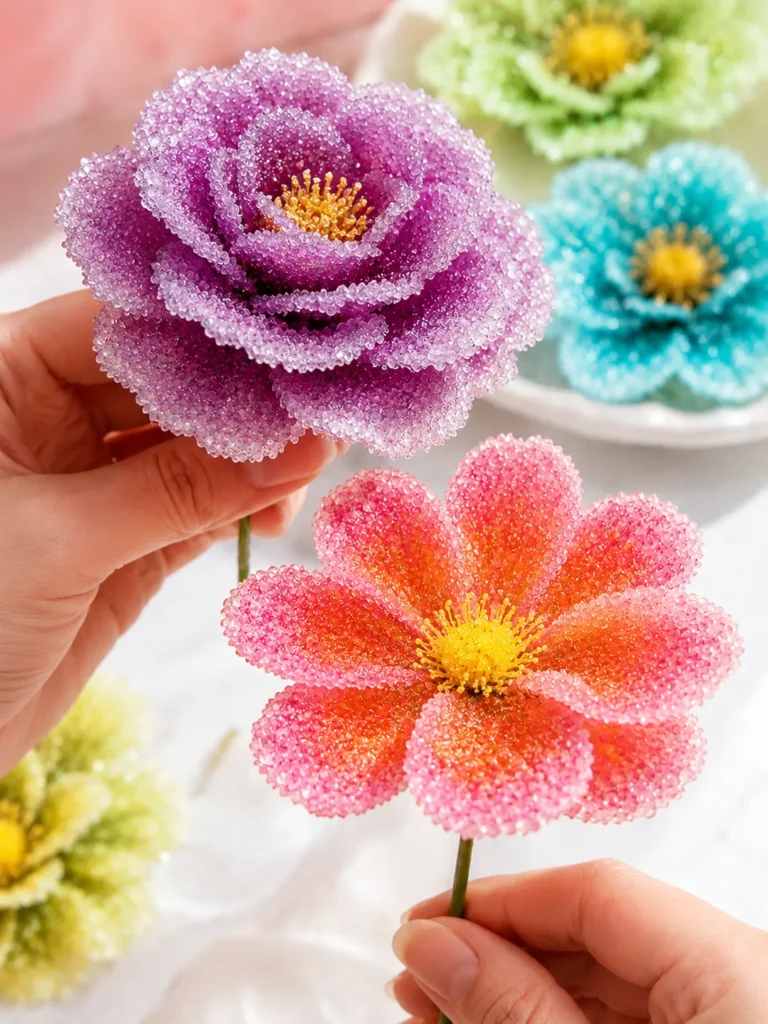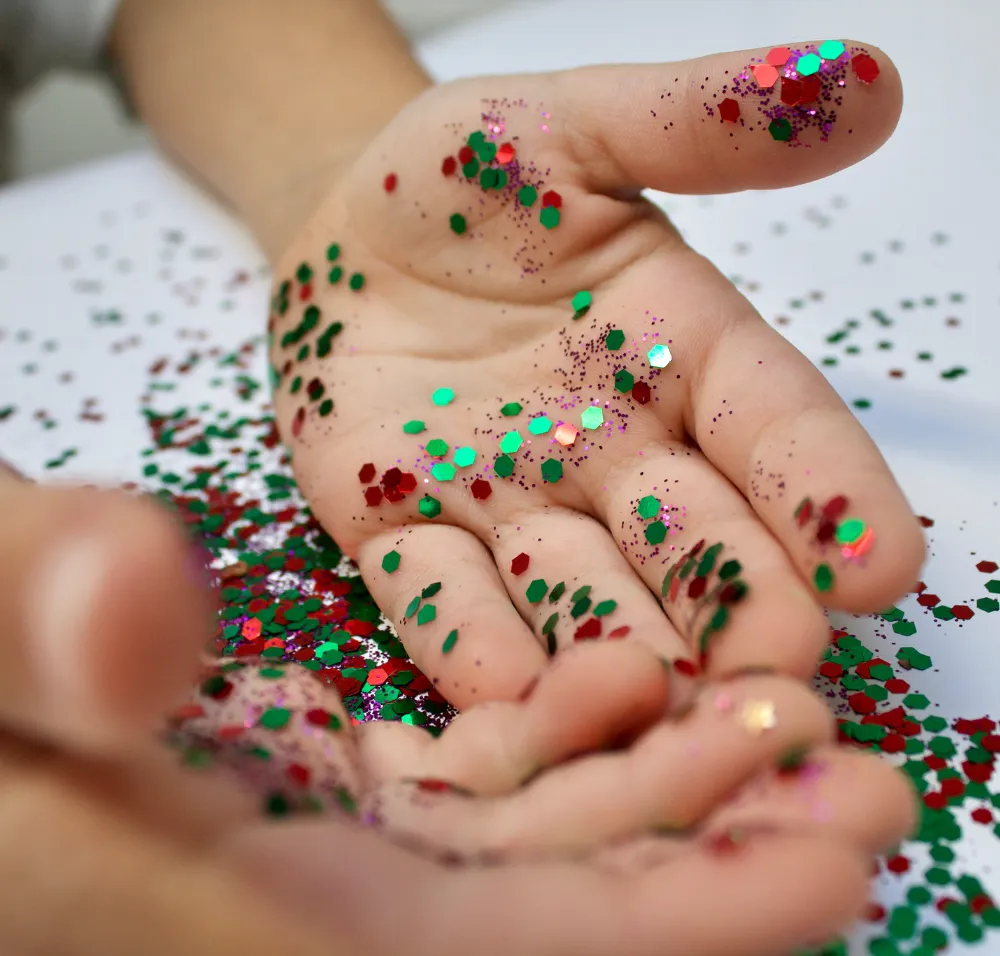
Edible glitter is one of those finishing touches that transforms a decent-looking cake or dessert into something genuinely impressive. The problem is that most store-bought edible glitter is expensive for what it is, comes in limited colors, and—if you read the label carefully—is often made from mica or other non-digestible materials that are technically “non-toxic” but not actually meant to be eaten in large quantities.
Making edible glitter at home solves both problems. It costs almost nothing, you can make any color you want, and depending on the method you use, it can be made from ingredients that are genuinely edible rather than just technically food-safe. Some of these recipes produce a fine, dust-like glitter. Others produce larger, more dramatic flakes. A few methods produce the specific pearlescent or metallic shimmer that makes edible glitter look different from just colored sugar.
This guide covers six different methods using different base ingredients—from simple colored sugar to gelatin sheets and isomalt—each producing a different type of glitter effect so you can match the recipe to the result you want.
What “Edible Glitter” Actually Means
The term “edible glitter” covers several different products that look similar but behave differently:
- Edible glitter: Made from food-grade ingredients that are fully digestible—sugar, starch, gelatin. Genuinely edible.
- Non-toxic glitter: Made from materials that won’t harm you in small quantities but aren’t designed to be eaten—mica, cellulose. Most commercial “edible glitter” falls into this category.
- Luster dust: A fine powder with a metallic or pearlescent sheen, often mica-based. Decorative rather than truly edible in most formulations.
The recipes in this guide produce genuinely edible glitter—made from food ingredients that are safe to eat in normal dessert quantities.
General Tips Before You Start
- Gel food coloring produces more vibrant results than liquid food coloring in every recipe. The concentrated pigment in gel gives deeper, more saturated colors without adding excess liquid that affects the texture of the finished glitter.
- Metallic and pearlescent effects come from light reflection off flat surfaces—flatter, more uniform particles catch and reflect light better than irregular ones. Methods that produce thinner, more even pieces produce more shimmer.
- Humidity is the enemy of most homemade edible glitter. Store in airtight containers and make in a dry environment. High humidity causes sugar-based glitters to clump and gelatin-based glitters to soften.
- Use immediately or store properly. Most homemade edible glitter lasts one to four weeks in an airtight container at room temperature, away from heat and humidity.
What You’ll Need (Depending on the Method)
- Granulated white sugar or superfine/caster sugar
- Gel food coloring
- Edible luster dust or pearl dust (optional—for shimmer effect)
- Unflavored gelatin powder
- Isomalt
- Cornstarch
- Meringue powder
- Parchment paper
- Baking sheets
- An oven
- A food processor or spice grinder (for some methods)
- Airtight storage containers
Method 1: Colored Sugar Glitter (Easiest Starting Point)
Colored sugar is the simplest form of edible glitter—it doesn’t have the metallic shimmer of more complex methods but it sparkles from light refracting through the sugar crystals and works beautifully on cupcakes, cookies, and the rim of cocktail glasses. It’s the right starting point for anyone making edible glitter for the first time.
What you’ll need:
- ½ cup granulated white sugar (superfine/caster sugar produces finer glitter; standard granulated produces a coarser sparkle)
- Gel food coloring
- A zip-lock bag or small bowl
- A baking sheet lined with parchment paper
Instructions:
- Pour the sugar into a zip-lock bag and add a tiny amount of gel food coloring—start with less than you think you need, approximately the size of a match head for half a cup of sugar. Too much colorant makes the sugar wet and clumpy rather than dry and sparkly.
- Seal the bag and work the color through the sugar by squeezing and massaging the bag until every crystal is evenly coated. Open and check—if there are uncolored crystals, add a tiny amount more color and continue working.
- Spread the colored sugar in a thin, even layer on a parchment-lined baking sheet.
- Allow to dry at room temperature for one to two hours, or dry in the oven at the lowest possible temperature (around 170°F/75°C) for 10–15 minutes. The goal is to evaporate any moisture from the food coloring without melting the sugar crystals.
- Once completely dry, break up any clumps with a fork and transfer to an airtight container.
- For added shimmer, add a small amount of edible pearl luster dust to the dried colored sugar and toss to coat. The luster dust catches light differently from the sugar crystals and adds a metallic dimension to the sparkle.
Best for: Cupcake and cookie decoration, cocktail glass rims, cake pops, anywhere a colorful sparkle is the goal rather than a metallic shimmer.
Method 2: Gelatin Glitter (Best Shimmer and Most Versatile)
Gelatin-based edible glitter produces a more impressive result than colored sugar—the thin, flat gelatin flakes catch and reflect light the way commercial edible glitter does, producing genuine shimmer rather than just colored sparkle. It’s the most versatile homemade glitter method and produces results that genuinely rival store-bought edible glitter.
What you’ll need:
- 2 tablespoons unflavored gelatin powder
- 3 tablespoons cold water
- Gel food coloring
- Edible luster dust (optional—significantly enhances the shimmer)
- A small saucepan
- Parchment paper or a silicone mat
- A baking sheet
Instructions:
- Bloom the gelatin by sprinkling it over the cold water in a small bowl and allowing it to absorb the water for five minutes. The gelatin will swell and become opaque—this is correct.
- Gently heat the bloomed gelatin in a small saucepan over the lowest possible heat, stirring constantly, until it becomes completely liquid and clear. Don’t allow it to boil—boiling degrades the gelatin’s setting ability and produces a weaker finished product.
- Add gel food coloring to the liquid gelatin and stir thoroughly until the color is completely uniform. Add luster dust at this stage if using—approximately a quarter teaspoon per batch produces a significant shimmer effect.
- Pour the liquid gelatin mixture in a very thin, even layer onto a parchment-lined baking sheet or silicone mat. Tilt the sheet to spread the gelatin as thin as possible—the thinner the layer, the more light-catching the finished flakes.
- Allow to set completely at room temperature for two to four hours, or refrigerate for one hour for faster setting.
- Once fully set and dry, peel the gelatin sheet from the parchment. It will be thin, flexible, and translucent.
- Break or cut the gelatin sheet into small pieces. For fine glitter, crumble between fingers or pulse briefly in a food processor. For larger flakes, break into irregular pieces by hand. For uniform shapes, cut with scissors or a pizza cutter into tiny squares or strips.
- Allow the pieces to dry completely at room temperature for another hour before storing—gelatin pieces that aren’t fully dry will stick together in storage.
- Store in an airtight container at room temperature for up to two weeks.
Best for: Cake decoration, cupcake toppers, anything where genuine shimmer and light reflection is the goal. This method produces the most impressive results of any recipe in this guide.
Method 3: Isomalt Glitter (Best for Dramatic Sparkle on Cakes)
Isomalt is a sugar substitute used extensively in professional sugar work—it produces harder, more brittle pieces than regular sugar and creates an almost glass-like clarity that gives exceptional light reflection. Isomalt glitter has a more dramatic, jewel-like sparkle than any other method and is the choice for statement cake decorations and high-end dessert finishing.
What you’ll need:
- ½ cup isomalt nibs or crystals (available from cake decorating suppliers and online)
- Gel food coloring
- Edible luster dust (optional)
- A silicone mat
- A small saucepan or microwave-safe bowl
- A candy thermometer
Instructions:
- Melt the isomalt in a small saucepan over medium heat, stirring occasionally, until fully liquid and clear. Isomalt melts at around 329°F/165°C—use a candy thermometer to monitor. Alternatively, melt in a microwave-safe bowl in 30-second intervals, stirring between each, until fully liquid.
- Add gel food coloring to the melted isomalt and stir quickly—work fast as isomalt begins to set quickly once removed from heat.
- Add luster dust if using and stir to distribute evenly.
- Pour the colored isomalt in a very thin layer onto a silicone mat. Tilt the mat to spread as thin as possible—thin isomalt produces more dramatic light reflection than thick pieces.
- Allow to cool and harden completely—usually 10–15 minutes at room temperature. Do not refrigerate—moisture causes isomalt to become sticky and cloudy.
- Break the hardened isomalt sheet into small pieces. Isomalt is brittle and shatters easily into irregular shards that have sharp edges—handle carefully and keep away from young children.
- For finer glitter, pulse the broken pieces briefly in a food processor until the desired size is reached.
- Store in an airtight container with a silica gel packet to absorb moisture—isomalt absorbs humidity from the air and becomes sticky quickly without desiccant.
Safety note: Melted isomalt is extremely hot and causes serious burns on contact with skin. Use silicone gloves and keep children away from the kitchen during preparation.
Best for: Wedding cakes and celebration cakes, high-end dessert decoration, situations where the most dramatic sparkle effect is the goal.
Method 4: Corn Syrup and Sugar Glitter (Best for Wet Applications)
This method produces edible glitter specifically designed to adhere to wet surfaces—frosting, ganache, fondant, and the surface of drinks. Standard dry glitter slides off wet surfaces; this formulation uses corn syrup as a binding agent that allows the glitter to stick to moist cake surfaces and dissolve slowly into drinks rather than floating on top.
What you’ll need:
- ¼ cup granulated sugar
- 1 teaspoon light corn syrup
- Gel food coloring
- Edible luster dust (optional)
- Parchment paper
- A baking sheet
Instructions:
- Mix the corn syrup and gel food coloring in a small bowl until the color is fully uniform.
- Add the sugar to the corn syrup mixture and stir until every crystal is coated. The mixture will look wet and clumped at this stage—this is correct.
- Add luster dust if using and stir to incorporate.
- Spread the mixture in a thin layer on a parchment-lined baking sheet, breaking up any large clumps with a fork.
- Bake at 200°F/95°C for 20–25 minutes until completely dry. The low temperature dries the glitter without melting the sugar crystals or burning the color.
- Allow to cool completely, then break up any remaining clumps with a fork.
- Test the texture. The finished glitter should be slightly tacky rather than completely dry—this slight tackiness is what allows it to adhere to moist surfaces. If it’s not adhering to a damp surface, the drying time was too long and the corn syrup has completely dried out.
- Store in an airtight container for up to two weeks. The slight tackiness means this glitter clumps more readily in storage than dry glitter—a brief stir before use breaks up any clumps.
Best for: Decorating freshly frosted cakes and cupcakes where adhesion is the priority, cocktail and drink decoration, fondant-covered cakes.
Method 5: Meringue Powder Glitter (Best for Fine Dust Effect)
Meringue powder produces a very fine, lightweight glitter that behaves more like a dusting powder than a sparkle—it creates a subtle, diffuse shimmer rather than the dramatic flash of gelatin or isomalt glitter. This is the right method when you want a delicate, ethereal shimmer on a cake rather than obvious decorative glitter.
What you’ll need:
- 2 tablespoons meringue powder
- 1 tablespoon water
- Gel food coloring
- Edible luster dust
- Parchment paper
- A baking sheet
- A fine mesh sieve or sifter
Instructions:
- Mix meringue powder and water in a small bowl until smooth. The mixture should be thick but pourable—add water a few drops at a time if needed to reach the right consistency.
- Add gel food coloring and stir until uniform.
- Add edible luster dust—meringue powder glitter relies more heavily on luster dust for its shimmer than other methods, since the meringue base itself is matte. Use a generous amount—half a teaspoon per batch—for the best effect.
- Spread the mixture as thinly as possible on a parchment-lined baking sheet using an offset spatula or the back of a spoon. The thinner the layer, the finer the finished glitter.
- Bake at 200°F/95°C for 30–40 minutes until completely dry and brittle.
- Allow to cool fully, then break into pieces and pulse in a food processor or spice grinder until a fine powder is achieved.
- Sift through a fine mesh sieve to remove any larger particles and achieve a uniform fine dust.
- Store in an airtight container for up to four weeks—meringue powder glitter has a longer shelf life than gelatin-based methods.
Application: Apply to cake surfaces by dipping a dry brush into the powder and dusting lightly over the surface. The fine powder distributes evenly with a brush in a way that larger glitter particles can’t.
Best for: Delicate cakes where subtle shimmer is preferred over obvious sparkle, dusting over chocolate truffles, applying to the surface of macarons.
Method 6: Cornstarch Glitter (Most Natural, Dye-Free Option)
Cornstarch-based glitter produces a soft, white shimmer without any added color—it’s the most natural option and produces a snow-like or frost-like effect that works beautifully on winter-themed cakes, wedding cakes, and any design where pure white shimmer is the goal. It can be colored with natural colorants for a softer, more muted palette than synthetic food coloring produces.
What you’ll need:
- 3 tablespoons cornstarch
- 1 tablespoon water
- 1 teaspoon edible pearl luster dust (white or silver)
- Natural colorants (optional—turmeric for gold, beet powder for rose, matcha for green)
- Parchment paper
- A baking sheet
Instructions:
- Mix cornstarch and water to form a smooth, thick paste. The paste should be stiff enough to spread thinly without running.
- Add pearl luster dust and stir thoroughly to distribute evenly throughout the paste.
- Add natural colorants if using—start with a small amount and add more to reach the desired depth of color. Natural colorants produce softer, more muted tones than synthetic food coloring, which suits the delicate nature of this glitter type.
- Spread as thinly as possible on a parchment-lined baking sheet using an offset spatula.
- Bake at 200°F/95°C for 25–30 minutes until completely dry and starting to crack slightly at the edges.
- Allow to cool completely, then break into pieces and grind in a food processor until the desired particle size is reached—fine for dust, coarser for visible flakes.
- Sift if a very fine texture is needed to remove larger particles.
- Store in an airtight container for up to three weeks.
Best for: White or silver shimmer effects, winter and snow-themed cakes, wedding cakes where natural ingredients are preferred, gold shimmer effect using turmeric-tinted version.
Method Comparison at a Glance
| Method | Shimmer Level | Difficulty | Shelf Life | Best Application |
|---|---|---|---|---|
| Colored sugar | Low | Very easy | 1 month | Cupcakes, cookies, drinks |
| Gelatin glitter | High | Moderate | 2 weeks | Cakes, cupcakes |
| Isomalt glitter | Very high | Advanced | 1–2 weeks | Statement cakes |
| Corn syrup sugar | Moderate | Easy | 2 weeks | Wet surfaces, drinks |
| Meringue powder | Moderate (fine dust) | Moderate | 4 weeks | Delicate cakes, truffles |
| Cornstarch | Soft shimmer | Easy | 3 weeks | White/natural effects |
How to Apply Edible Glitter
Getting the glitter onto the food is as important as making it correctly:
On buttercream and fresh frosting: Sprinkle directly from the container and tap the side to distribute evenly. Fresh frosting is slightly tacky and holds glitter without any adhesive.
On fondant: Fondant dries to a matte surface that doesn’t hold glitter as well as frosting. Brush the surface lightly with a tiny amount of clear alcohol (vodka evaporates without affecting flavor) or piping gel before applying glitter to create adhesion.
On chocolate: Sprinkle glitter onto chocolate immediately after pouring while the surface is still liquid—the glitter sinks slightly into the surface and holds permanently once the chocolate sets.
On drinks and cocktails: Stir glitter into drinks rather than floating it on top—gelatin-based and sugar-based glitters dissolve and disperse through the drink when stirred. Add immediately before serving for maximum visual effect.
Brush application: For luster dust and meringue powder glitter, apply with a dry food-safe brush using gentle sweeping motions across the surface. A soft, wide brush distributes the powder evenly without disturbing the surface beneath.
FAQ
What’s the difference between edible glitter and luster dust? Luster dust is a fine powder applied dry or mixed with alcohol for painting—it creates a metallic or pearlescent sheen but doesn’t have the sparkle of glitter particles. Edible glitter has visible particle structure that reflects light more dramatically. Many of the recipes above use luster dust as an ingredient within a glitter recipe to add shimmer to the glitter particles themselves.
Can I make gold or silver edible glitter at home? Gold and silver effects require edible metallic luster dust as an ingredient—you can’t achieve genuine metallic effects from food coloring alone. Gold luster dust added to the gelatin or sugar method produces convincing gold glitter. Silver luster dust similarly produces silver effects. Both are available from cake decorating suppliers.
Will homemade edible glitter dissolve on a cake overnight? Sugar-based glitters absorb moisture from frosting over time and can dissolve or lose their sparkle if applied too far in advance. Apply within a few hours of serving for best results. Gelatin and isomalt glitters hold their shape and sparkle much better overnight—apply the evening before serving without issue.
Is homemade edible glitter safe for children? All six recipes in this guide use food-grade ingredients in quantities appropriate for normal dessert consumption. Isomalt is the one exception to note for preparation safety—melted isomalt causes serious burns. The finished isomalt glitter is safe to eat; the preparation process requires adult supervision only.
The Bottom Line
The gelatin method produces the best homemade edible glitter for most purposes—it’s versatile, genuinely shimmery, and works on a wide range of applications. Use colored sugar for quick, simple color sparkle on everyday bakes. Use isomalt for the most dramatic effect on statement cakes. Use meringue powder when you want a fine dust rather than visible particles. And use luster dust in every recipe where shimmer rather than just color is the goal—it’s the ingredient that makes the difference between colored glitter and actually shimmery glitter.
Enjoyed this project? Get even more DIY ideas that save (and make) you money.
Join our free newsletter for profitable DIY projects, clever cleaning hacks, home ideas, and creative crafts delivered straight to your inbox.
✓ Free forever • No spam • Unsubscribe anytime